Li Zhenhua, Yan Yifan, Xu Si-Min, Zhou Hua, Xu Ming, Ma Lina, Shao Mingfei, Kong Xianggui, Wang Bin, Zheng Lirong, Duan Haohong
State Key Laboratory of Chemical Resource Engineering, College of Chemistry, Beijing University of Chemical Technology, Beijing, 100029, China.
Department of Chemistry, Tsinghua University, Beijing, 100084, China.
Nat Commun. 2022 Jan 10;13(1):147. doi: 10.1038/s41467-021-27806-3.
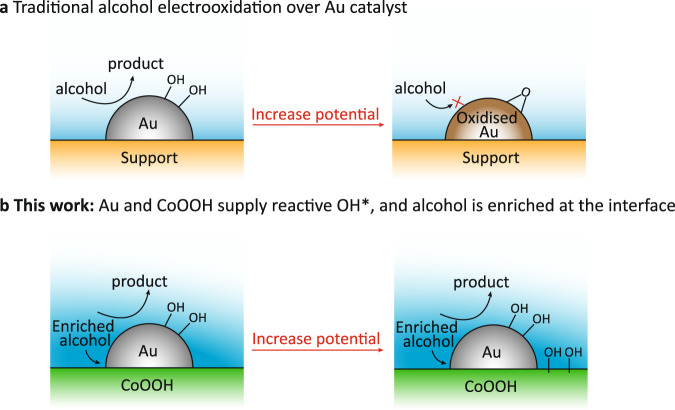
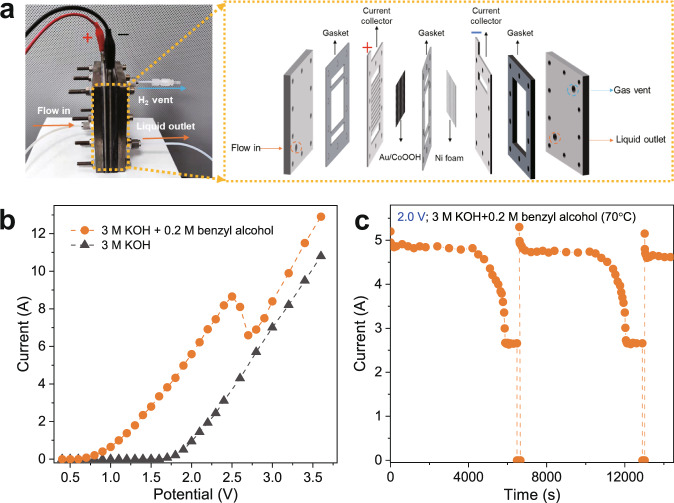
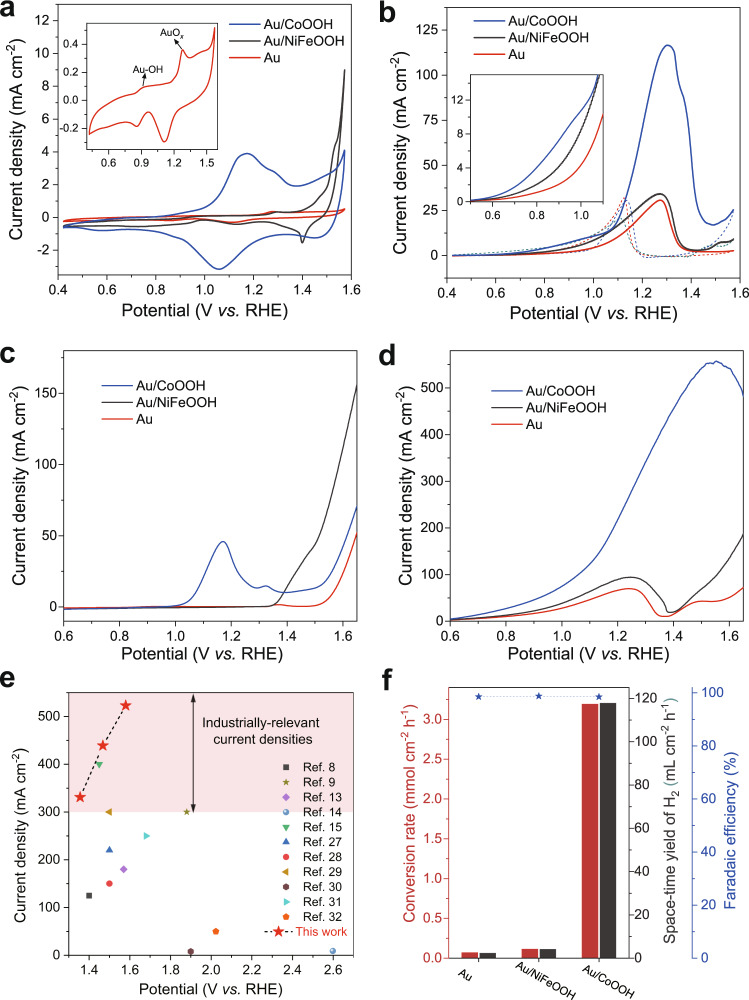
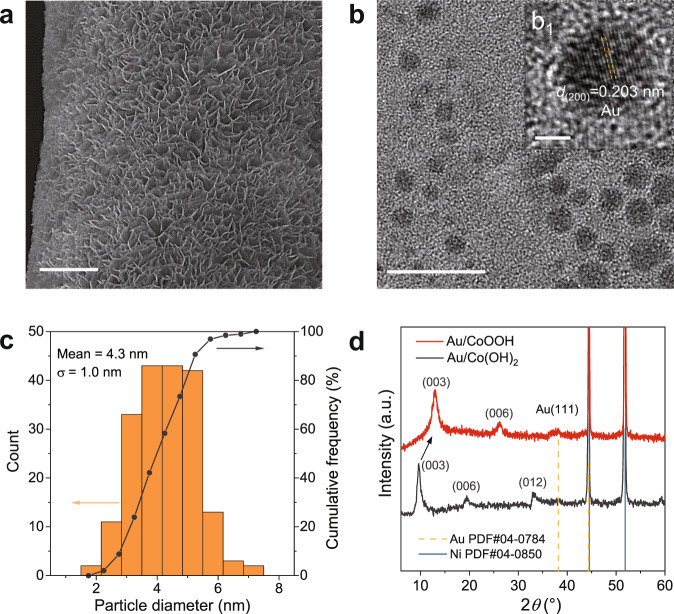
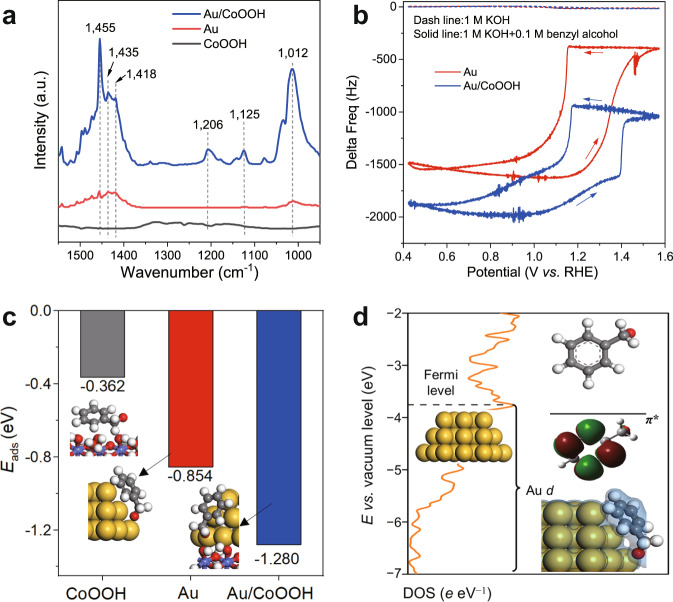
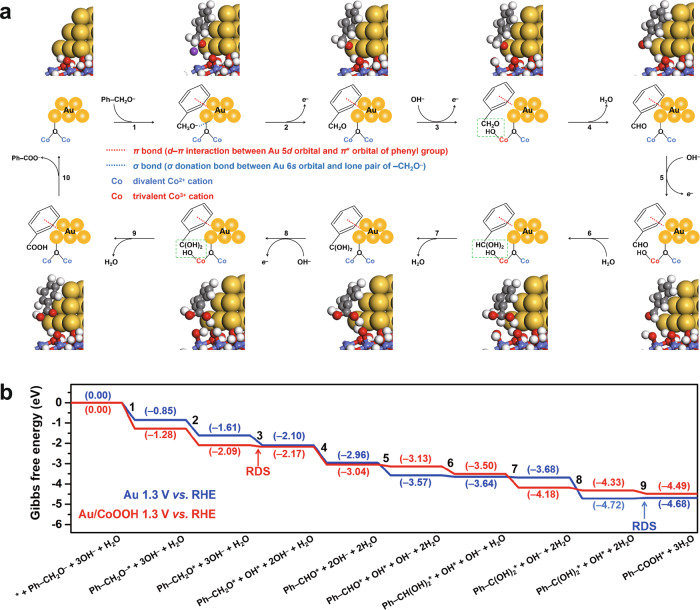
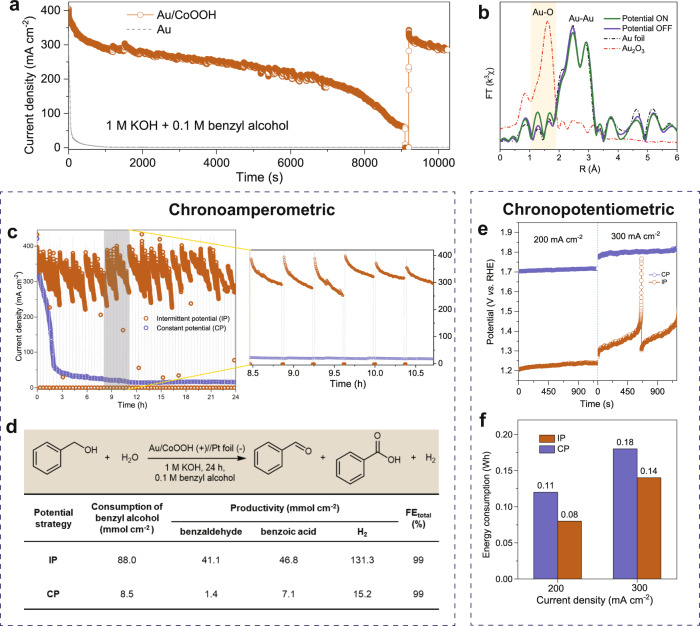
Electrochemical alcohols oxidation offers a promising approach to produce valuable chemicals and facilitate coupled H production. However, the corresponding current density is very low at moderate cell potential that substantially limits the overall productivity. Here we report the electrooxidation of benzyl alcohol coupled with H production at high current density (540 mA cm at 1.5 V vs. RHE) over a cooperative catalyst of Au nanoparticles supported on cobalt oxyhydroxide nanosheets (Au/CoOOH). The absolute current can further reach 4.8 A at 2.0 V in a more realistic two-electrode membrane-free flow electrolyzer. Experimental combined with theoretical results indicate that the benzyl alcohol can be enriched at Au/CoOOH interface and oxidized by the electrophilic oxygen species (OH*) generated on CoOOH, leading to higher activity than pure Au. Based on the finding that the catalyst can be reversibly oxidized/reduced at anodic potential/open circuit, we design an intermittent potential (IP) strategy for long-term alcohol electrooxidation that achieves high current density (>250 mA cm) over 24 h with promoted productivity and decreased energy consumption.
电化学醇氧化为生产有价值的化学品和促进耦合制氢提供了一种很有前景的方法。然而,在适中的电池电势下,相应的电流密度非常低,这极大地限制了整体生产率。在此,我们报道了在氢氧化氧钴纳米片负载的金纳米颗粒(Au/CoOOH)协同催化剂上,苯甲醇在高电流密度(相对于可逆氢电极,在1.5 V时为540 mA cm)下进行电氧化并耦合制氢。在更实际的无膜双电极流动电解槽中,在2.0 V时绝对电流可进一步达到4.8 A。实验与理论结果相结合表明,苯甲醇可在Au/CoOOH界面富集,并被CoOOH上生成的亲电氧物种(OH*)氧化,从而导致活性高于纯金。基于该催化剂可在阳极电势/开路下可逆氧化/还原这一发现,我们设计了一种间歇电势(IP)策略用于长期醇电氧化,该策略在24小时内实现了高电流密度(>250 mA cm),提高了生产率并降低了能耗。