Department of Botany, University of Wyoming, Laramie, Wyoming, USA.
Program in Ecology, University of Wyoming, Laramie, Wyoming, USA.
mSystems. 2022 Feb 22;7(1):e0097321. doi: 10.1128/msystems.00973-21. Epub 2022 Jan 11.
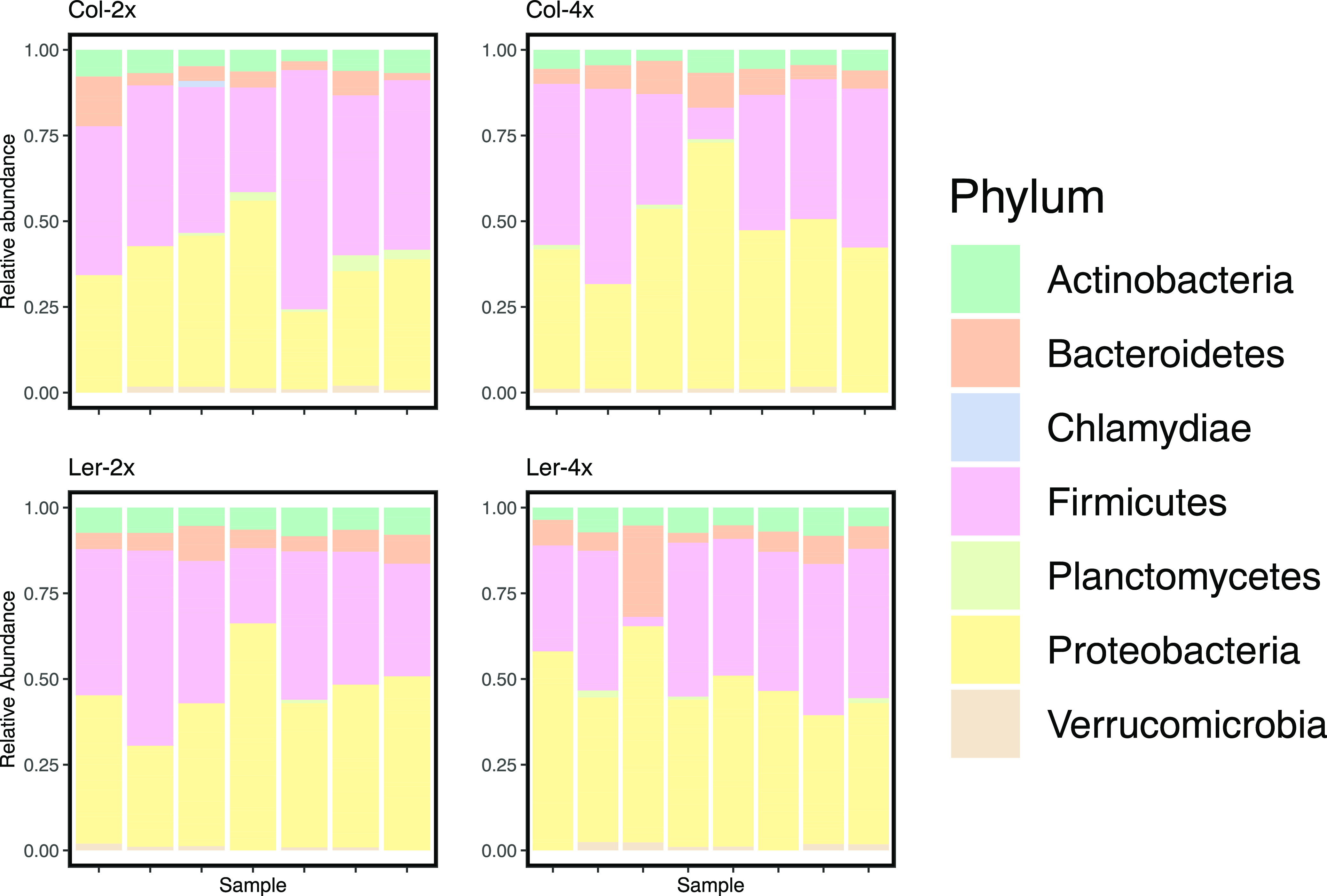
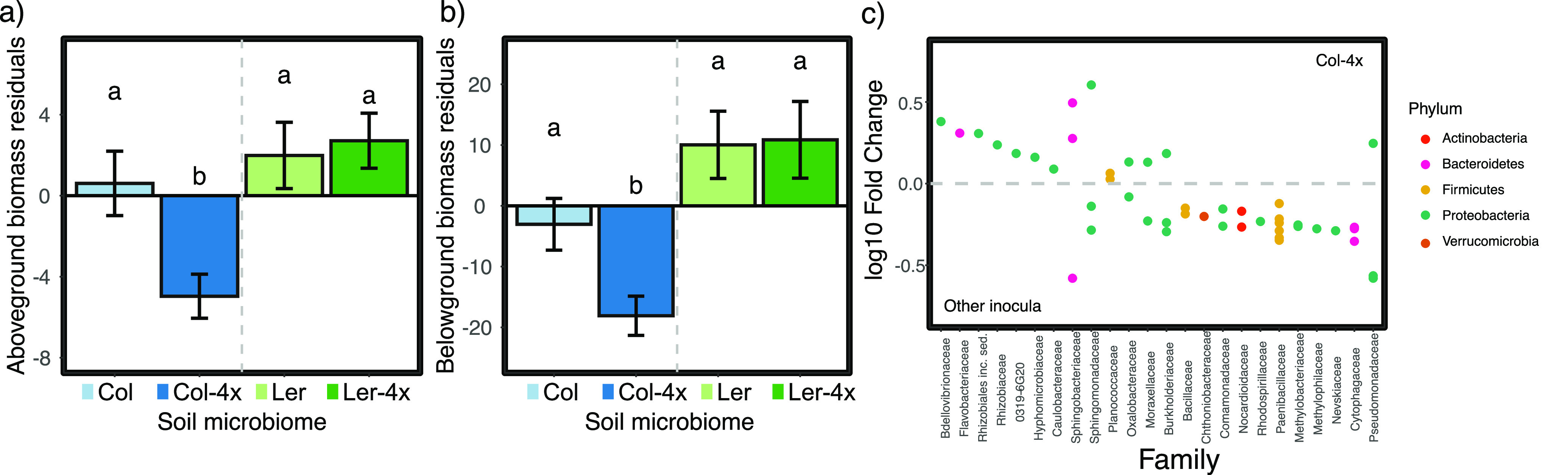
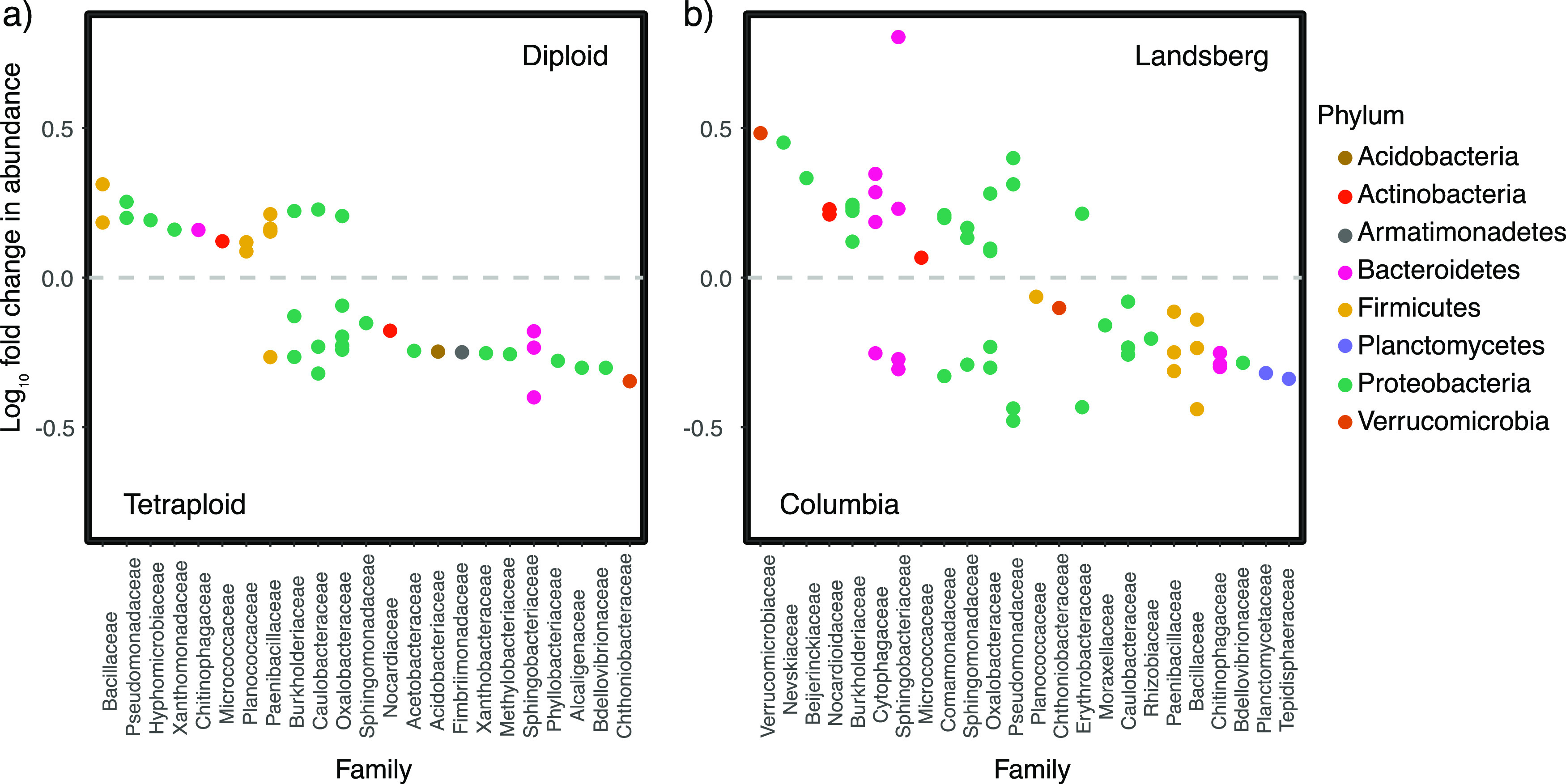
The composition of microbial communities found in association with plants is influenced by host phenotype and genotype. However, the ways in which specific genetic architectures of host plants shape microbiomes are unknown. Genome duplication events are common in the evolutionary history of plants and influence many important plant traits, and thus, they may affect associated microbial communities. Using experimentally induced whole-genome duplication (WGD), we tested the effect of WGD on rhizosphere bacterial communities in Arabidopsis thaliana. We performed 16S rRNA amplicon sequencing to characterize differences between microbiomes associated with specific host genetic backgrounds (Columbia versus Landsberg) and ploidy levels (diploid versus tetraploid). We modeled relative abundances of bacterial taxa using a hierarchical Bayesian approach. We found that host genetic background and ploidy level affected rhizosphere community composition. We then tested to what extent microbiomes derived from a specific genetic background or ploidy level affected plant performance by inoculating sterile seedlings with microbial communities harvested from a prior generation. We found a negative effect of the tetraploid Columbia microbiome on growth of all four plant genetic backgrounds. These findings suggest an interplay between host genetic background and ploidy level and bacterial community assembly with potential ramifications for host fitness. Given the prevalence of ploidy-level variation in both wild and managed plant populations, the effects on microbiomes of this aspect of host genetic architecture could be a widespread driver of differences in plant microbiomes. Plants influence the composition of their associated microbial communities, yet the underlying host-associated genetic determinants are typically unknown. Genome duplication events are common in the evolutionary history of plants and affect many plant traits. Using Arabidopsis thaliana, we characterized how whole-genome duplication affected the composition of rhizosphere bacterial communities and how bacterial communities associated with two host plant genetic backgrounds and ploidy levels affected subsequent plant growth. We observed an interaction between ploidy level and genetic background that affected both bacterial community composition and function. This research reveals how genome duplication, a widespread genetic feature of both wild and crop plant species, influences bacterial assemblages and affects plant growth.
与植物相关的微生物群落的组成受到宿主表型和基因型的影响。然而,特定宿主植物遗传结构塑造微生物组的方式尚不清楚。基因组加倍事件在植物的进化历史中很常见,影响许多重要的植物性状,因此它们可能会影响相关的微生物群落。我们使用实验诱导的全基因组加倍(WGD)来测试 WGD 对拟南芥根际细菌群落的影响。我们通过 16S rRNA 扩增子测序来描述与特定宿主遗传背景(哥伦比亚与莱格朗)和倍性水平(二倍体与四倍体)相关的微生物组之间的差异。我们使用分层贝叶斯方法来模拟细菌分类群的相对丰度。我们发现宿主遗传背景和倍性水平影响根际群落组成。然后,我们通过用来自前一代的微生物群落接种无菌幼苗来测试源自特定遗传背景或倍性水平的微生物组在多大程度上影响植物的表现。我们发现四倍体哥伦比亚微生物组对所有四个植物遗传背景的生长都有负面影响。这些发现表明宿主遗传背景和倍性水平与细菌群落组装之间存在相互作用,这可能对宿主适应性产生潜在影响。鉴于在野生和管理植物种群中普遍存在倍性水平的变化,宿主遗传结构这一方面对微生物组的影响可能是植物微生物组差异的广泛驱动因素。 植物会影响与其相关的微生物群落的组成,但潜在的宿主相关遗传决定因素通常是未知的。基因组加倍事件在植物的进化历史中很常见,并且会影响许多植物性状。我们使用拟南芥来描述全基因组加倍如何影响根际细菌群落的组成,以及与两个宿主植物遗传背景和倍性水平相关的细菌群落如何影响随后的植物生长。我们观察到倍性水平和遗传背景之间的相互作用,这影响了细菌群落的组成和功能。这项研究揭示了基因组加倍(野生和作物植物物种的广泛遗传特征)如何影响细菌组合并影响植物生长。