High National Veterinary School, Laboratory of Food Hygiene and Quality Insurance System, El-Alia, Oued Smar, Algeria.
Friedrich-Loeffler-Institut/Federal Research Institute for Animal Health, Institute of Molecular Pathogenesis, Germany.
PLoS One. 2022 Jan 11;17(1):e0262390. doi: 10.1371/journal.pone.0262390. eCollection 2022.
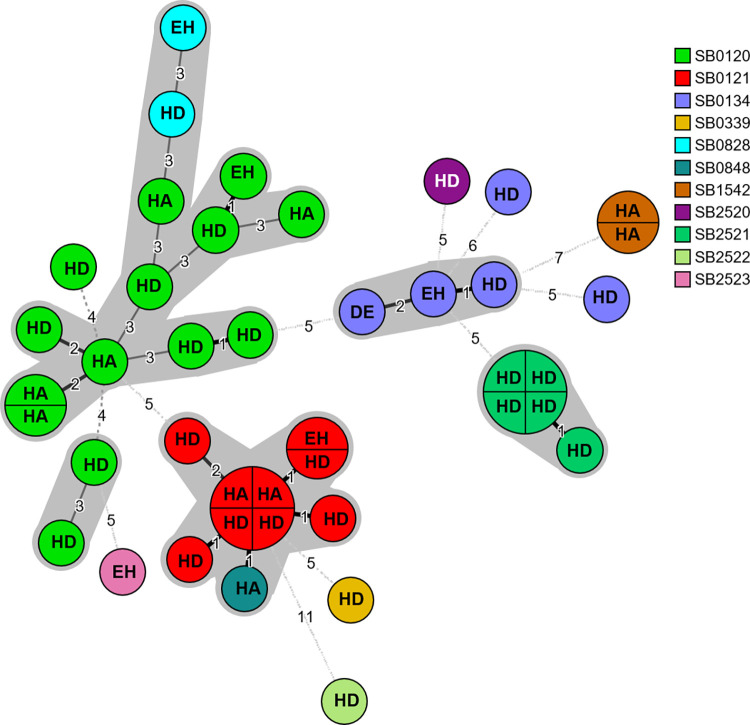
Bovine tuberculosis (bTB) caused by Mycobacterium (M.) bovis and M. caprae is a transmissible disease of livestock, notifiable to the World Organization for Animal Health (OIE). BTB particularly affects cattle and small ruminants and can be transmitted to humans thereby posing a significant threat to veterinary and public health worldwide. M. bovis is the principal cause of bTB in Algeria. In order to better understand the route of spreading and elaborate an eradication program, isolation and characterization of mycobacteria from Algerian cattle was performed. Sixty strains belonging to the M. tuberculosis complex were analyzed by spoligotyping, thereof 42 by 19-locus-MIRU-VNTR-typing. Spoligotyping revealed 16 distinguishable patterns (Hunter-Gaston discriminatory index [HGDI] of 0.8294), with types SB0120 (n = 20) and SB0121 (n = 13) being the most frequent patterns, representing 55% of the strains. Analyses based on 19-locus-MIRU-VNTR yielded 32 different profiles, five clusters and one orphan pattern, showing higher discriminatory power (HGDI = 0.9779) than spoligotyping. Seven VNTR-loci [VNTR 577 (alias ETR C), 2163b (QU11b), 2165 (ETR A), 2461 (ETR B), 3007 (MIRU 27), 2163a (QUB11a) and 3232 (QUB 3232)] were the most discriminative loci (HGDI ˃ 0.50). In conclusion, 19-locus-MIRU-VNTR yielded more information than spoligotyping concerning molecular differentiation of strains and better supports the elucidation of transmission routes of M. bovis between Algerian cattle herds.
牛型结核分枝杆菌(bTB)由牛分枝杆菌(M. bovis)和 M. caprae 引起,是一种可在牲畜中传播的疾病,需向世界动物卫生组织(OIE)报告。bTB 主要影响牛和小反刍动物,也可传播给人类,从而对全球兽医和公共卫生构成重大威胁。M. bovis 是阿尔及利亚 bTB 的主要病因。为了更好地了解传播途径并制定根除计划,对阿尔及利亚牛分枝杆菌进行了分离和特征分析。通过 spoligotyping 分析了 60 株属于结核分枝杆菌复合群的菌株,其中 42 株通过 19 个基因座 MIRU-VNTR 分型。 spoligotyping 揭示了 16 种可区分的模式(0.8294 的 Hunter-Gaston 区分指数 [HGDI]),其中 SB0120(n = 20)和 SB0121(n = 13)是最常见的模式,占菌株的 55%。基于 19 个基因座 MIRU-VNTR 的分析产生了 32 种不同的谱型,5 个聚类和 1 个孤儿谱型,显示出比 spoligotyping 更高的区分能力(HGDI = 0.9779)。7 个 VNTR 基因座 [VNTR577(别名 ETR C)、2163b(QU11b)、2165(ETR A)、2461(ETR B)、3007(MIRU 27)、2163a(QUB11a)和 3232(QUB3232)] 是最具区分力的基因座(HGDI>0.50)。综上所述,19 个基因座 MIRU-VNTR 提供的信息比 spoligotyping 更能区分菌株的分子差异,并更好地支持阐明 M. bovis 在阿尔及利亚牛群之间的传播途径。