Department of Rheumatology, Erasmus University MC, NB 850, PO box 2040, 3315EJ, Rotterdam, The Netherlands.
Nuffield Department of Orthopedics, Rheumatology and Musculoskeletal Sciences, Un. of Oxford, Oxford, UK.
Arthritis Res Ther. 2022 Jan 11;24(1):22. doi: 10.1186/s13075-021-02680-y.
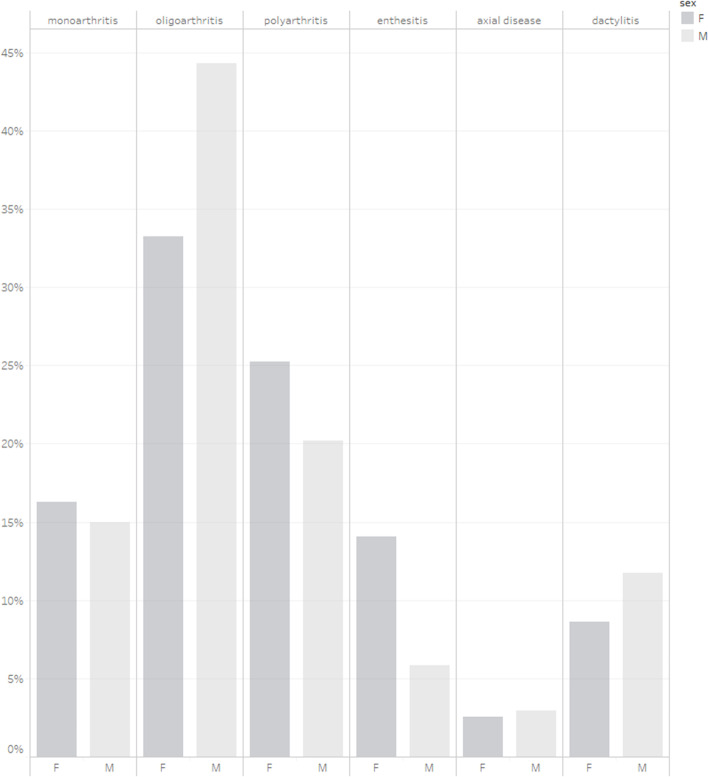
The prevalence of psoriatic arthritis (PsA) is the same in men and women; however, the latter experience a higher burden of disease and are affected more frequently by polyarthritis. Here, we performed an early PsA cohort analysis to assess sex-related differences in demographics, disease characteristics, and evolution over 1 year including applied treatment strategies.
Our study is embedded in the Dutch south-west Early Psoriatic Arthritis cohoRt. We described patient characteristics and treatment decisions. For the comparison across sexes and baseline and 1 year follow-up, appropriate tests depending on the distribution were used.
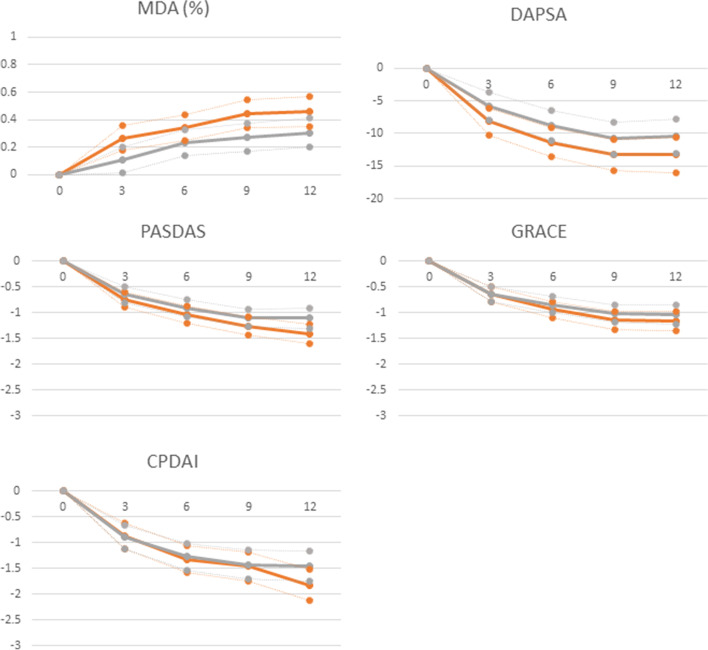
Two hundred seventy-three men and 294 women with no significant differences in age and ethnicity were included. Women reported significantly longer duration of symptoms before diagnosis and significantly higher tender joint count, a higher disease activity, higher levels of pain, and lower functional capacity. Although minimal disease activity (MDA) rates increased over time for both sexes, MDA remained significantly more prevalent among men at 1 year (58.1% vs 35.7%, p < 0.00). Initially, treatment strategies were similar in both sexes with methotrexate being the most frequently used drug during the first year. Women received methotrexate for a shorter period [196 (93-364) vs 306 (157-365), p < 0.00] and therefore received a lower cumulative dose compared to men. Retention time was shorter for all DMARDs, and women had a delayed start on b-DMARDs.
After 1 year of standard-of-care treatment, women did not surpass their baseline disadvantages. Despite the overall improvement, they still presented higher disease activity, higher levels of pain, and lower functional capacity score than men. The nature of these findings may advocate a need for sex specific adjustment of treatment strategies and evaluation in early PsA patients.
银屑病关节炎(PsA)的患病率在男性和女性中相同;然而,女性患者的疾病负担更高,并且更频繁地受到多发性关节炎的影响。在这里,我们进行了一项早期 PsA 队列分析,以评估性别相关的人口统计学、疾病特征和 1 年期间的演变,包括应用的治疗策略。
我们的研究嵌入在荷兰西南部早期银屑病关节炎队列中。我们描述了患者的特征和治疗决策。为了比较性别、基线和 1 年随访,我们使用了适当的检验方法,取决于数据的分布。
纳入了 273 名男性和 294 名女性患者,他们在年龄和种族方面没有显著差异。女性患者报告的症状持续时间明显更长,触诊关节计数更高,疾病活动度更高,疼痛程度更高,功能能力更低。尽管两性的微小疾病活动(MDA)率随着时间的推移而增加,但 1 年后 MDA 仍在男性中更为普遍(58.1%对 35.7%,p<0.00)。最初,两性的治疗策略相似,甲氨蝶呤是第一年最常用的药物。女性接受甲氨蝶呤的时间更短[196(93-364)对 306(157-365),p<0.00],因此与男性相比,累积剂量较低。所有 DMARD 的保留时间更短,女性开始使用 b-DMARD 的时间更晚。
在标准治疗 1 年后,女性并没有超过其基线的劣势。尽管总体上有所改善,但她们的疾病活动度、疼痛程度和功能能力评分仍高于男性。这些发现的性质可能表明需要对早期 PsA 患者进行特定于性别的治疗策略调整和评估。