Agostinelli Francesco, Doepke Matthias, Sorrenti Giuseppe, Zilibotti Fabrizio
Department of Economics, University of Pennsylvania, 133 S 36th St, Philadelphia, PA 19104, United States.
Department of Economics, Northwestern University, 2211 Campus Drive, Evanston, IL 60208, United States.
J Public Econ. 2022 Feb;206:104574. doi: 10.1016/j.jpubeco.2021.104574. Epub 2022 Jan 6.
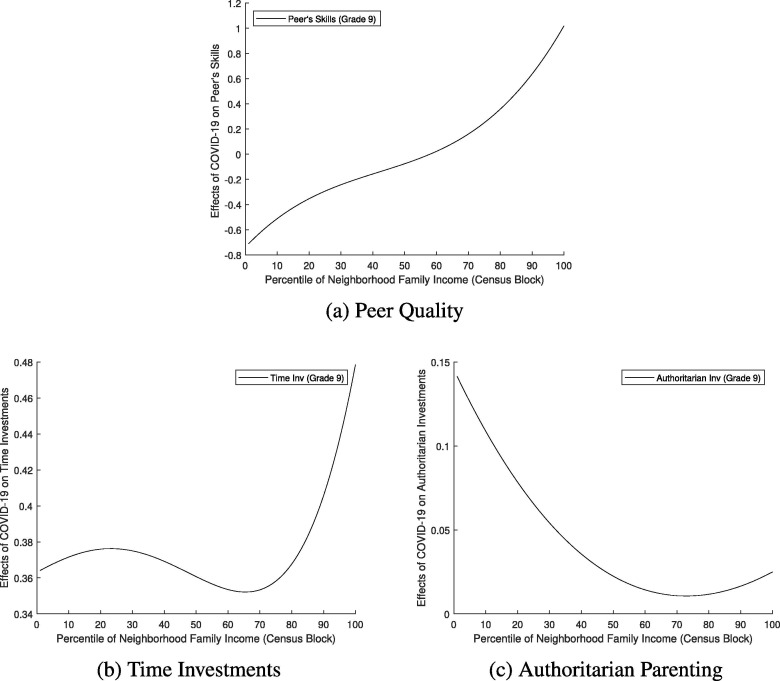
What are the effects of school closures during the Covid-19 pandemic on children's education? Online education is an imperfect substitute for in-person learning, particularly for children from low-income families. Peer effects also change: schools allow children from different socio-economic backgrounds to mix together, and this effect is lost when schools are closed. Another factor is the response of parents, some of whom compensate for the changed environment through their own efforts, while others are unable to do so. We examine the interaction of these factors with the aid of a structural model of skill formation. We find that school closures have a large, persistent, and unequal effect on human capital accumulation. High school students from low-income neighborhoods suffer a learning loss of 0.4 standard deviations after a one-year school closure, whereas children from high-income neighborhoods initially remain unscathed. The channels operating through schools, peers, and parents all contribute to growing educational inequality during the pandemic.
新冠疫情期间学校关闭对儿童教育有何影响?在线教育是面对面学习的不完美替代方式,尤其对于低收入家庭的孩子来说。同伴效应也会改变:学校让来自不同社会经济背景的孩子相互交往,而学校关闭时这种效应就会消失。另一个因素是家长的反应,有些家长通过自身努力弥补环境变化带来的影响,而有些家长则无能为力。我们借助技能形成的结构模型来研究这些因素之间的相互作用。我们发现,学校关闭对人力资本积累有巨大、持久且不平等的影响。低收入社区的高中生在学校关闭一年后学习成绩下降0.4个标准差,而高收入社区的孩子最初并未受到影响。通过学校、同伴和家长发挥作用的这些渠道都导致了疫情期间教育不平等的加剧。