Department of Neurosurgery, Huashan Hospital, Shanghai Medical College, Fudan University, Shanghai, China.
Department of Endocrinology and Metabolism, Huashan Hospital, Shanghai Medical College, Fudan University, Shanghai, China.
Microbiol Spectr. 2022 Feb 23;10(1):e0042521. doi: 10.1128/spectrum.00425-21. Epub 2022 Jan 12.
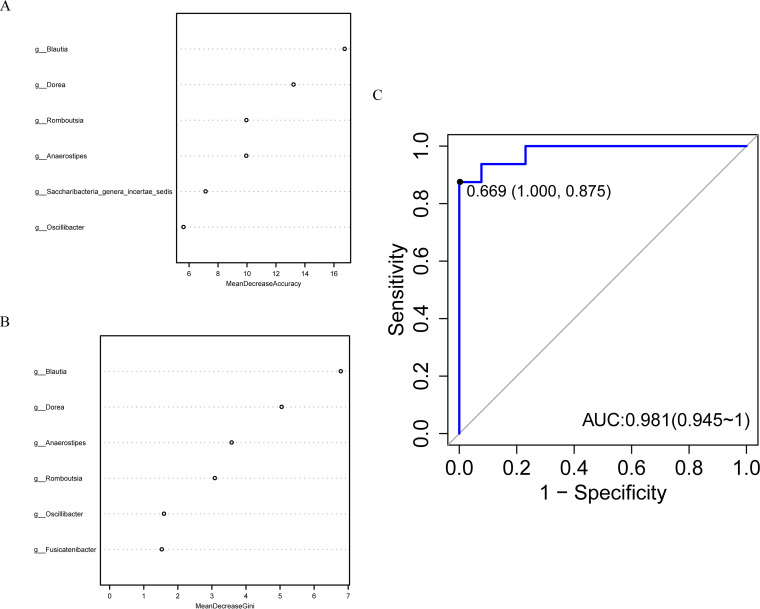
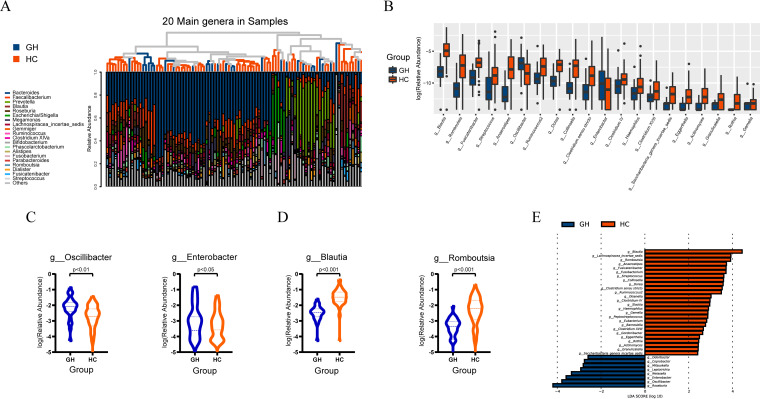
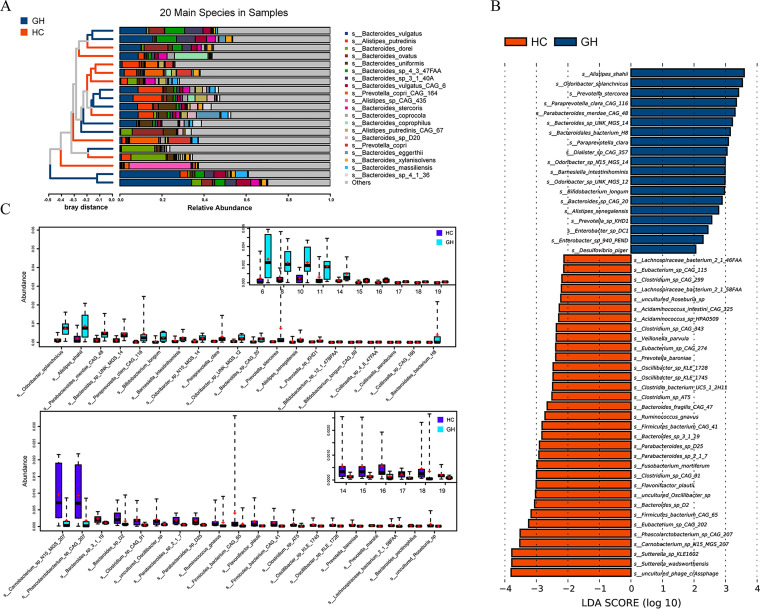
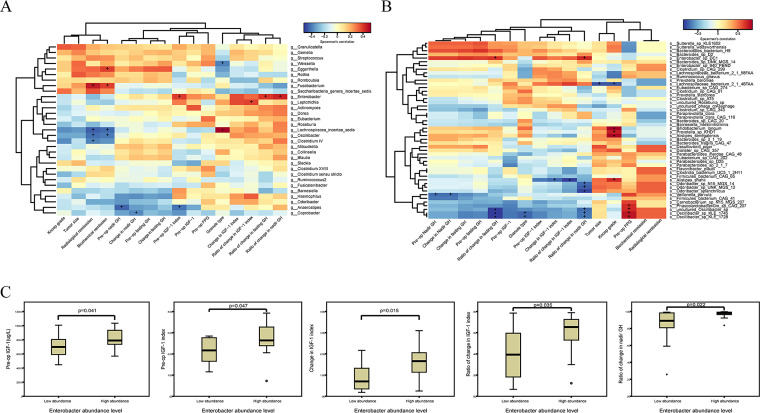
Prior study has demonstrated that gut microbiota at the genus level is significantly altered in patients with growth hormone (GH)-secreting pituitary adenoma (GHPA). Yet, no studies exist describing the state of gut microbiota at species level in GHPA. We performed a study using 16S rRNA amplicon sequencing in a cohort of patients with GH-secreting pituitary adenoma (GHPA, = 28) and healthy controls ( = 67). Among them, 9 patients and 10 healthy controls were randomly chosen and enrolled in metagenomics shotgun sequencing, generating 280,426,512 reads after aligning to NCBI GenBank DataBase to acquire taxa information at the species level. Weighted UniFrac analysis revealed that microbial diversity was notably decreased in patients with GHPA, consistent with a previous study. With 16S rRNA sequencing, after correction for false-discovery rate (FDR), rank-sum test at the genus level revealed that the relative abundance of and was remarkably increased in patients and and genera predominated in the controls, augmented by additional LEfSe (linear discriminant analysis effect size) analysis. As for further comparison at the species level with metagenomics sequencing, rank-sum test together with LEfSe analysis confirmed the enrichment of Alistipes shahii and Odoribacter splanchnicus in the patient group. Notably, LEfSe analysis with metagenomics also demonstrated that sp. and sp. , derived from , were both significantly enriched in patients. Functional analysis showed that amino acid metabolism pathway was remarkably enriched in GHPA, while carbohydrate metabolism pathway was notably enriched in controls. Further, significant positive correlations were observed between and baseline insulin-like growth factor 1 (IGF-1), indicating that may be strongly associated with GH/IGF-1 axis in GHPA. Our data extend our insight into the GHPA microbiome, which may shed further light on GHPA pathogenesis and facilitate the exploration of novel therapeutic targets based on microbiota manipulation. Dysbiosis of gut microbiota is associated not only with intestinal disorders but also with numerous extraintestinal diseases. Growth hormone-secreting pituitary adenoma (GHPA) is an insidious disease with persistent hypersecretion of GH and IGF-1, causing increased morbidity and mortality. Researches have reported that the GH/IGF-1 axis exerts its own influence on the intestinal microflora. Here, the results showed that compared with healthy controls, GHPA patients not only decreased the alpha diversity of the intestinal flora but also significantly changed their beta diversity. Further, metagenomics shotgun sequencing in the present study exhibited that sp. and sp. were enriched in patients. Also, we were pleasantly surprised to find that the genus was strongly positively correlated with baseline IGF-1 levels. Collectively, our work provides the first glimpse of the dysbiosis of the gut microbiota at species level, providing a better understanding of the pathophysiological process of GHPA.
先前的研究表明,生长激素(GH)分泌性垂体腺瘤(GHPA)患者的肠道微生物群落在属水平上显著改变。然而,目前还没有研究描述 GHPA 患者在种水平上的肠道微生物群落状态。我们使用 16S rRNA 扩增子测序对一组 GH 分泌性垂体腺瘤(GHPA, = 28)患者和健康对照者( = 67)进行了研究。其中,随机选择 9 名患者和 10 名健康对照者进行宏基因组 shotgun 测序,对齐到 NCBI GenBank DataBase 后获得物种水平的分类群信息,共产生 280,426,512 个读数。加权 UniFrac 分析表明,GHPA 患者的微生物多样性明显降低,这与之前的研究一致。通过 16S rRNA 测序,在对错误发现率(FDR)进行校正后,属水平的秩和检验显示,患者中 和 的相对丰度显著增加,而 和 属则在对照组中占主导地位,此外还通过额外的 LEfSe(线性判别分析效应大小)分析进行了补充。对于使用宏基因组测序进行进一步的种水平比较,秩和检验和 LEfSe 分析共同证实了患者组中 Alistipes shahii 和 Odoribacter splanchnicus 的富集。值得注意的是,LEfSe 分析与宏基因组测序相结合还表明,源自 的 sp. 和 sp. 在患者中均显著富集。功能分析表明,氨基酸代谢途径在 GHPA 中显著富集,而碳水化合物代谢途径在对照组中显著富集。此外,还观察到 和基线胰岛素样生长因子 1(IGF-1)之间存在显著的正相关,表明 可能与 GH/IGF-1 轴在 GHPA 中密切相关。我们的数据扩展了我们对 GHPA 微生物组的了解,这可能进一步揭示 GHPA 的发病机制,并有助于基于微生物群操作探索新的治疗靶点。肠道微生物群落失调不仅与肠道疾病有关,还与许多肠道外疾病有关。生长激素分泌性垂体腺瘤(GHPA)是一种隐匿性疾病,其特征是持续过度分泌 GH 和 IGF-1,导致发病率和死亡率增加。研究表明,GH/IGF-1 轴对肠道微生物群有其自身的影响。在这里,结果表明,与健康对照组相比,GHPA 患者不仅降低了肠道菌群的 alpha 多样性,而且还显著改变了他们的 beta 多样性。此外,本研究中的宏基因组 shotgun 测序显示,患者中 sp. 和 sp. 得到了富集。我们还惊喜地发现, 属与基线 IGF-1 水平呈强烈正相关。总之,我们的工作首次揭示了种水平上肠道微生物群落的失调,为更好地理解 GHPA 的病理生理过程提供了依据。