Brito Cheila, Tomás Ana, Azevedo Ana, Esteves Susana, Mafra Manuela, Roque Lúcia, Pojo Marta
Unidade de Investigação em Patobiologia Molecular (UIPM), Instituto Português de Oncologia de Lisboa Francisco Gentil E.P.E., Lisboa, Portugal.
Serviço de Neurologia, Instituto Português de Oncologia de Lisboa Francisco Gentil E.P.E., Lisboa, Portugal.
Clin Med Insights Oncol. 2022 Jan 6;16:11795549211068804. doi: 10.1177/11795549211068804. eCollection 2022.
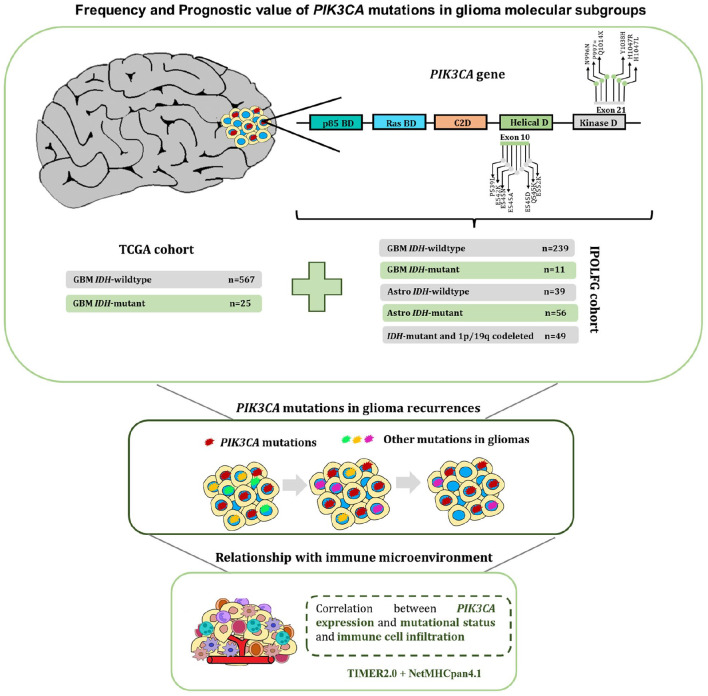
is one of the most mutated oncogenes in solid tumors. In breast cancer (ER-positive, HER2-negative), these events represent a predictive biomarker of response to alpelisib. In glioblastomas (GBM), mutations were described as early constitutive events. Here, we investigated mutational profile across glioma molecular subgroups and its relevance during glioma recurrence. Furthermore, mutations' effect in PI3K pathway, prognosis, and response to therapy was also explored.
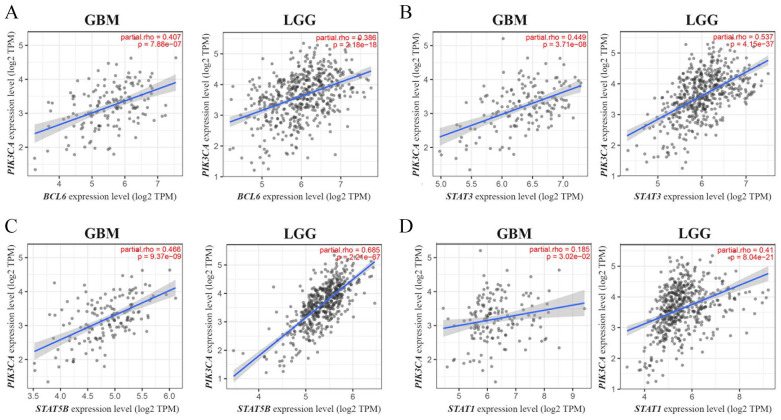
Exons 10 and 21 of mutations were evaluated in 394 gliomas and 19 glioma recurrences from Instituto Português de Oncologia Lisboa Francisco Gentil (IPOLFG) and compared with The Cancer Genome Atlas (TCGA) data. TIMER2.0 and NetMHCpan4.1 were used to assess the immune-microenvironment contribution.
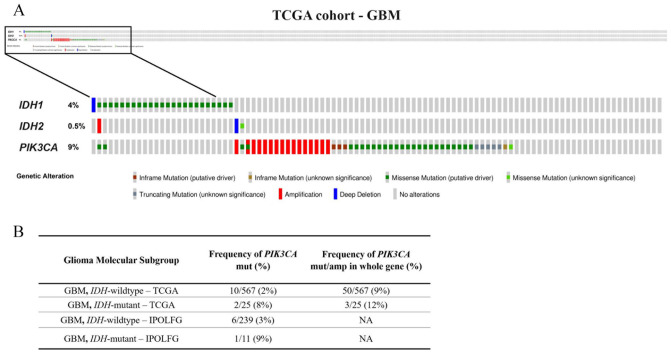
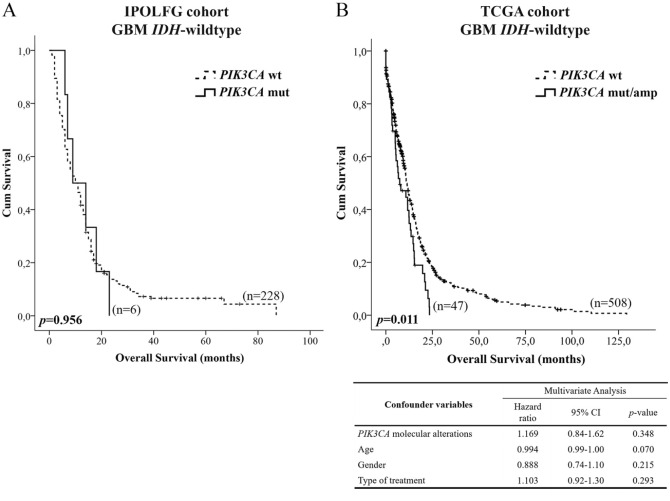
mutations were identified among all glioma subgroups, although with no impact on their stratification or prognosis. In both cohorts (IPOLFG and TCGA), mutation frequencies in -mutant and -wild-type GBM were similar (IPOLFG: 9% and 3%; TCGA: 8% and 2%). These mutations were not mutually exclusive with deletion and amplification. Despite their reduced frequency, we discovered mutations were maintained during glioma recurrence regardless of administered therapies. The immune microenvironment might not contribute to this phenotype as mutations did not influence immune cell infiltration.
Despite the absence of a predominant effect in glioma stratification, mutations were maintained during glioma recurrence, possibly contributing to glioma cell survival, representing promising therapeutic targets in recurrent glioma. Nevertheless, understanding the potential synergistic effects between mutations, deletion, and amplification is pivotal to targeted therapies' efficiency.
是实体瘤中突变最多的致癌基因之一。在乳腺癌(雌激素受体阳性、人表皮生长因子受体2阴性)中,这些事件代表了对阿培利司反应的预测生物标志物。在胶质母细胞瘤(GBM)中,突变被描述为早期组成性事件。在此,我们研究了胶质瘤分子亚组中的突变谱及其在胶质瘤复发过程中的相关性。此外,还探讨了突变对PI3K通路、预后和治疗反应的影响。
在葡萄牙里斯本弗朗西斯科·詹蒂尔肿瘤研究所(IPOLFG)的394例胶质瘤和19例胶质瘤复发中评估了突变的第10和21外显子,并与癌症基因组图谱(TCGA)数据进行比较。使用TIMER2.0和NetMHCpan4.1评估免疫微环境的贡献。
在所有胶质瘤亚组中均发现了突变,尽管对其分层或预后没有影响。在两个队列(IPOLFG和TCGA)中,突变型和野生型GBM中的突变频率相似(IPOLFG:9%和3%;TCGA:8%和2%)。这些突变与缺失和扩增并非相互排斥。尽管其频率降低,但我们发现无论采用何种治疗方法,突变在胶质瘤复发期间均得以维持。免疫微环境可能对这种表型没有贡献,因为突变不影响免疫细胞浸润。
尽管在胶质瘤分层中没有显著影响,但突变在胶质瘤复发期间得以维持,可能有助于胶质瘤细胞存活,是复发胶质瘤中有前景的治疗靶点。然而,了解突变、缺失和扩增之间的潜在协同效应对于靶向治疗的效率至关重要。