Centre for Genomic and Experimental Medicine, Institute of Genetics and Cancer, University of Edinburgh, Edinburgh, EH4 2XU, UK.
Lothian Birth Cohorts, Department of Psychology, University of Edinburgh, Edinburgh, EH8 9JZ, UK.
Genome Biol. 2022 Jan 17;23(1):26. doi: 10.1186/s13059-021-02596-5.
Blood-based markers of cognitive functioning might provide an accessible way to track neurodegeneration years prior to clinical manifestation of cognitive impairment and dementia.
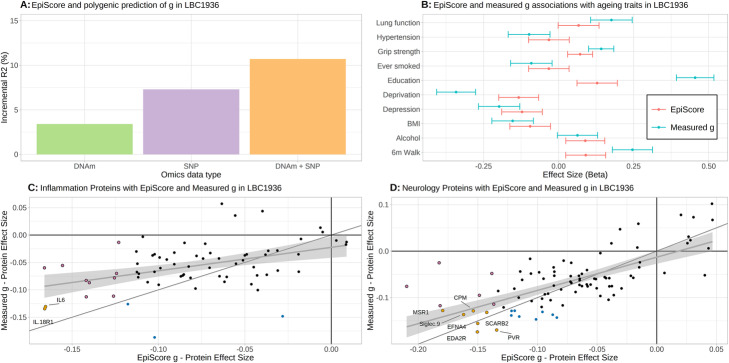
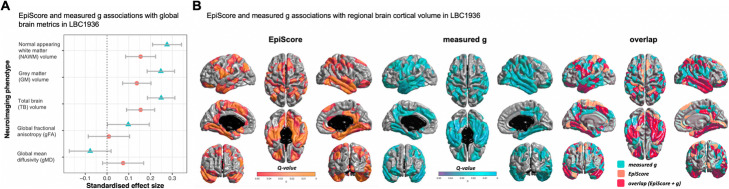
Using blood-based epigenome-wide analyses of general cognitive function, we show that individual differences in DNA methylation (DNAm) explain 35.0% of the variance in general cognitive function (g). A DNAm predictor explains ~4% of the variance, independently of a polygenic score, in two external cohorts. It also associates with circulating levels of neurology- and inflammation-related proteins, global brain imaging metrics, and regional cortical volumes.
As sample sizes increase, the ability to assess cognitive function from DNAm data may be informative in settings where cognitive testing is unreliable or unavailable.
基于血液的认知功能标志物可能提供一种可及的方式,在认知障碍和痴呆出现临床症状前数年跟踪神经退行性变。
我们使用基于血液的全基因组认知功能表观遗传组学分析,显示 DNA 甲基化(DNAm)的个体差异解释了一般认知功能(g)变异的 35.0%。一个 DNAm 预测因子在两个外部队列中独立于多基因评分,解释了~4%的变异。它还与神经和炎症相关蛋白的循环水平、全脑成像指标和区域皮质体积相关。
随着样本量的增加,从 DNAm 数据评估认知功能的能力在认知测试不可靠或不可用时可能具有信息性。