Kurittu Paula, Khakipoor Banafsheh, Jalava Jari, Karhukorpi Jari, Heikinheimo Annamari
Department of Food Hygiene and Environmental Health, Faculty of Veterinary Medicine, University of Helsinki, Helsinki, Finland.
Finnish Institute for Health and Welfare, Helsinki, Finland.
Front Microbiol. 2022 Jan 4;12:789280. doi: 10.3389/fmicb.2021.789280. eCollection 2021.
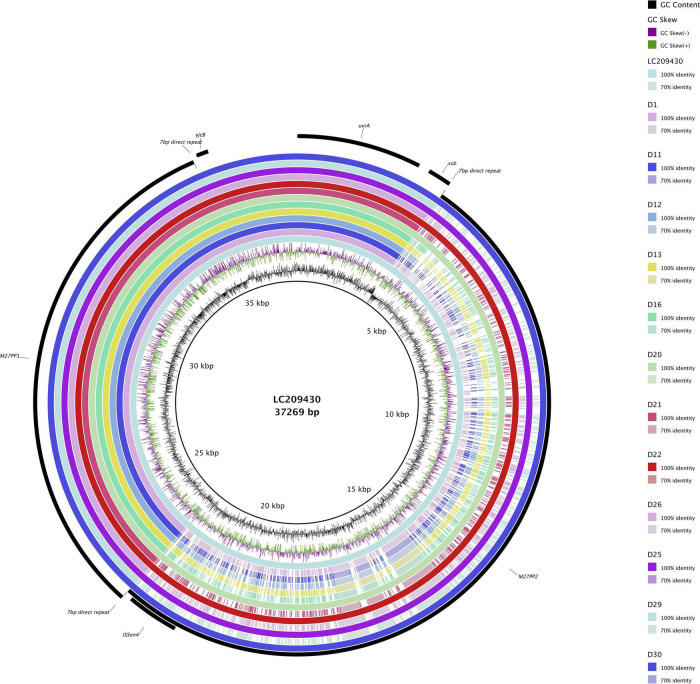
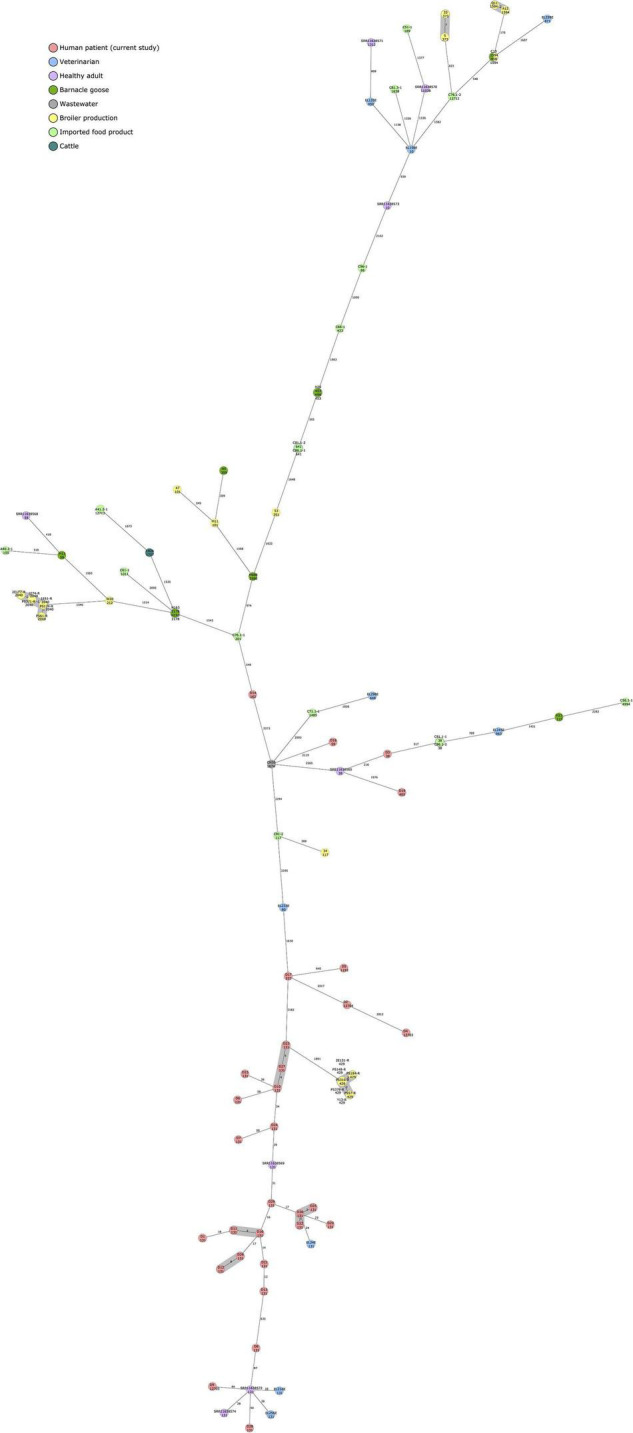
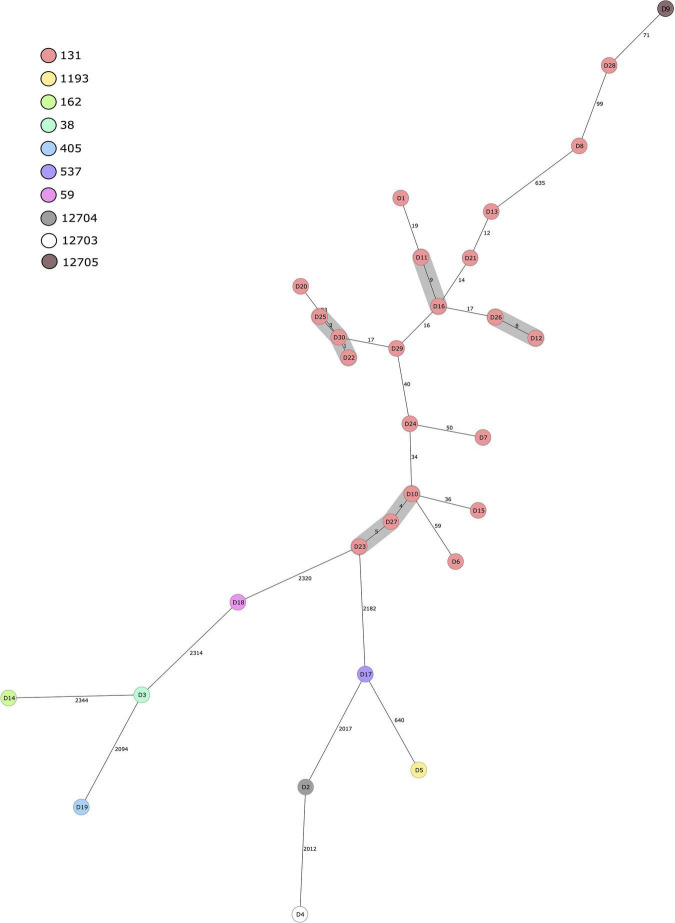
Antimicrobial resistance (AMR) is a growing concern in public health, particularly for the clinically relevant extended-spectrum beta-lactamase (ESBL) and AmpC-producing Enterobacteriaceae. Studies describing ESBL-producing clinical samples from Finland to the genomic level and investigation of possible zoonotic transmission routes are scarce. This study characterizes ESBL-producing from clinical samples in Finland using whole genome sequencing (WGS). Comparison is made between animal, food, and environmental sources in Finland to gain insight into potential zoonotic transmission routes and to recognize successful AMR genes, bacterial sequence types (STs), and plasmids. ESBL-producing isolates ( = 30) obtained from the Eastern Finland healthcare district between 2018 and 2020 underwent WGS and were compared to sequences from non-human and healthy human sources ( = 67) isolated in Finland between 2012 and 2018. A majority of the clinical isolates belonged to ST131 ( = 21; 70%), of which 19 represented O25:H4 and 30 allele, and 2 O16:H5 and 41 allele. Multidrug resistance was common, and the most common gene identified was ( = 14; 47%) followed by ( = 10; 33%). was identified in 13 out of 21 isolates representing ST131, with 12 isolates belonging to a recently discovered international ST131 C1-M27 subclade. Isolates were found to be genetically distinct from non-human sources with core genome multilocus sequence typing based analysis. Most isolates ( = 26; 87%) possessed multiple replicons, with IncF family plasmids appearing in 27 (90%) and IncI1 in 5 (17%) isolates. IncF[F1:A2:B20] replicon was identified in 11, and IncF[F-:A2:B20] in 4 isolates. The results indicate the ST131-C1-M27 clade gaining prevalence in Europe and provide further evidence of the concerning spread of this globally successful pathogenic clonal group. This study is the first to describe ESBL-producing in human infections with WGS in Finland and provides important information on global level of the spread of ESBL-producing belonging to the C1-M27 subclade. The results will help guide public health actions and guide future research.
抗菌药物耐药性(AMR)日益引起公共卫生领域的关注,尤其是对于临床上具有重要意义的产超广谱β-内酰胺酶(ESBL)和产AmpC酶的肠杆菌科细菌。描述从芬兰临床样本中产ESBL细菌至基因组水平以及调查可能的人畜共患病传播途径的研究很少。本研究使用全基因组测序(WGS)对芬兰临床样本中产ESBL细菌进行特征分析。对芬兰的动物、食品和环境来源进行比较,以深入了解潜在的人畜共患病传播途径,并识别成功的AMR基因、细菌序列类型(STs)和质粒。对2018年至2020年从芬兰东部医疗保健区获得的30株产ESBL分离株进行WGS,并与2012年至2018年在芬兰分离的非人类和健康人类来源的67个序列进行比较。大多数临床分离株属于ST131(21株;70%),其中19株代表O25:H4和30等位基因,2株代表O16:H5和41等位基因。多重耐药很常见,鉴定出的最常见的ESBL基因是CTX-M(14株;47%),其次是TEM(10株;33%)。在代表ST131的21株分离株中有13株鉴定出CTX-M,其中12株属于最近发现的国际ST131 C1-M27亚分支。基于核心基因组多位点序列分型分析发现,分离株在基因上与非人类来源不同。大多数分离株(26株;87%)拥有多个复制子,IncF家族质粒出现在27株(90%)中,IncI1出现在5株(17%)分离株中。在11株中鉴定出IncF[F1:A2:B20]复制子,4株中鉴定出IncF[F-:A2:B20]。结果表明ST131-C1-M27分支在欧洲日益流行,并为这个在全球范围内成功的致病克隆群令人担忧的传播提供了进一步证据。本研究首次在芬兰使用WGS描述人类感染中产ESBL细菌的情况,并提供了关于属于C1-M27亚分支的产ESBL细菌在全球传播水平的重要信息。这些结果将有助于指导公共卫生行动并指导未来的研究。