Yang Chao, Zhang Tianxi, Tian Quanhua, Cheng Yan, Gebeyew Kefyalew, Liu Guowei, Tan Zhiliang, He Zhixiong
CAS Key Laboratory for Agro-Ecological Processes in Subtropical Region, National Engineering Laboratory for Pollution Control and Waste Utilization in Livestock and Poultry Production, South-Central Experimental Station of Animal Nutrition and Feed Science in Ministry of Agriculture, Hunan Provincial Engineering Research Center for Healthy Livestock and Poultry Production, Institute of Subtropical Agriculture, The Chinese Academy of Sciences, Changsha, China.
University of Chinese Academy of Sciences, Beijing, China.
Front Microbiol. 2022 Jan 4;12:795081. doi: 10.3389/fmicb.2021.795081. eCollection 2021.
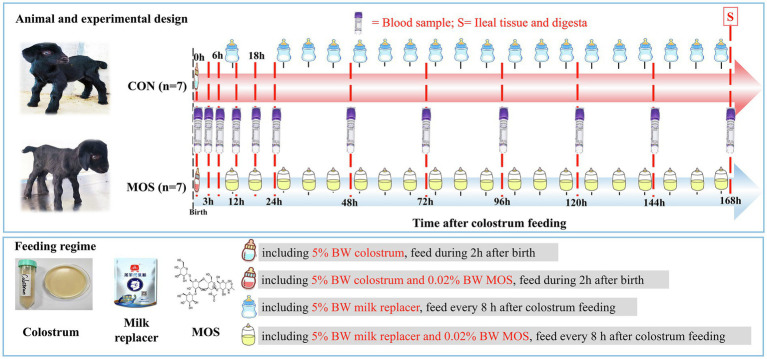
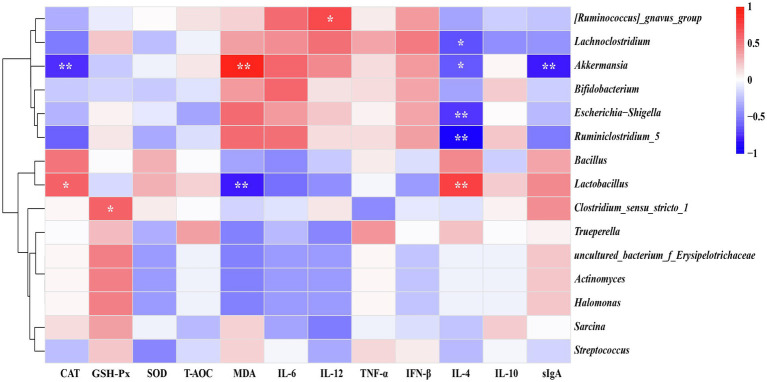
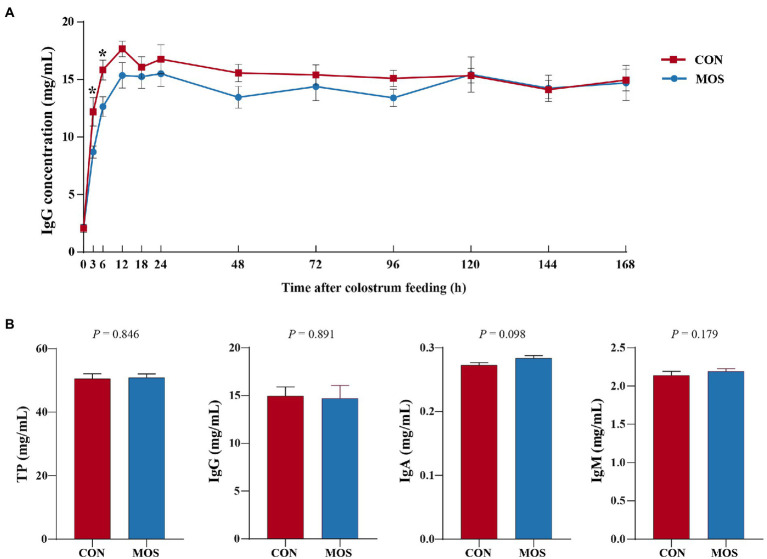
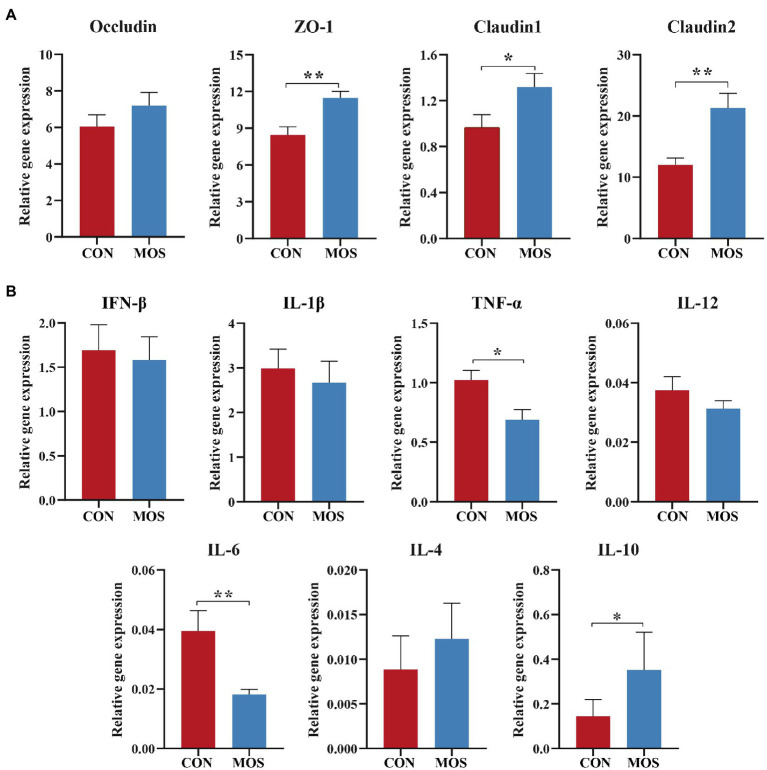
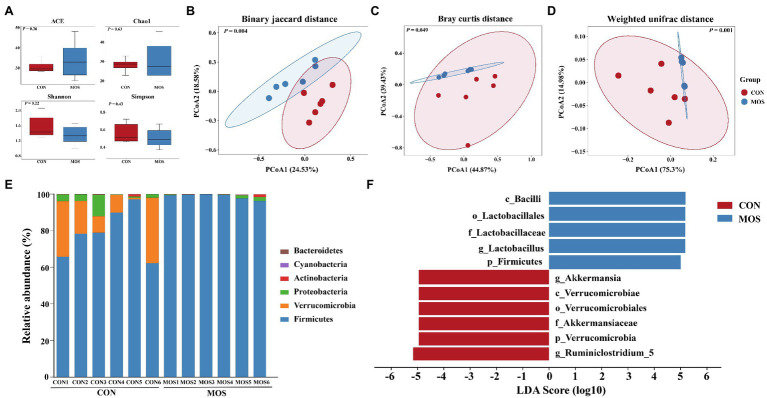
Successful establishment of passive immunity (PIT) and regulation of intestinal microbiota are crucial for ruminants to maintain body health and reduce the risk of disease during the neonatal period. Thus, the objective of this study was to investigate the effects of mannan oligosaccharide (MOS) supplementation on passive transfer of immunoglobulin G (IgG), serum inflammatory cytokines and antioxidant levels as well as bacteria composition in the ileal digesta. A total of 14 healthy neonatal Ganxi black goats with similar birth weight (BW: 2.35 ± 0.55 kg) were selected and allocated into two groups, only fed colostrum and milk replacer (CON, = 7) and supplemented MOS (0.06% of birth BW) in the colostrum and milk replacer (MOS, = 7). The results indicated that MOS supplementation significantly reduced ( < 0.05) serum IgG level at 3 and 6 h after colostrum feeding. Serum GLP-1 level of goats in the MOS group was significantly lower ( = 0.001) than that in the CON group. Goats in the MOS group had higher serum CAT and lower MDA level than those in the CON group ( < 0.05). Serum anti-inflammatory cytokine level of interleukin 4 (IL-4) was increased ( < 0.05), while pro-inflammatory cytokine IL-6 level was reduced ( < 0.05) in the MOS group when compared with the CON group. In addition, MOS supplementation remarkably increased ( < 0.05) the level of secretory IgA (sIgA) in the ileal digesta. Principal coordinate analysis of 16S rRNA sequence based on Brinary jaccard, Bray curtis, and weighted UniFrac distance of ileal microbiota showed a distinct microbial differentiation between the CON and MOS groups ( < 0.05). The relative abundance of in the MOS group was higher than that in the CON group, while the abundance of was lower in the MOS group than that in the CON group at the phylum level ( < 0.05). The relative abundance of tended to decrease ( = 0.078) in the MOS group at the phylum level. The results of LEfSe analysis showed that MOS group was characterized by a higher relative abundance of , while the CON group was represented by a higher relative abundance of and . Our findings demonstrated that MOS supplementation during the neonatal period increases antioxidant capacity and reduces the inflammatory response, and promotes IgA secretion and colonization in the ileum. Thus, MOS induced positive effects are more pronounced in neonatal goats that might be an effective approach to maintain intestinal health and improve the surviving rate of neonatal ruminants.
成功建立被动免疫(PIT)和调节肠道微生物群对于反刍动物在新生期维持身体健康和降低疾病风险至关重要。因此,本研究的目的是探讨补充甘露寡糖(MOS)对免疫球蛋白G(IgG)的被动转移、血清炎性细胞因子和抗氧化水平以及回肠消化物中细菌组成的影响。总共选择了14只出生体重相似(体重:2.35±0.55千克)的健康新生赣西黑山羊,并将其分为两组,一组仅饲喂初乳和代乳粉(CON,n = 7),另一组在初乳和代乳粉中补充MOS(出生体重的0.06%,MOS,n = 7)。结果表明,补充MOS显著降低了(P<0.05)初乳喂养后3小时和6小时的血清IgG水平。MOS组山羊血清GLP-1水平显著低于(P = 0.001)CON组。MOS组山羊血清CAT水平高于CON组,MDA水平低于CON组(P<0.05)。与CON组相比,MOS组血清抗炎细胞因子白细胞介素4(IL-4)水平升高(P<0.05),而促炎细胞因子IL-6水平降低(P<0.05)。此外,补充MOS显著提高了(P<0.05)回肠消化物中分泌型IgA(sIgA)的水平。基于回肠微生物群的二元杰卡德、布雷-柯蒂斯和加权非加权组平均距离对16S rRNA序列进行主坐标分析,结果显示CON组和MOS组之间存在明显的微生物分化(P<0.05)。在门水平上,MOS组中某菌属的相对丰度高于CON组,而另一菌属的丰度在MOS组中低于CON组(P<0.05)。在门水平上,MOS组中另一菌属的相对丰度有降低趋势(P = 0.078)。线性判别分析效应大小(LEfSe)分析结果表明,MOS组的特征是某菌属的相对丰度较高,而CON组则以另两个菌属的相对丰度较高为特征。我们的研究结果表明,新生期补充MOS可提高抗氧化能力,减轻炎症反应,并促进回肠中IgA分泌和某菌属的定殖。因此,MOS诱导的积极作用在新生山羊中更为明显,这可能是维持肠道健康和提高新生反刍动物存活率的有效方法。