Hygiene Unit, Policlinico Riuniti Foggia Hospital, Department of Medical and Surgical Sciences, University of Foggia, Ospedale Colonnello D'Avanzo, Viale degli Aviatori 2, 71122, Foggia, Italy.
Microbiology and Virology Section, Policlinico Riuniti Foggia Hospital, Foggia, Italy.
BMC Infect Dis. 2022 Jan 22;22(1):77. doi: 10.1186/s12879-022-07052-8.
From the initial stages of the pandemic in early 2020, COVID-19-related olfactory and gustatory dysfunctions have been widely reported and are emerging as one of the most frequent long-term sequelae of SARS-CoV-2 infection. However, data regarding the long-term recovery of the sense of smell and taste are lacking. This study aimed to characterize the evolution up to one year after the diagnosis of self-reported olfactory and gustatory dysfunctions in COVID-19 cases.
Based on the data of the active surveillance platform of the Apulia region, Italy, we selected the residents of Foggia district who were confirmed positive for SARS-CoV-2 from March 1st to June 16th, 2020, and home-quarantined with paucisymptomatic-to-mild clinical presentation. Self-reported olfactory and gustatory dysfunctions were recorded at baseline through a survey of dichotomous questions. The evolution of these symptoms at approximately one year was prospectively assessed via telephone by the validated sino-nasal outcome test 22 (SNOT-22, Italian version).
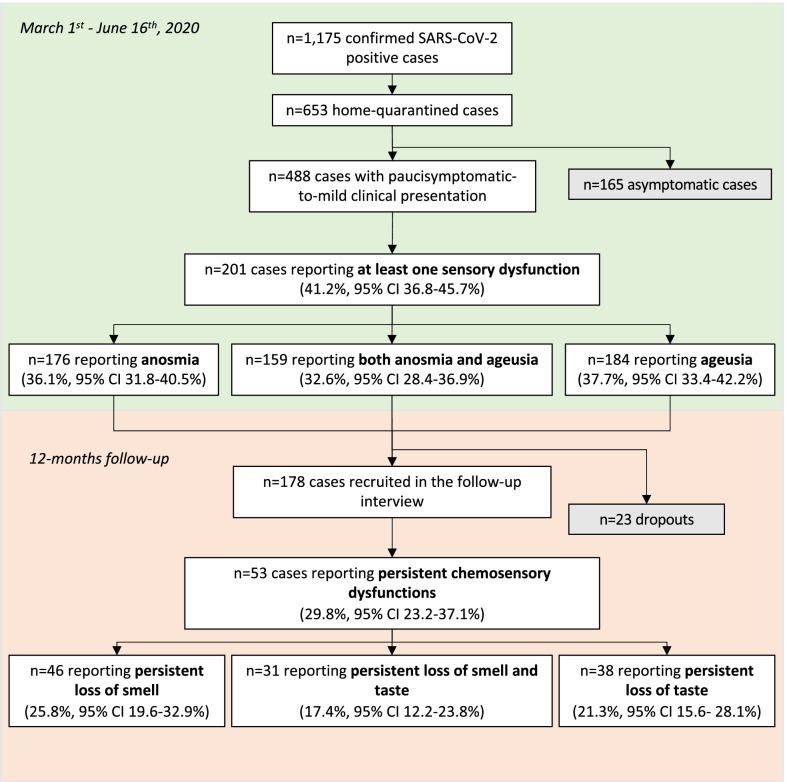
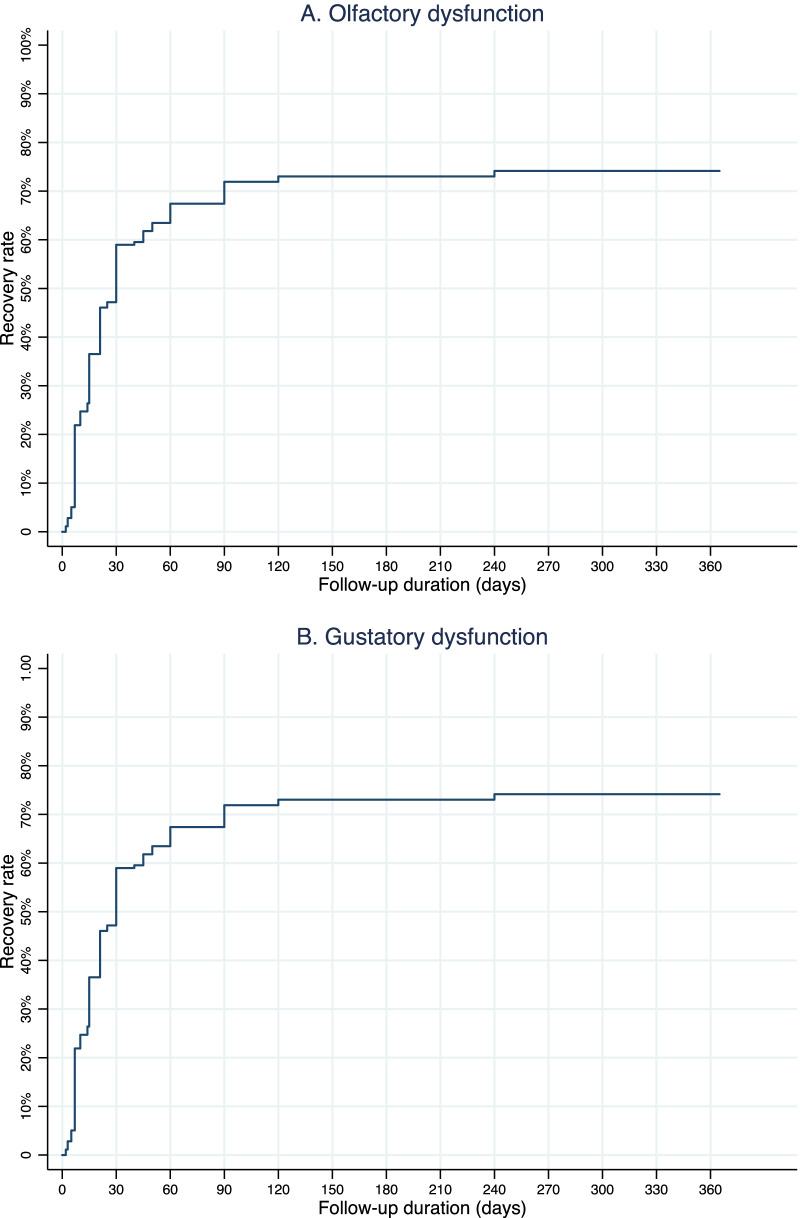
Among the 1,175 COVID-19 cases notified in the Foggia district during the first epidemic wave, 488 had paucisymptomatic-to-mild clinical presentation. Of these, 41.2% (n = 201, 95% confidence interval [CI] 36.8-45.7%) reported at least one sensory dysfunction. A total of 178 to 201 (88.5%) patients agreed to participate in the follow-up survey. According to the SNOT-22 results, the persistence of a sensory dysfunction was observed in the 29.8% (n = 53, 95% CI 23.2-37.1%) of them. Particularly, loss of smell persisted in 25.8% (n = 46, 95% CI 19.6-32.9%), loss of taste in 21.3% (n = 38, 95% CI 15.6-28.1%), loss of both in 17.4% (n = 31, 95% CI 12.2-23.8%) of participants in the follow-up. The rates of full recovery increased over time: from 59% at 30 days to 71.9% at 90 days for the sense of smell; from 61.3% at 30 days to 74.7% at 90 days for the sense of taste.
The persistence of COVID-19-related olfactory and gustatory dysfunctions up to 12 months after the disease onset in a noteworthy proportion (approximately 3 out of 10) of patients with paucisymptomatic-to-mild clinical presentation deserves further investigations due to its possible pathophysiological implications and impact on the quality of life.
自 2020 年初大流行的初始阶段以来,COVID-19 相关的嗅觉和味觉障碍已被广泛报道,并成为 SARS-CoV-2 感染的最常见长期后遗症之一。然而,关于嗅觉和味觉的长期恢复的数据却缺乏。本研究旨在描述 COVID-19 病例自我报告的嗅觉和味觉障碍诊断后一年的演变情况。
基于意大利普利亚地区主动监测平台的数据,我们选择了 2020 年 3 月 1 日至 6 月 16 日在福贾区被确诊为 SARS-CoV-2 阳性并伴有轻度至无症状临床症状的居民进行居家隔离。通过二项式问题的调查,在基线时记录自我报告的嗅觉和味觉障碍。通过经过验证的鼻-鼻窦结局测试 22(SNOT-22,意大利语版本),在大约一年时通过电话前瞻性评估这些症状的演变情况。
在第一次疫情浪潮中,福贾区报告了 1175 例 COVID-19 病例,其中 488 例有轻度至无症状的临床症状。在这些患者中,41.2%(n=201,95%置信区间[CI]36.8-45.7%)报告至少有一种感觉功能障碍。共有 178 至 201 名(88.5%)患者同意参加随访调查。根据 SNOT-22 的结果,29.8%(n=53,95%CI 23.2-37.1%)的患者仍存在感觉功能障碍。特别是,嗅觉丧失持续存在于 25.8%(n=46,95%CI 19.6-32.9%)的患者中,味觉丧失持续存在于 21.3%(n=38,95%CI 15.6-28.1%)的患者中,两种感觉都丧失的患者占 17.4%(n=31,95%CI 12.2-23.8%)。完全恢复的比例随着时间的推移而增加:嗅觉从 30 天的 59%增加到 90 天的 71.9%;味觉从 30 天的 61.3%增加到 90 天的 74.7%。
在伴有轻度至无症状临床症状的患者中,大约 3 至 10 例患者在疾病发作后 12 个月内仍存在 COVID-19 相关的嗅觉和味觉障碍,这一比例较高,这可能与其可能的病理生理意义和对生活质量的影响有关,值得进一步研究。