Faculty of Medicine, Military Medical Academy, University of Defense, Belgrade, Serbia.
Institute for Medical Research, Military Medical Academy, Crnotravska 17, 11002, Belgrade, Serbia.
Sci Rep. 2022 Jan 25;12(1):1296. doi: 10.1038/s41598-022-05399-1.
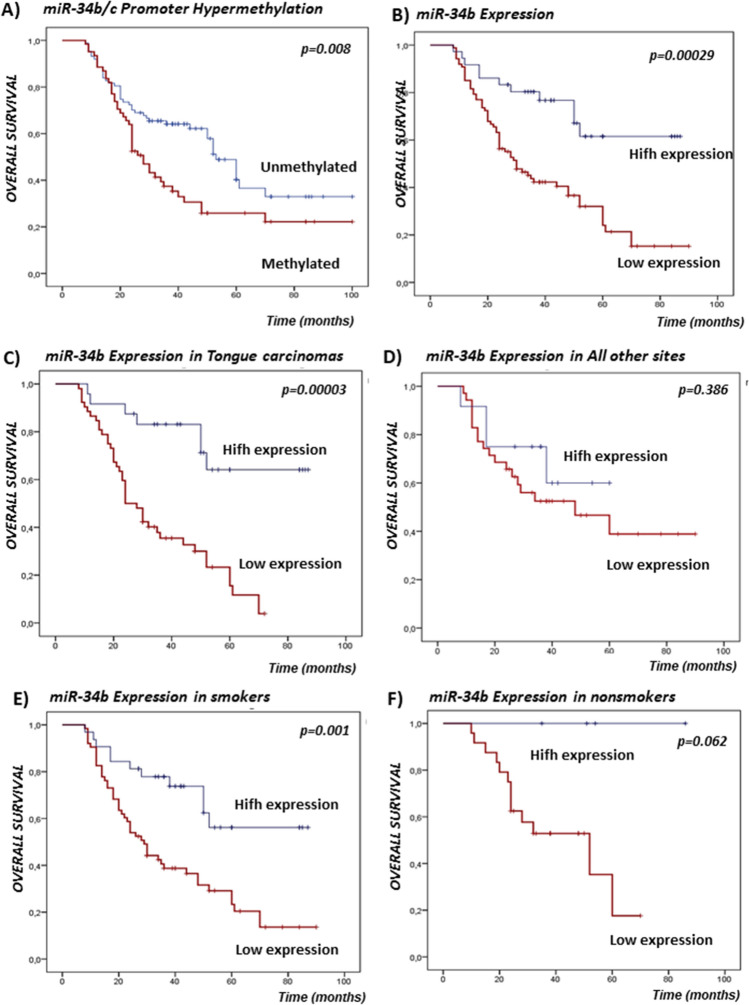
Micro RNAs (miRNAs) have a key role in gene expression regulation in cancer. The aim of the current study is to evaluate the prognostic value of miR-34b/c promoter hypermethylation, gene expression, and polymorphism in HPV-negative oral squamous cell carcinomas (OSCC). MiR-34b/c promoter hypermethylation and pre-miR-34b/c polymorphism rs4938723 were evaluated in tumor tissues of 148 patients, and miR-34b expression in 123 HPV-negative OSCC. For risk assessment, the control group was comprised of 175 healthy individuals. MiR-34b/c promoter hypermethylation was determined by methylation-specific PCR. Gene expression, genotyping and HPV screening was assessed by Q-PCR. The data from our hospital cohort indicated that miR-34b/c DNA methylation was associated with nodal status (p = 0.048), and predicted the shorter overall survival of HPV-negative OSCC patients (p = 0.008). Down-regulated miR-34b/c expression was associated with smoking (p = 0.047), alcohol use (p = 0.009), stage (p = 0.025), recurrences (p = 0.000), and a poor survival (p = 0.00029). Median values of miR-34b expression were significantly lower in advanced stages III/IV as opposed to stage I/II, p = 0.006, and in nodal positive vs negative patients (p = 0.045). TCGA data also indicated that tumors with stage I-III expressed significantly higher levels of miR-34b, compared to tumors with stage IV (p = 0.035), Low miR-34b/c expression was associated with poor survival in smokers (p = 0.001) and patients with tongue carcinomas (p = 0.00003), and TCGA analysis confirmed these findings although miR-34b expression and miR-34b/c methylation were not associated with survival outcome in the whole TCGA cohort. A significant negative miR-34b/c expression-methylation correlation was observed in our hospital cohort (p = 0.017) and in TCGA cohort. Pre-miR-34b/c polymorphism was not associated with oral cancer risk. Our findings indicate that miR-34b/c hypermethylation and low miR-34b expression could promote the progression and predict the poor prognosis for HPV-negative OSCC, which suggests miR-34b/c as a promising biomarker and therapeutic target for OSCC in the future.
微小 RNA(miRNAs)在癌症基因表达调控中具有关键作用。本研究旨在评估 miR-34b/c 启动子高甲基化、基因表达和 HPV 阴性口腔鳞状细胞癌(OSCC)中多态性的预后价值。在 148 例患者的肿瘤组织中评估了 miR-34b/c 启动子高甲基化和 pre-miR-34b/c 多态性 rs4938723,在 123 例 HPV 阴性 OSCC 中评估了 miR-34b 的表达。为了进行风险评估,对照组由 175 名健康个体组成。通过甲基化特异性 PCR 确定 miR-34b/c 启动子甲基化。通过 Q-PCR 评估基因表达、基因分型和 HPV 筛查。我们医院队列的数据表明,miR-34b/c DNA 甲基化与淋巴结状态相关(p=0.048),并预测 HPV 阴性 OSCC 患者的总生存期较短(p=0.008)。下调的 miR-34b/c 表达与吸烟(p=0.047)、饮酒(p=0.009)、分期(p=0.025)、复发(p=0.000)和不良生存相关(p=0.00029)。与 I/II 期相比,III/IV 期的 miR-34b 表达中位数显著降低,p=0.006,与淋巴结阳性患者相比,p=0.045。TCGA 数据还表明,与 IV 期相比,I-III 期肿瘤的 miR-34b 表达水平显著更高(p=0.035)。低 miR-34b/c 表达与吸烟者(p=0.001)和舌癌患者(p=0.00003)的不良生存相关,TCGA 分析证实了这一发现,尽管 miR-34b 表达和 miR-34b/c 甲基化与整个 TCGA 队列的生存结果无关。在我们的医院队列和 TCGA 队列中观察到 miR-34b/c 表达与甲基化之间存在显著的负相关(p=0.017)。Pre-miR-34b/c 多态性与口腔癌风险无关。我们的研究结果表明,miR-34b/c 高甲基化和低 miR-34b 表达可能促进进展并预测 HPV 阴性 OSCC 的不良预后,这表明 miR-34b/c 可能成为未来 OSCC 的有前途的生物标志物和治疗靶点。