Cancer Control Center, Osaka International Cancer Institute.
Tokyo University of Science, Department of Information and Computer Technology.
J Epidemiol. 2022 Apr 5;32(4):195-203. doi: 10.2188/jea.JE20210268. Epub 2022 Feb 22.
Coronavirus disease 2019 (COVID-19) has disproportionately affected the most vulnerable populations. We assessed the prevalence and disparities of economic hardships and their impact on health deterioration in Japan.
Data were obtained from a nation-wide, cross-sectional, internet-based, self-reported survey conducted during August-September, 2020 with individuals aged 15-79 years in Japan (n = 25,482). Economic hardships and changes in various physical and mental health status were measured using sample-weighted data. Adjusted prevalence ratios (APRs) were estimated to investigate the associations between economic hardships and health outcomes.
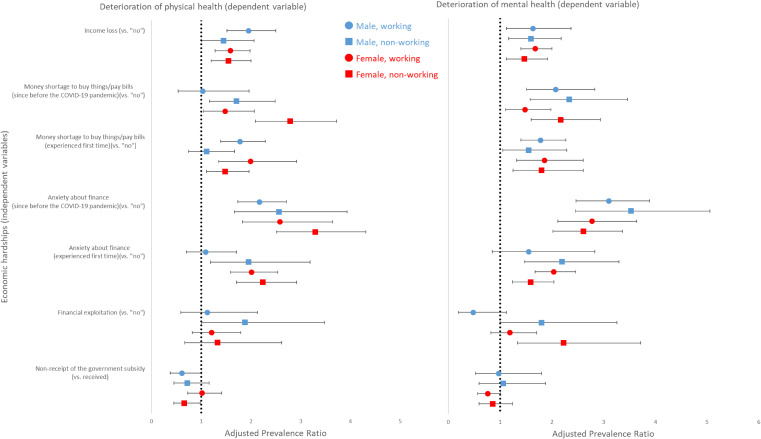
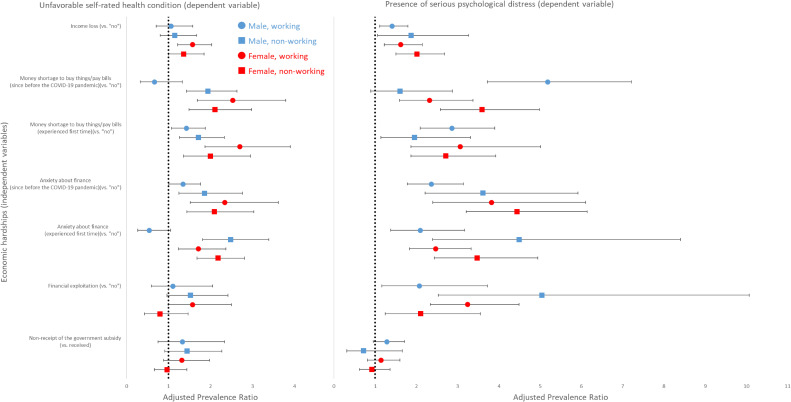
During April-September, 2020 in Japan, 25.0%, 9.6%, 7.9%, and 3.1% of the respondents experienced income loss, money shortage, financial anxiety and financial exploitation, respectively, with higher prevalence among workers (vs non-workers). Stratifying by sex and working status, income loss was associated with physical health deterioration (APRs ranged from 1.45-1.95), mental health deterioration (APRs ranged from 1.47-1.68), and having serious psychological distress (APRs ranged from 1.41-2.01) across all strata. Shortage of money and financial anxiety were also associated with increased likelihood of all adverse health outcomes assessed, regardless of whether the hardships were pre-existing or experienced first time. Among non-working individuals, financial exploitation was associated with physical health deterioration among males (APR 1.88) and mental health deterioration among both males (APR 1.80) and females (APR 2.23), while such associations were not observed among working individuals.
During the early phase of the COVID-19 epidemic, COVID-19-related economic hardships were associated with physical and mental health deterioration in Japan, particularly among the vulnerable populations. Timely and prompt responses are warranted to mitigate both economic and health burdens.
2019 年冠状病毒病(COVID-19)对弱势群体的影响不成比例。我们评估了经济困难的普遍性和差异及其对日本健康恶化的影响。
数据来自 2020 年 8 月至 9 月期间在日本进行的一项全国性、横断面、基于互联网的、自我报告调查,调查对象为年龄在 15-79 岁的个人(n=25482)。使用样本加权数据衡量经济困难和各种身心健康状况的变化。估计调整后的患病率比(APR)以调查经济困难与健康结果之间的关联。
在 2020 年 4 月至 9 月期间,日本有 25.0%、9.6%、7.9%和 3.1%的受访者分别经历了收入损失、资金短缺、财务焦虑和财务剥削,其中工人(与非工人相比)的患病率更高。按性别和工作状态分层,收入损失与身体健康恶化(APR 范围为 1.45-1.95)、心理健康恶化(APR 范围为 1.47-1.68)和严重心理困扰(APR 范围为 1.41-2.01)相关,所有这些关联在所有人群中均存在。资金短缺和财务焦虑也与评估的所有不良健康结果的可能性增加相关,无论困难是先前存在的还是首次经历的。在非工人中,财务剥削与男性的身体健康恶化(APR 1.88)和男性(APR 1.80)和女性(APR 2.23)的心理健康恶化相关,而在工人中则没有观察到这种关联。
在 COVID-19 疫情的早期阶段,与 COVID-19 相关的经济困难与日本的身心健康恶化有关,特别是在弱势群体中。需要及时采取措施减轻经济和健康负担。