Aliro T, Chenais E, Odongo W, Okello D M, Masembe C, Ståhl K
Faculty of Agriculture and Environment, Gulu University, Gulu, Uganda.
Department of Disease Control and Epidemiology, National Veterinary Institute, Uppsala, Sweden.
Front Vet Sci. 2022 Jan 13;8:707819. doi: 10.3389/fvets.2021.707819. eCollection 2021.
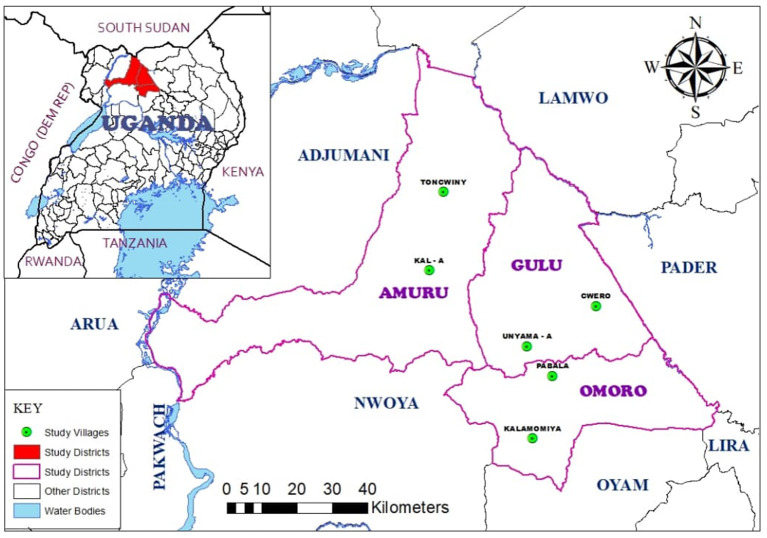
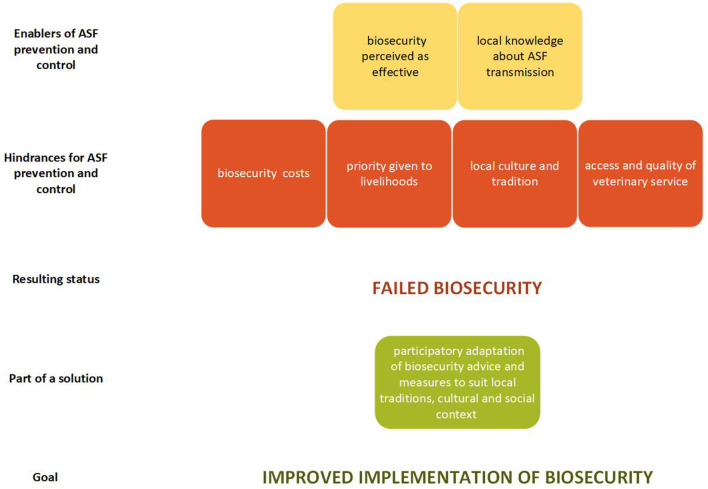
African swine fever (ASF) is endemic in Uganda and considered a major constraint to pig production. In the absence of a vaccine, biosecurity is key for ASF prevention and control. To improve prevention and control on farm and community level there is need for more knowledge on current application of biosecurity practises, and better understanding of how pig value chain actors perceive prevention and control. To achieve this, a qualitative interview study involving focus group discussions (FGD) was conducted with actors from the smallholder pig value chain in northern Uganda. Six villages were purposively selected based on previous outbreaks of ASF, preliminary perceived willingness to control ASF, and the representation of several different value chain actors in the village. Results indicated that biosecurity practises such as basic hygiene routines including safe carcass handling, minimising direct and indirect contacts between pigs or between pigs and people, trade restrictions and sharing of disease information were implemented in some of the villages. Thematic analysis based on grounded theory revealed six categories of data relating to ASF prevention and control. Together these categories form a logical framework including both enablers and hindrances for ASF prevention and control. In summary participants mostly had . Participants further possessed of ASF and its transmission, some of which was in line with known scientific knowledge and some not. Nevertheless, participants were hindered from preventing and controlling ASF due to and a need to over disease transmission risks, incompatibility of current biosecurity practises with and finally lack of . The constraints could be addressed by applying participatory processes in designing biosecurity measures to ensure better adaptation to local cultural and social contexts.
非洲猪瘟(ASF)在乌干达呈地方流行性,被视为养猪业的主要制约因素。在没有疫苗的情况下,生物安全是预防和控制非洲猪瘟的关键。为了加强农场和社区层面的预防和控制工作,需要更多地了解生物安全措施的当前应用情况,并更好地理解生猪价值链参与者对预防和控制的看法。为此,对乌干达北部小农户生猪价值链中的参与者进行了一项定性访谈研究,其中包括焦点小组讨论(FGD)。根据以往的非洲猪瘟疫情、初步感知的防控意愿以及村庄中不同价值链参与者的代表性,有目的地选择了六个村庄。结果表明,一些村庄实施了生物安全措施,如基本卫生程序,包括安全处理 carcass、尽量减少猪之间或猪与人之间的直接和间接接触、贸易限制以及疾病信息共享。基于扎根理论的主题分析揭示了与非洲猪瘟预防和控制相关的六类数据。这些类别共同构成了一个逻辑框架,包括非洲猪瘟预防和控制的促进因素和阻碍因素。总之,参与者大多有……参与者还对非洲猪瘟及其传播有……,其中一些与已知的科学知识相符,一些则不符。然而,由于……以及需要……疾病传播风险、当前生物安全措施与……不兼容,以及最终缺乏……,参与者在预防和控制非洲猪瘟方面受到阻碍。通过在设计生物安全措施时应用参与式方法,可以解决这些制约因素,以确保更好地适应当地文化和社会背景。 (注:原文中carcass未翻译完整,以及部分表述不完整,翻译可能存在一定局限性)