Fonseca Mariana, Heider Luke C, Léger David, Mcclure J Trenton, Rizzo Daniella, Dufour Simon, Kelton David F, Renaud David, Barkema Herman W, Sanchez Javier
Health Management Department, University of Prince Edward Island, Charlottetown, PE, Canada.
Public Health Agency of Canada, Center for Foodborne, Environmental and Zoonotic Infectious Diseases, Guelph, ON, Canada.
Front Vet Sci. 2022 Jan 12;8:799622. doi: 10.3389/fvets.2021.799622. eCollection 2021.
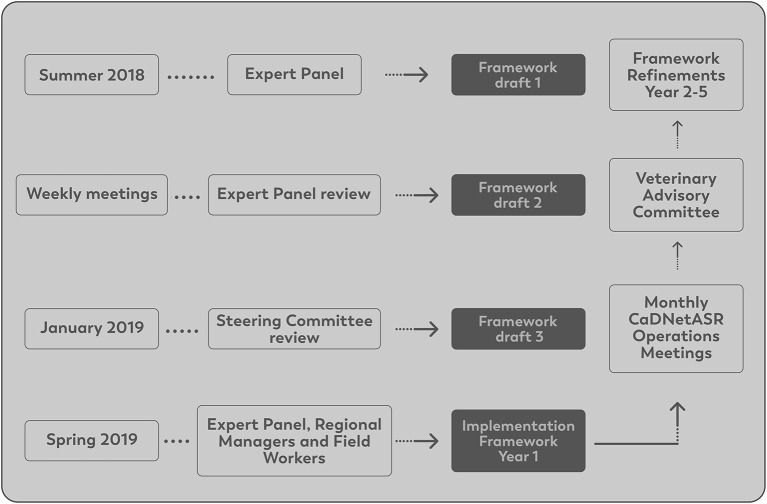
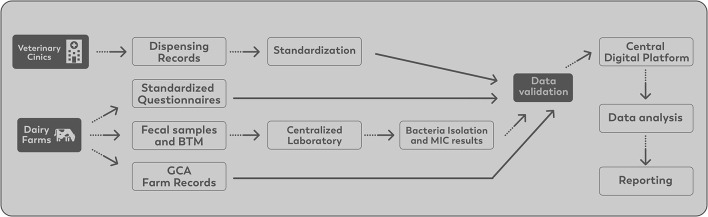
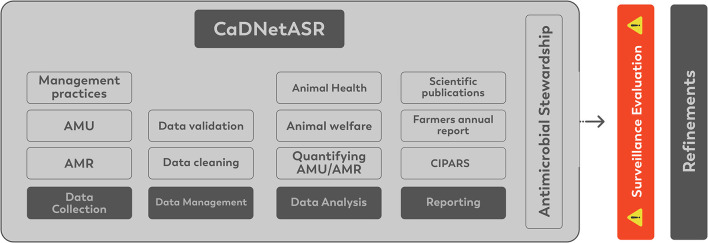
Canada has implemented on-farm antimicrobial resistance (AMR) surveillance systems for food-producing animals under the Canadian Integrated Program for Antimicrobial Resistance (CIPARS); however, dairy cattle have not been included in that program yet. The objective of this manuscript was to describe the development and implementation of the Canadian Dairy Network for Antimicrobial Stewardship and Resistance (CaDNetASR). An Expert Panel (EP) of researchers was created to lead the development of the dairy surveillance system. The EP initiated a draft document outlining the essential elements of the surveillance framework. This document was then circulated to a Steering Committee (SC), which provided recommendations used by the EP to finalize the framework. CaDNetASR has the following components: (1) a herd-level antimicrobial use quantification system; (2) annually administered risk factor questionnaires; and (3) methods for herd-level detection of AMR in three sentinel enteric pathogens (generic spp., and spp.) recovered from pooled fecal samples collected from calves, heifers, cows, and the manure pit. A total of 144 dairy farms were recruited in five Canadian provinces (British-Columbia, Alberta, Ontario, Québec, and Nova-Scotia), with the help of local herd veterinarians and regional field workers, and in September 2019, the surveillance system was launched. 97.1 and 94.4% of samples were positive for , 63.8, and 49.1% of samples were positive for spp., and 5.0 and 7.7% of samples were positive for spp., in 2019 and 2020, respectively. was equally distributed among all sample types. However, it was more likely that spp. were recovered from heifer and cow samples. On the other hand, it was more common to isolate spp. from the manure pit compared to samples from calves, heifers, or cows. CaDNetASR will continue sampling until 2022 after which time this system will be integrated into CIPARS. CaDNetASR will provide online access to farmers and veterinarians interested in visualizing benchmarking metrics regarding AMU practices and their relationship to AMR and animal health in dairy herds. This will provide an opportunity to enhance antimicrobial stewardship practices on dairy farms in Canada.
加拿大已根据加拿大抗菌药物耐药性综合计划(CIPARS),针对食用动物实施了农场层面的抗菌药物耐药性(AMR)监测系统;然而,奶牛尚未被纳入该计划。本论文的目的是描述加拿大奶牛抗菌药物管理与耐药性网络(CaDNetASR)的开发与实施情况。成立了一个由研究人员组成的专家小组(EP)来领导奶牛监测系统的开发。该专家小组起草了一份概述监测框架基本要素的文件。然后将这份文件分发给指导委员会(SC),指导委员会提供的建议被专家小组用于最终确定该框架。CaDNetASR有以下几个组成部分:(1)一个牛群层面的抗菌药物使用量化系统;(2)每年发放的风险因素调查问卷;(3)用于在从犊牛、小母牛、母牛和粪池采集的混合粪便样本中检测三种哨兵肠道病原体(通用 spp.和 spp.)中AMR的牛群层面方法。在加拿大五个省份(不列颠哥伦比亚省、艾伯塔省、安大略省、魁北克省和新斯科舍省),借助当地牛群兽医和地区现场工作人员的帮助,共招募了144个奶牛场,并于2019年9月启动了监测系统。在2019年和2020年,分别有97.1%和94.4%的样本对 呈阳性,63.8%和49.1%的样本对 spp.呈阳性,5.0%和7.7%的样本对 spp.呈阳性。 在所有样本类型中分布均匀。然而, spp.更有可能从小母牛和母牛样本中检出。另一方面,与犊牛、小母牛或母牛的样本相比,从粪池样本中分离出 spp.更为常见。CaDNetASR将持续采样至2022年,之后该系统将被纳入CIPARS。CaDNetASR将为有兴趣查看奶牛场抗菌药物使用(AMU)实践及其与AMR和动物健康关系的基准指标的农民和兽医提供在线访问。这将为加强加拿大奶牛场的抗菌药物管理实践提供机会。