Department of Microbiology and Immunology, Geisel School of Medicine at Dartmouth, Hanover, New Hampshire, USA.
Louvain Institute of Biomolecular Science and Technology, Université Catholique de Louvain, Louvain-la-Neuve, Belgium.
mBio. 2021 Feb 22;13(1):e0375421. doi: 10.1128/mbio.03754-21. Epub 2022 Feb 1.
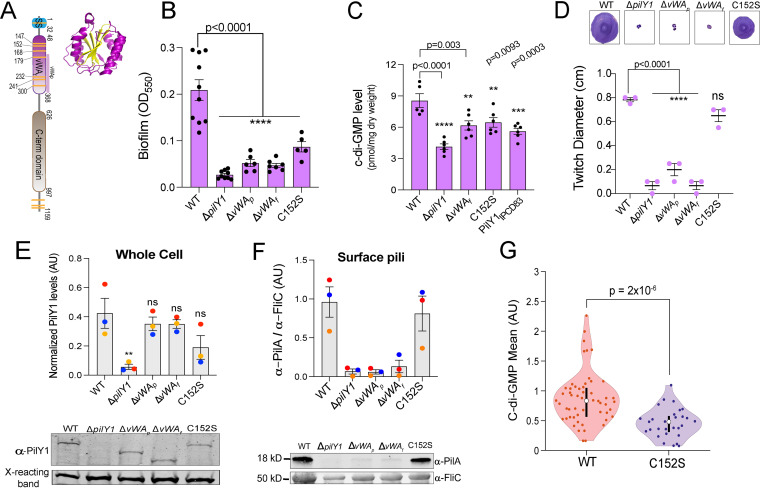
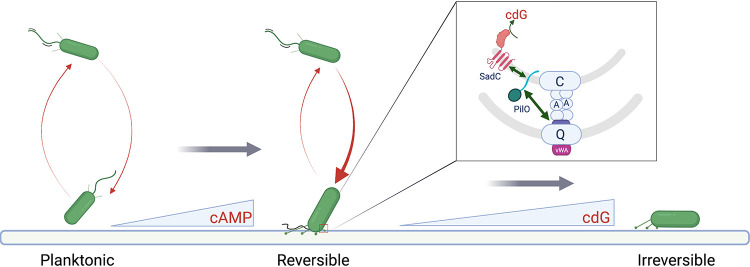
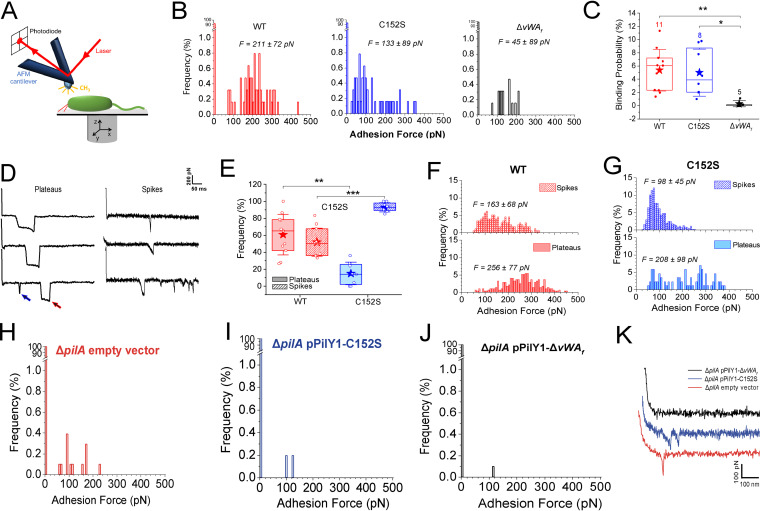
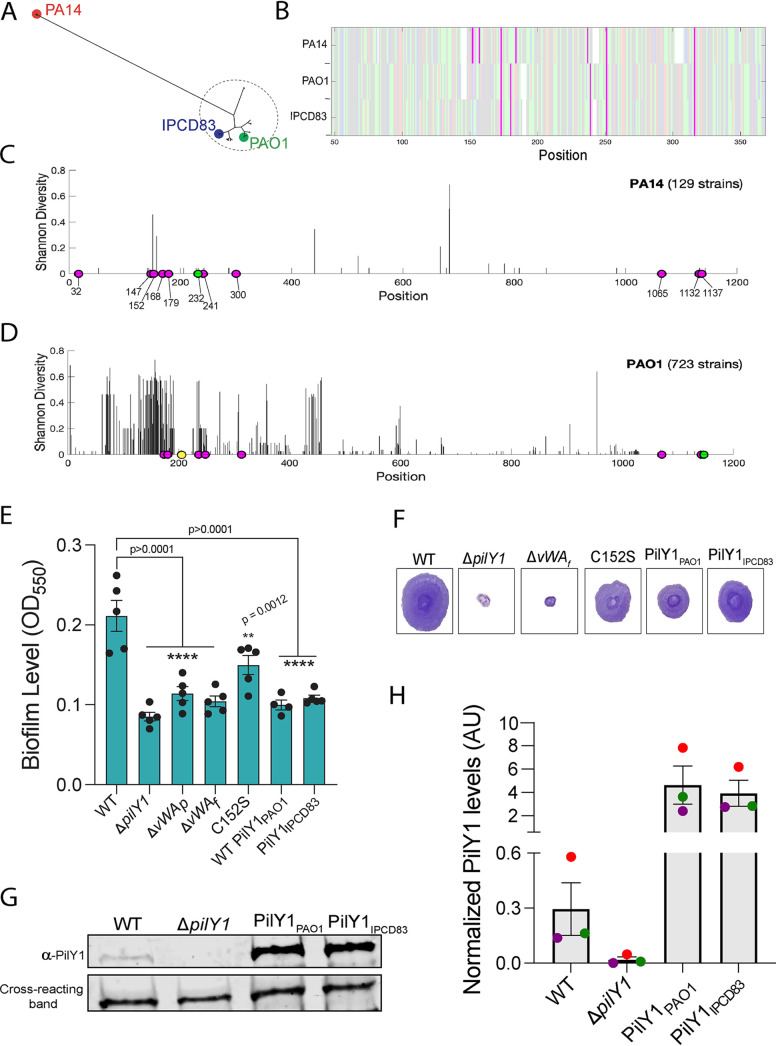
During biofilm formation, the opportunistic pathogen Pseudomonas aeruginosa uses its type IV pili (TFP) to sense a surface, eliciting increased second-messenger production and regulating target pathways required to adapt to a surface lifestyle. The mechanisms whereby TFP detect surface contact are still poorly understood, although mechanosensing is often invoked, with few data supporting this claim. Using a combination of molecular genetics and single-cell analysis, with biophysical, biochemical, and genomics techniques, we show that force-induced changes mediated by the von Willebrand A (vWA) domain-containing, TFP tip-associated protein PilY1 are required for surface sensing. Atomic force microscopy shows that TFP/PilY1 can undergo force-induced, sustained conformational changes akin to those observed for mechanosensitive proteins like titin. We show that mutation of a single cysteine residue in the vWA domain of PilY1 results in modestly lower surface adhesion forces, reduced sustained conformational changes, and increased nanospring-like properties, as well as reduced c-di-GMP signaling and biofilm formation. Mutating this cysteine has allowed us to genetically separate a role for TFP in twitching motility from surface-sensing signaling. The conservation of this Cys residue in all P. aeruginosa PA14 strains and its absence in the ∼720 sequenced strains of P. aeruginosa PAO1 may contribute to explaining the observed differences in surface colonization strategies observed for PA14 versus PAO1. Most bacteria live on abiotic and biotic surfaces in surface-attached communities known as biofilms. Surface sensing and increased levels of the second-messenger molecule c-di-GMP are crucial to the transition from planktonic to biofilm growth. The mechanism(s) underlying TFP-mediated surface detection that triggers this c-di-GMP signaling cascade is unclear. Here, we provide key insight into this question; we show that the eukaryote-like vWA domain of the TFP tip-associated protein PilY1 responds to mechanical force, which in turn drives the production of a key second messenger needed to regulate surface behaviors. Our studies highlight a potential mechanism that may account for differing surface colonization strategies.
在生物膜形成过程中,机会性病原体铜绿假单胞菌利用其四型菌毛(TFP)感知表面,引发第二信使产生增加,并调节适应表面生活方式所需的靶途径。TFP 检测表面接触的机制仍知之甚少,尽管经常援引机械感觉,但很少有数据支持这一说法。我们使用分子遗传学和单细胞分析以及生物物理、生物化学和基因组学技术,表明由富含血管性血友病 A (vWA)结构域的 TFP 尖端相关蛋白 PilY1 介导的力诱导变化是表面感应所必需的。原子力显微镜显示,TFP/PilY1 可以经历力诱导的、持续的构象变化,类似于机械敏感蛋白如肌联蛋白观察到的变化。我们表明,PilY1 vWA 结构域中单个半胱氨酸残基的突变导致表面粘附力略有降低,持续构象变化减少,纳米弹簧样特性增加,以及 c-di-GMP 信号转导和生物膜形成减少。突变这个半胱氨酸使我们能够从 twitching 运动到表面感应信号遗传上分离 TFP 的作用。该 Cys 残基在所有铜绿假单胞菌 PA14 菌株中的保守性及其在约 720 个测序的铜绿假单胞菌 PAO1 菌株中的缺失可能有助于解释观察到的 PA14 与 PAO1 之间表面定植策略的差异。大多数细菌生活在称为生物膜的表面附着群落中的非生物和生物表面上。表面感应和第二信使分子 c-di-GMP 水平的增加对于从浮游生物到生物膜生长的转变至关重要。TFP 介导的表面检测引发这种 c-di-GMP 信号级联的机制尚不清楚。在这里,我们提供了对此问题的关键见解;我们表明,TFP 尖端相关蛋白 PilY1 的真核样 vWA 结构域对机械力作出反应,这反过来又驱动了调节表面行为所需的关键第二信使的产生。我们的研究强调了一种可能的机制,该机制可能解释了不同的表面定植策略。