Clinical Neuroimmunology Unit, Institute of Experimental Neurology, Division of Neuroscience, IRCCS Ospedale San Raffaele, Milan, Italy.
Neuroimmunology Unit, Institute of Experimental Neurology, Division of Neuroscience, IRCCS Ospedale San Raffaele, Milan, Italy.
J Extracell Vesicles. 2022 Feb;11(2):e12162. doi: 10.1002/jev2.12162.
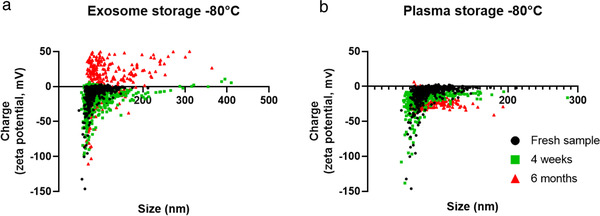
Mounting evidence suggests that storage has an impact on extracellular vesicles (EVs) properties. While -80°C storage is a widespread approach, some authors proposed improved storage strategies with conflicting results. Here, we designed a systematic study to assess the impact of -80°C storage and freeze-thaw cycles on EVs. We tested the differences among eight storage strategies and investigated the possible fusion phenomena occurring during storage. EVs were collected from human plasma and murine microglia culture by size exclusion chromatography and ultracentrifugation, respectively. The analysis included: concentration, size and zeta potential (tunable resistive pulse sensing), contaminant protein assessment; flow cytometry for the analysis of two single fluorescent-tagged EVs populations (GFP and mCherry), mixed before preservation. We found that -80°C storage reduces EVs concentration and sample purity in a time-dependent manner. Furthermore, it increases the particle size and size variability and modifies EVs zeta potential, with a shift of EVs in size-charge plots. None of the tested conditions prevented the observed effects. Freeze-thaw cycles lead to an EVs reduction after the first cycle and to a cycle-dependent increase in particle size. With flow cytometry, after storage, we observed a significant population of double-positive EVs (GFP -mCherry ). This observation may suggest the occurrence of fusion phenomena during storage. Our findings show a significant impact of storage on EVs samples in terms of particle loss, purity reduction and fusion phenomena leading to artefactual particles. Depending on downstream analyses and experimental settings, EVs should probably be processed from fresh, non-archival, samples in majority of cases.
越来越多的证据表明,储存方式会对细胞外囊泡(EVs)的性质产生影响。虽然-80°C 储存是一种广泛应用的方法,但一些作者提出了改进的储存策略,结果却存在冲突。在这里,我们设计了一项系统研究来评估-80°C 储存和冻融循环对 EVs 的影响。我们测试了八种储存策略之间的差异,并研究了储存过程中可能发生的融合现象。EVs 通过大小排阻色谱法和超速离心法分别从人血浆和鼠小胶质细胞培养物中收集。分析包括:浓度、大小和zeta 电位(可调电阻脉冲感应)、污染物蛋白评估;流式细胞术用于分析两种荧光标记的 EVs 群体(GFP 和 mCherry),在保存前混合。我们发现,-80°C 储存会以时间依赖的方式降低 EVs 的浓度和样品纯度。此外,它会增加颗粒大小和大小变异性,并改变 EVs 的 zeta 电位,使 EVs 在大小电荷图中发生位移。没有一种测试条件可以防止观察到的效果。冻融循环会导致第一周期后 EVs 减少,并导致颗粒大小随周期增加。通过流式细胞术,储存后,我们观察到双阳性 EVs(GFP-mCherry)的显著群体。这种观察可能表明在储存过程中发生了融合现象。我们的研究结果表明,储存对 EVs 样品在颗粒损失、纯度降低和融合现象导致人工颗粒方面有显著影响。根据下游分析和实验设置,在大多数情况下,EVs 可能需要从新鲜的、非存档的样本中处理。