Department of Epidemiology, UCLA Fielding School of Public Health, Los Angeles, California, USA.
Department of Neurology, University of California, Davis, Sacramento, California, USA.
Alzheimers Dement. 2022 Nov;18(11):2209-2217. doi: 10.1002/alz.12522. Epub 2022 Feb 1.
Most dementia studies are not population-representative; statistical tools can be applied to samples to obtain critically-needed population-representative estimates, but are not yet widely used.
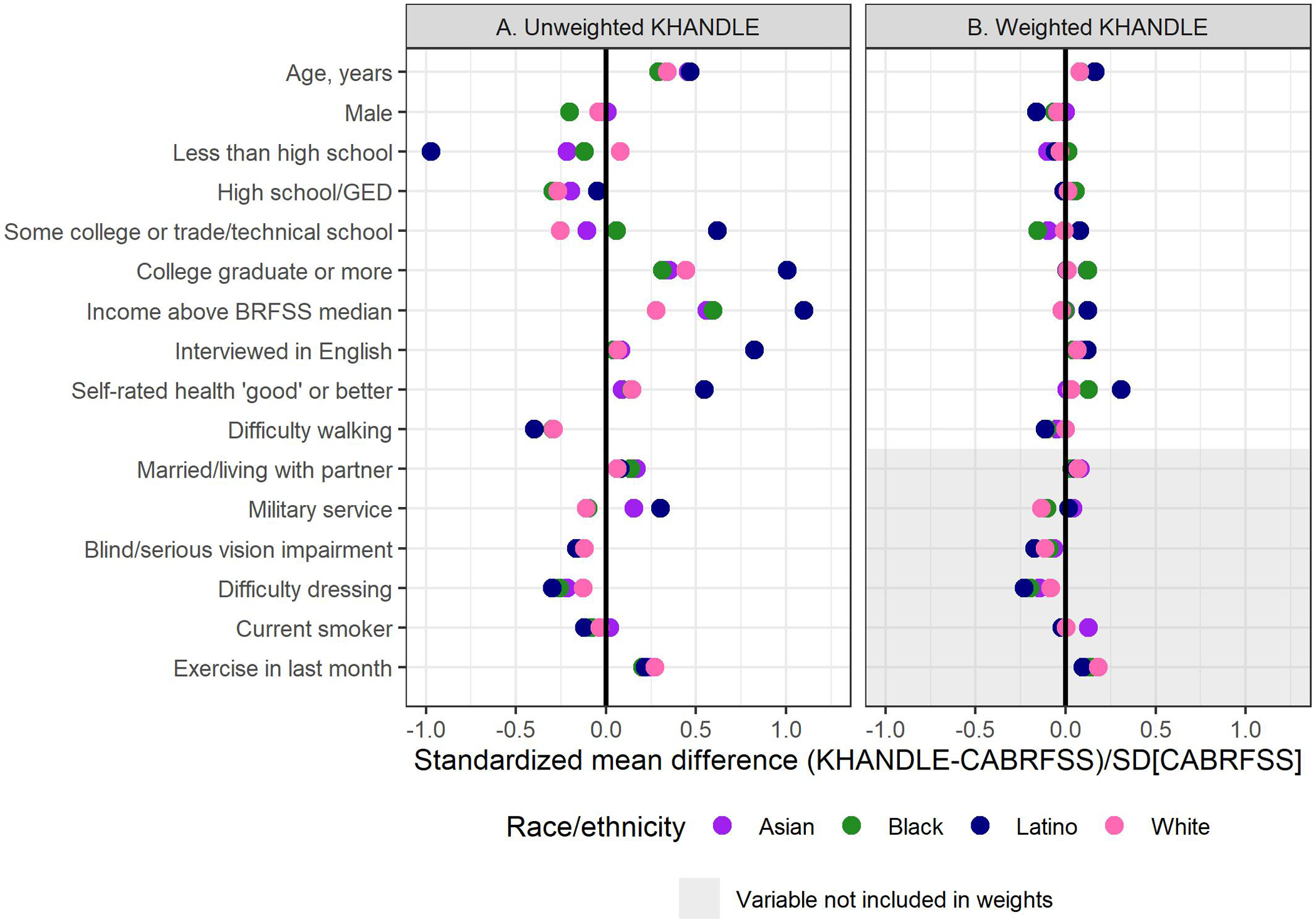
We pooled data from the Kaiser Healthy Aging and Diverse Life Experiences (KHANDLE) study and the California Behavioral Risk Factor Surveillance System (CA-BRFSS), a population-representative study. Using weights accounting for sociodemographic/health differences between KHANDLE and CA-BRFSS, we estimated cognitive impairment prevalence and age- and sex-adjusted racial/ethnic inequalities in California adults 65+ without prior dementia diagnosis.
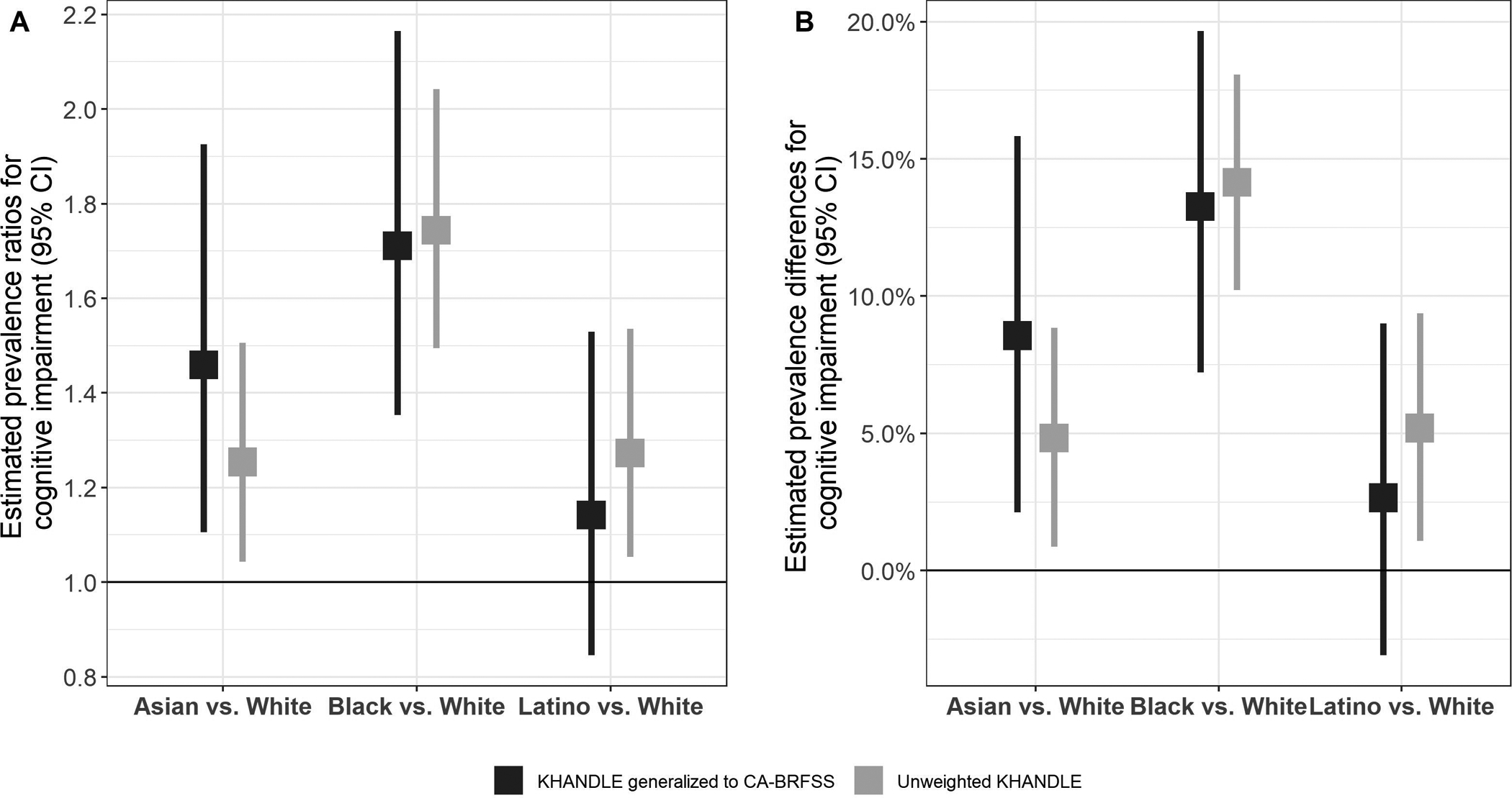
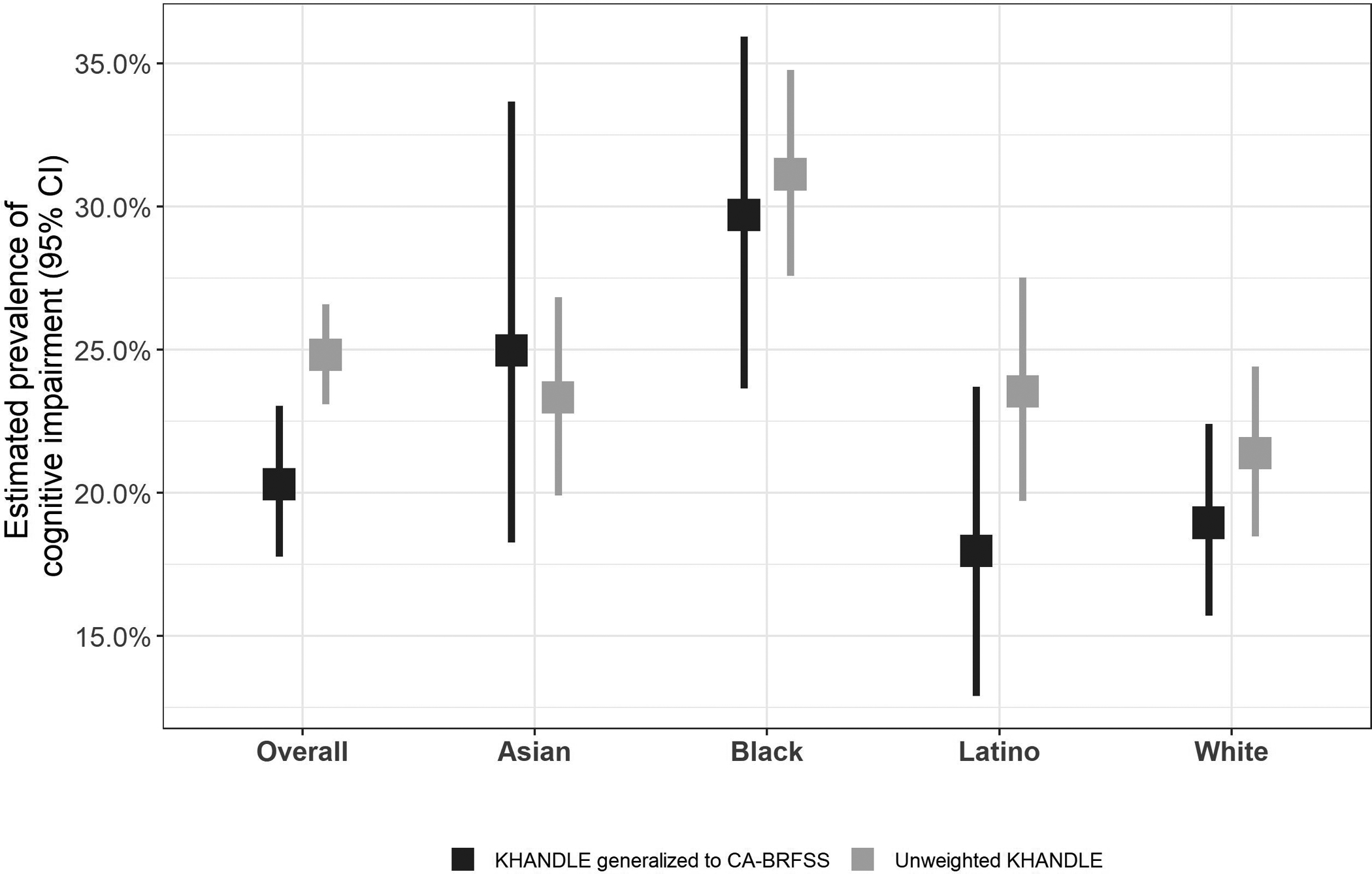
After weighting KHANDLE, the estimated cognitive impairment prevalence in California was 20.3% (95% confidence interval 17.8-23.0); unweighted prevalence was 24.8% (23.1%-26.6%). Inequalities (larger prevalences) were observed among Black and Asian groups versus whites.
We used a novel statistical approach to estimate population-representative cognitive impairment prevalence and inequalities. Such statistical tools can help obtain population-representative estimates from existing studies and inform efforts to reduce racial/ethnic disparities.
大多数痴呆症研究都不具有代表性;可以应用统计工具对样本进行分析,以获得急需的代表性人口估计值,但尚未得到广泛应用。
我们汇集了 Kaiser Healthy Aging and Diverse Life Experiences(KHANDLE)研究和具有代表性的加利福尼亚行为风险因素监测系统(CA-BRFSS)的数据。使用考虑到 KHANDLE 和 CA-BRFSS 之间社会人口统计学/健康差异的权重,我们估计了加利福尼亚州 65 岁及以上没有先前痴呆症诊断的成年人的认知障碍患病率以及年龄和性别调整的种族/族裔不平等。
在加权 KHANDLE 后,加利福尼亚州认知障碍的估计患病率为 20.3%(95%置信区间 17.8-23.0);未加权的患病率为 24.8%(23.1%-26.6%)。在黑人组和亚洲组与白人相比,观察到不平等(更高的患病率)。
我们使用了一种新颖的统计方法来估计具有代表性的人口认知障碍患病率和不平等。这种统计工具可以帮助从现有研究中获得具有代表性的估计值,并为减少种族/族裔差异的努力提供信息。