Ma Yue, Mora Pinzon Maria C, Buckingham William R, Bersch Andrew J, Powell W Ryan, LeCaire Tamara J, Ennis Gilda E, Deming Yuetiva, Jonaitis Erin M, Chin Nathaniel A, Clark Lindsay R, Edwards Dorothy F, Walaszek Art, Okonkwo Ozioma C, Zuelsdorff Megan, Chappell Richard J, Johnson Sterling C, Asthana Sanjay, Gleason Carey E, Kind Amy J, Bendlin Barbara B, Carlsson Cynthia M
Department of Medicine Division of Geriatrics and Gerontology University of Wisconsin School of Medicine and Public Health Madison Wisconsin USA.
Wisconsin Alzheimer's Disease Research Center University of Wisconsin School of Medicine and Public Health Madison Wisconsin USA.
Alzheimers Dement (N Y). 2025 Jan 16;11(1):e70036. doi: 10.1002/trc2.70036. eCollection 2025 Jan-Mar.
Understanding how a research sample compares to the population from which it is drawn can help inform future recruitment planning. We compared the Wisconsin Alzheimer's Disease Research Center (WADRC) participant sample to the Wisconsin state population (WI-pop) on key demographic, social exposome, and vascular risk measures.
The WADRC sample included 930 participants. Population statistics were estimated using several national and state data sources. We compared WADRC to WI-pop for two age groups, 45-64 years and ≥65 years, separately.
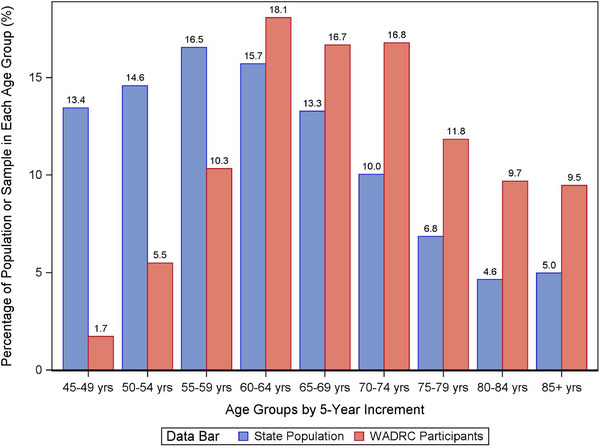
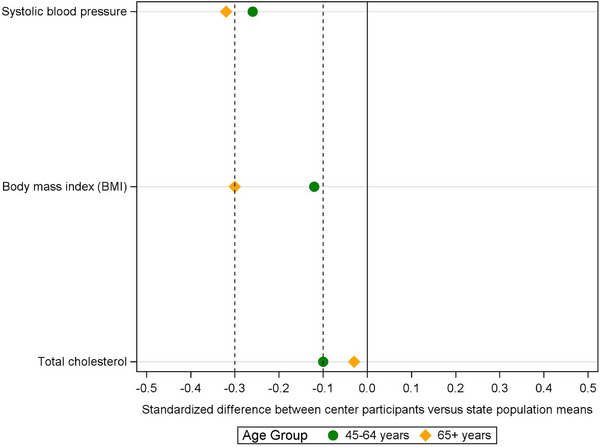
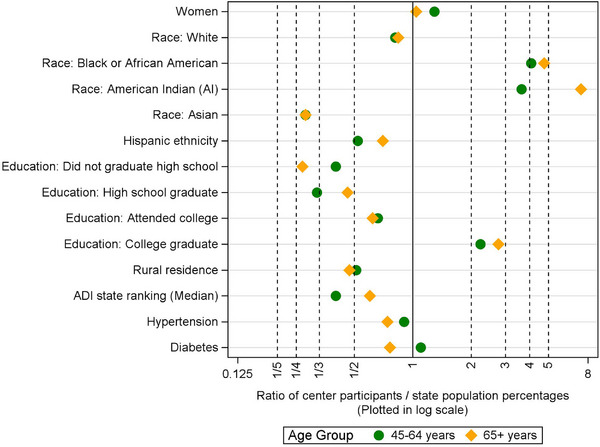
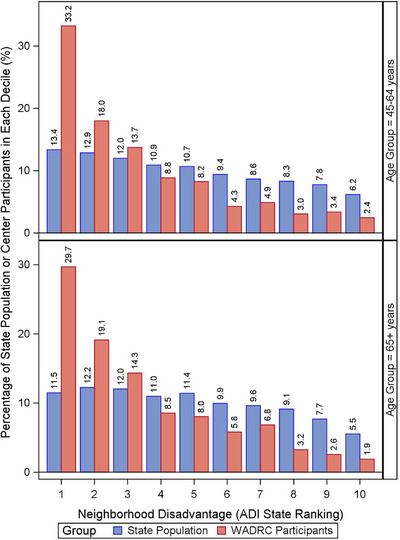
Compared to WI-pop, WADRC participants were older and included more women, more Black and American Indian individuals, and fewer Hispanic and Asian individuals. WADRC participants had higher levels of educational attainment, consisted of smaller proportions living in rural areas and disadvantaged neighborhoods, and showed lower vascular risks. Greater differences between WADRC and WI-pop were found for most metrics in the ≥65 group compared to the 45-64 group.
The findings revealed opportunities to increase enrollment from the Hispanic/Latino and Asian American populations, to include participants from a broader range of educational backgrounds, and to enroll more residents from rural areas and disadvantaged neighborhoods, which may lead to a broader distribution of cardiovascular risk factors. Expanding sociodemographic and health profiles represented in the participant candidate pool for study selection and including those who are underrepresented in research may potentially reduce selection bias but not eliminate it. Statistical approaches can be applied to address bias and generalize findings from a study sample to its target population by adjusting for their differences in the joint distribution of covariates. Although research centers have different regional populations and specific recruitment focuses for scientific reasons, evaluating their participant characteristics may help plan engagement efforts to improve the inclusion of underrepresented groups and collaboratively support generalizable research nationwide.
We compared the characteristics of Wisconsin Alzheimer's Disease Research Center (WADRC) participants with the Wisconsin population.Metrics of comparison included demographics, social exposomes, and vascular risks.WADRC participants are different from the Wisconsin population.We explored the implications and causes of the differences.We discussed strategies for engaging and recruiting underrepresented groups.
了解研究样本与从中抽取样本的总体之间的比较情况,有助于为未来的招募计划提供参考。我们在关键人口统计学、社会暴露组和血管风险指标方面,将威斯康星州阿尔茨海默病研究中心(WADRC)的参与者样本与威斯康星州总体人口(WI-pop)进行了比较。
WADRC样本包括930名参与者。使用多个国家和州数据源估计总体统计数据。我们分别针对45 - 64岁和≥65岁这两个年龄组,将WADRC与WI-pop进行了比较。
与WI-pop相比,WADRC的参与者年龄更大,女性更多,黑人及美洲印第安人更多,西班牙裔和亚裔更少。WADRC的参与者受教育程度更高,居住在农村地区和弱势社区的比例更小,血管风险更低。与45 - 64岁组相比,≥65岁组中WADRC与WI-pop在大多数指标上的差异更大。
研究结果揭示了增加西班牙裔/拉丁裔和亚裔美国人群体参与度的机会,纳入更广泛教育背景的参与者,以及招募更多农村地区和弱势社区居民的机会,这可能导致心血管危险因素分布更广泛。在研究选择的候选参与者池中扩大社会人口统计学和健康状况的代表性,并纳入在研究中代表性不足的人群,可能会减少但无法消除选择偏倚。可以应用统计方法来解决偏倚问题,并通过调整协变量联合分布中的差异,将研究样本的结果推广到目标总体。尽管研究中心因科学原因有不同的地区总体人群和特定招募重点,但评估其参与者特征可能有助于规划参与工作,以改善代表性不足群体的纳入情况,并在全国范围内协同支持可推广的研究。
我们比较了威斯康星州阿尔茨海默病研究中心(WADRC)参与者与威斯康星州总体人群的特征。比较指标包括人口统计学、社会暴露组和血管风险。WADRC参与者与威斯康星州总体人群不同。我们探讨了差异的影响和原因。我们讨论了吸引和招募代表性不足群体的策略。