Department of Translational Research in Psychiatry, Max Planck Institute of Psychiatry, Munich, Germany.
International Max Planck Research School for Translational Psychiatry (IMPRS-TP), Munich, Germany.
Transl Psychiatry. 2022 Feb 1;12(1):46. doi: 10.1038/s41398-022-01802-7.
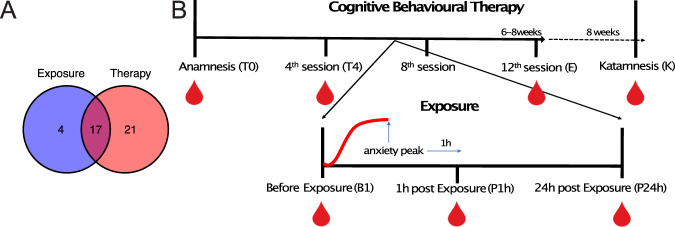
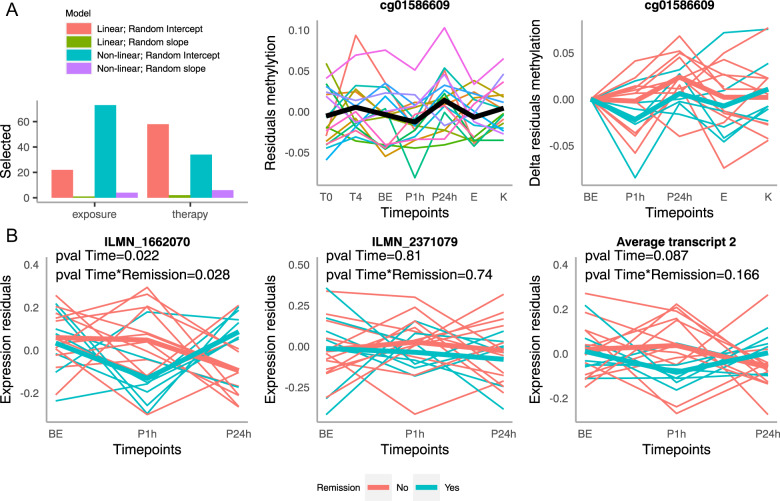
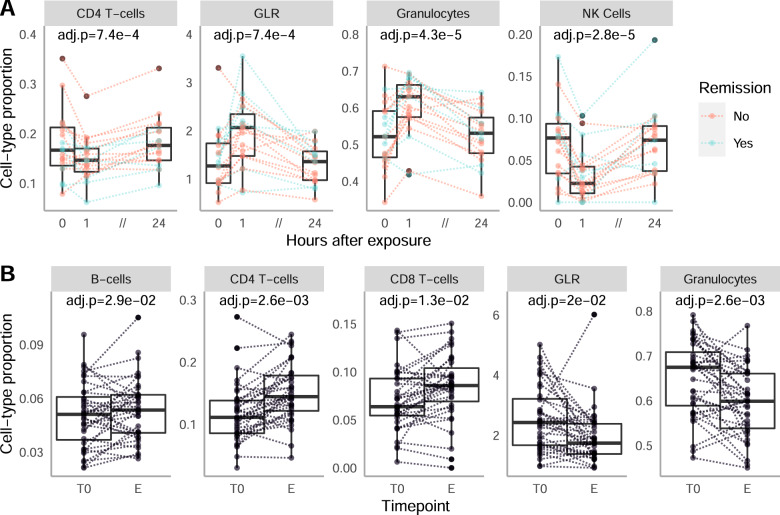
Interaction of genetic predispositions and environmental factors via epigenetic mechanisms have been hypothesized to play a central role in Panic Disorder (PD) aetiology and therapy. Cognitive Behavioral Therapy (CBT), including exposure interventions, belong to the most efficient treatments of PD although its biological mechanism of action remains unknown. For the first time, we explored the dynamics and magnitude of DNA-methylation and immune cell-type composition during CBT (n = 38) and the therapeutic exposure intervention (n = 21) to unravel their biological correlates and identify possible biomarkers of therapy success. We report transient regulation of the CD4 + T-Cells, Natural Killers cells, Granulocytes during exposure and a significant change in the proportions of CD4 + T cells, CD8 + T cells and B-Cells and Granulocytes during therapy. In an epigenome-wide association study we identified cg01586609 located in a CpG island and annotated to the serotonin receptor 3 A (HTR3A) to be differentially methylated during fear exposure and regulated at gene expression level with significant differences between remitters and non-remitters (p = 0.028). We moreover report cg01699630 annotated to ARG1 to undergo long lasting methylation changes during therapy (paired t test, genome-wide adj.p value = 0.02). This study reports the first data-driven biological candidates for epigenetically mediated effects of acute fear exposure and CBT in PD patients. Our results provide evidence of changes in the serotonin receptor 3 A methylation and expression during fear exposure associated with different long-term CBT trajectories and outcome, making it a possible candidate in the search of markers for therapy success. Finally, our results add to a growing body of evidence showing immune system changes associated with PD.
遗传易感性和环境因素通过表观遗传机制的相互作用被假设在惊恐障碍(PD)的发病机制和治疗中起核心作用。认知行为疗法(CBT),包括暴露干预,是 PD 最有效的治疗方法之一,尽管其作用的生物学机制尚不清楚。我们首次探索了 CBT(n=38)和治疗暴露干预(n=21)期间 DNA 甲基化和免疫细胞类型组成的动态变化和幅度,以揭示其生物学相关性,并确定可能的治疗成功的生物标志物。我们报告了暴露过程中 CD4+T 细胞、自然杀伤细胞、粒细胞的瞬时调节,以及治疗过程中 CD4+T 细胞、CD8+T 细胞和 B 细胞以及粒细胞比例的显著变化。在全基因组关联研究中,我们发现 cg01586609 位于 CpG 岛中,注释为血清素受体 3A(HTR3A),在恐惧暴露期间发生差异甲基化,并在表达水平上受缓解者和非缓解者之间的显著差异调节(p=0.028)。此外,我们报告 cg01699630 注释为 ARG1,在治疗过程中发生持久的甲基化变化(配对 t 检验,全基因组调整 p 值=0.02)。这项研究报告了惊恐障碍患者急性恐惧暴露和 CBT 中表观遗传介导影响的首个数据驱动的生物学候选物。我们的结果提供了证据,表明在恐惧暴露期间,血清素受体 3A 的甲基化和表达发生变化,与不同的长期 CBT 轨迹和结果相关,使其成为治疗成功标志物搜索的可能候选物。最后,我们的结果增加了越来越多的证据,表明免疫系统变化与惊恐障碍有关。