Vitrolife A/S, Aarhus, Denmark.
Harrison AI, Sydney, New South Wales, Australia.
PLoS One. 2022 Feb 2;17(2):e0262661. doi: 10.1371/journal.pone.0262661. eCollection 2022.
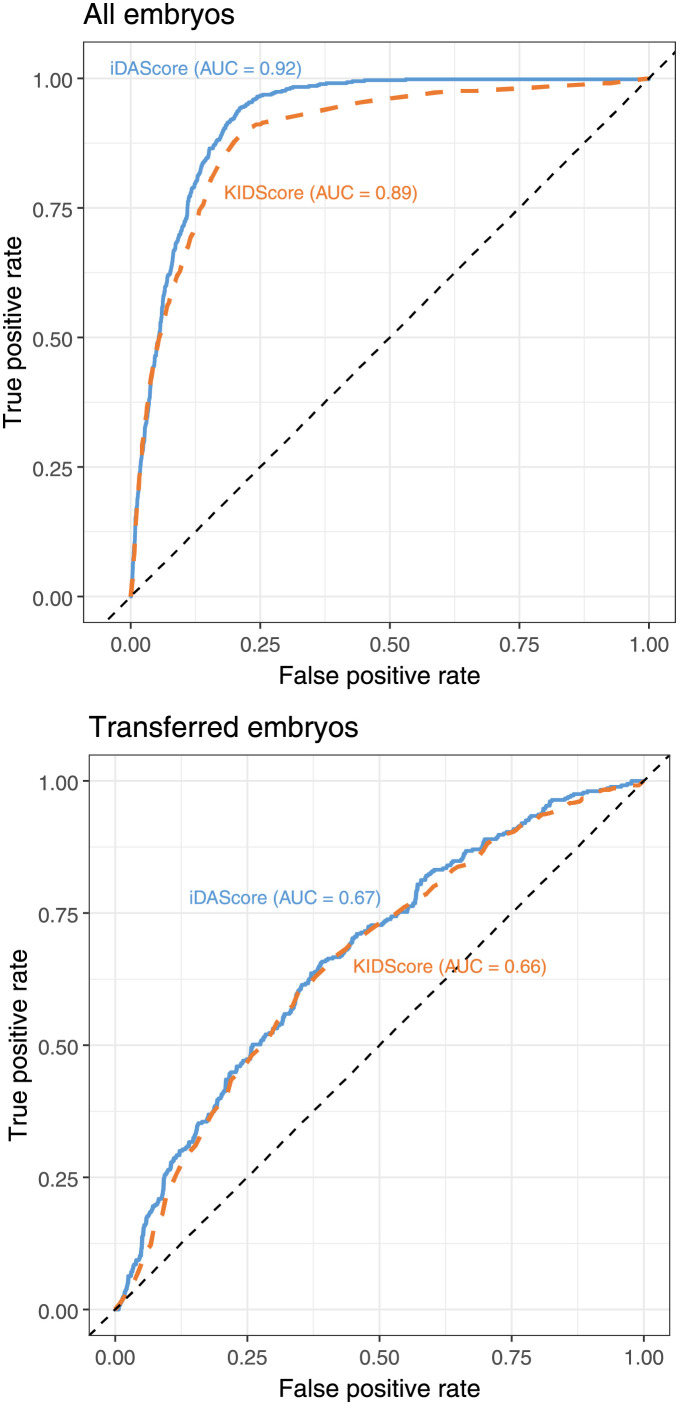
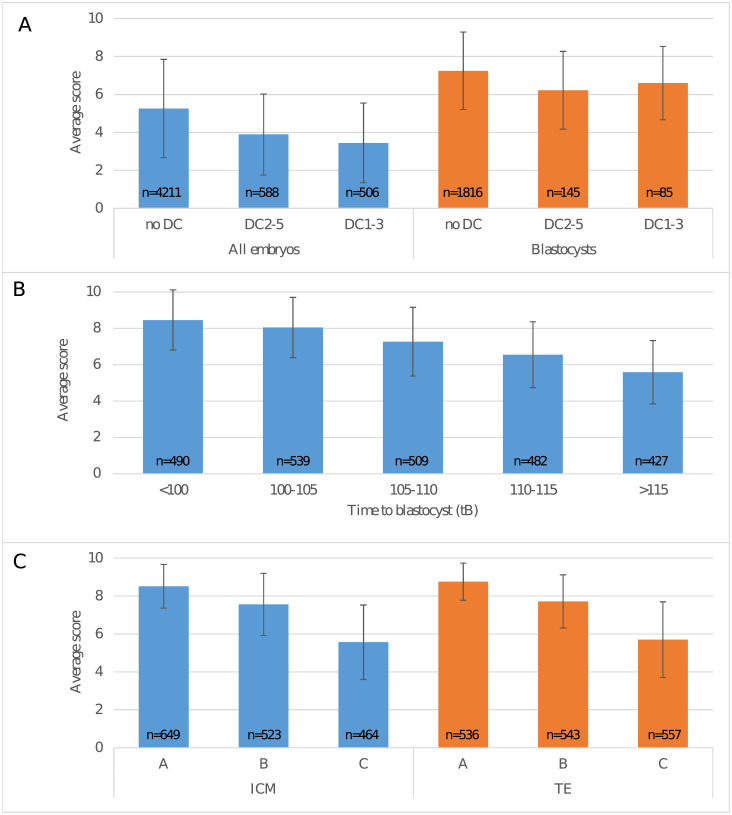
Assessing and selecting the most viable embryos for transfer is an essential part of in vitro fertilization (IVF). In recent years, several approaches have been made to improve and automate the procedure using artificial intelligence (AI) and deep learning. Based on images of embryos with known implantation data (KID), AI models have been trained to automatically score embryos related to their chance of achieving a successful implantation. However, as of now, only limited research has been conducted to evaluate how embryo selection models generalize to new clinics and how they perform in subgroup analyses across various conditions. In this paper, we investigate how a deep learning-based embryo selection model using only time-lapse image sequences performs across different patient ages and clinical conditions, and how it correlates with traditional morphokinetic parameters. The model was trained and evaluated based on a large dataset from 18 IVF centers consisting of 115,832 embryos, of which 14,644 embryos were transferred KID embryos. In an independent test set, the AI model sorted KID embryos with an area under the curve (AUC) of a receiver operating characteristic curve of 0.67 and all embryos with an AUC of 0.95. A clinic hold-out test showed that the model generalized to new clinics with an AUC range of 0.60-0.75 for KID embryos. Across different subgroups of age, insemination method, incubation time, and transfer protocol, the AUC ranged between 0.63 and 0.69. Furthermore, model predictions correlated positively with blastocyst grading and negatively with direct cleavages. The fully automated iDAScore v1.0 model was shown to perform at least as good as a state-of-the-art manual embryo selection model. Moreover, full automatization of embryo scoring implies fewer manual evaluations and eliminates biases due to inter- and intraobserver variation.
评估和选择最可行的胚胎进行移植是体外受精(IVF)的重要环节。近年来,人们利用人工智能(AI)和深度学习技术,提出了几种改进和自动化该过程的方法。基于具有已知着床数据(KID)的胚胎图像,AI 模型已经被训练出来,能够自动对胚胎进行评分,以预测其着床成功的可能性。然而,截至目前,仅有少量研究评估了胚胎选择模型如何推广到新的诊所,以及它们在不同条件下的亚组分析中的表现。在本文中,我们研究了一种仅使用延时图像序列的基于深度学习的胚胎选择模型在不同患者年龄和临床条件下的表现,以及它与传统形态动力学参数的相关性。该模型是基于来自 18 个 IVF 中心的 115832 个胚胎的大型数据集进行训练和评估的,其中 14644 个胚胎是 KID 胚胎。在一个独立的测试集中,AI 模型对 KID 胚胎的排序准确率为曲线下面积(AUC)的 0.67,对所有胚胎的排序准确率为 AUC 的 0.95。一个诊所外测试表明,该模型能够推广到新的诊所,KID 胚胎的 AUC 范围为 0.60-0.75。在不同的年龄、授精方法、培养时间和转移方案亚组中,AUC 范围在 0.63-0.69 之间。此外,模型预测与囊胚分级呈正相关,与直接分裂呈负相关。全自动的 iDAScore v1.0 模型表现至少与最先进的手动胚胎选择模型一样好。此外,胚胎评分的完全自动化意味着需要进行更少的手动评估,并消除了由于观察者间和观察者内的差异而导致的偏差。