Central Lab, Shanghai Pudong New Area People's Hospital, 490 Chuanhuan South Road, Shanghai, 201299, China.
College of Sport Sciences, Qufu Normal University, Qufu, 273165, Shandong Province, China.
J Transl Med. 2022 Feb 2;20(1):60. doi: 10.1186/s12967-022-03250-9.
High intensity interval training (HIIT) has been reported to exert better effects on cardiovascular fitness in obesity, but little known about the arterial stiffness (AS) in female university students with normal weight obesity (NWO). Thus, this study aimed to investigate the effects of HIIT on the body composition, heart rate (HR), blood pressure (BP), blood lipids metabolism as well as the novel parameters of propensity for AS (arterial velocity pulse index [AVI], arterial pressure volume index [API]) for female university students with NWO.
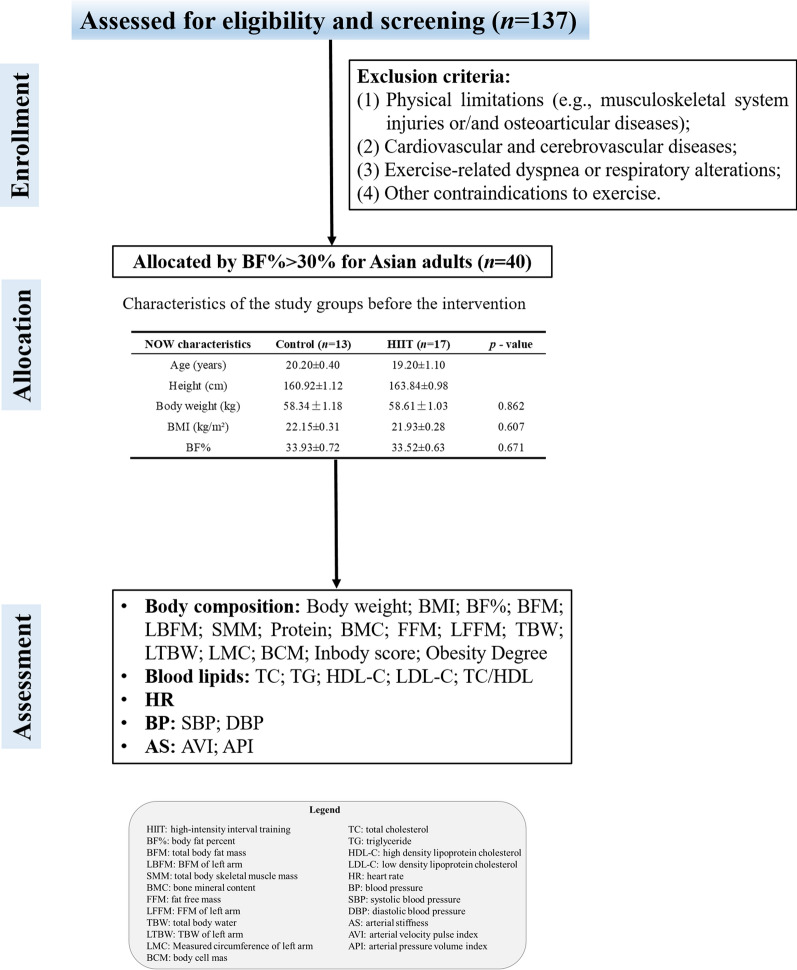
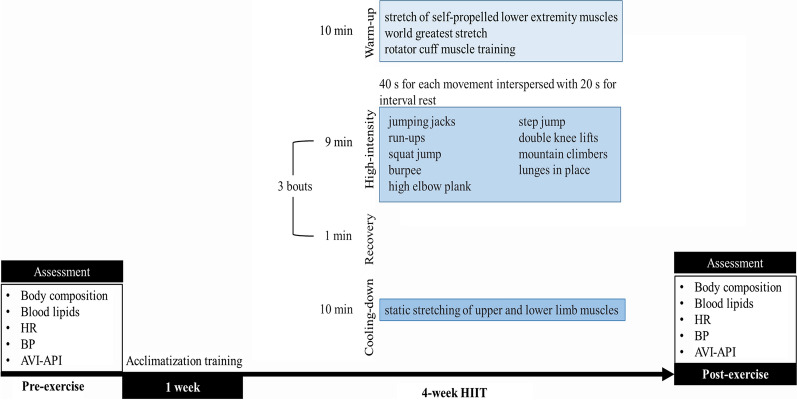
Forty female university students with NWO were randomly assigned to control group (n = 20) and HIIT group (3 bouts of 9‑min intervals at 90% of the maximal heart rate [HR], interspersed by 1 min rest, 5 days a week, n = 20). Tests were performed before and after 4 weeks of training. Repeated measures ANOVA and simple effect test analysis were used to analyze dependent variable changes.
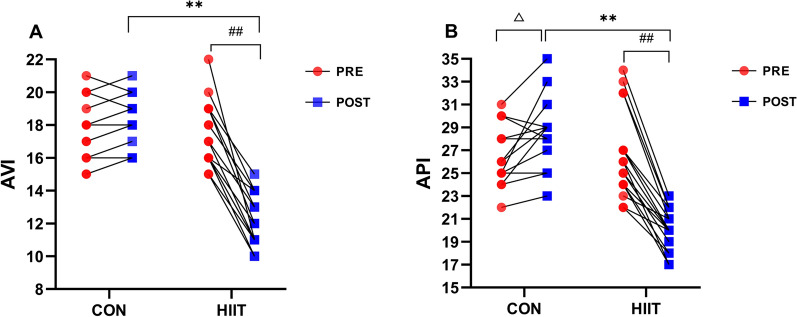
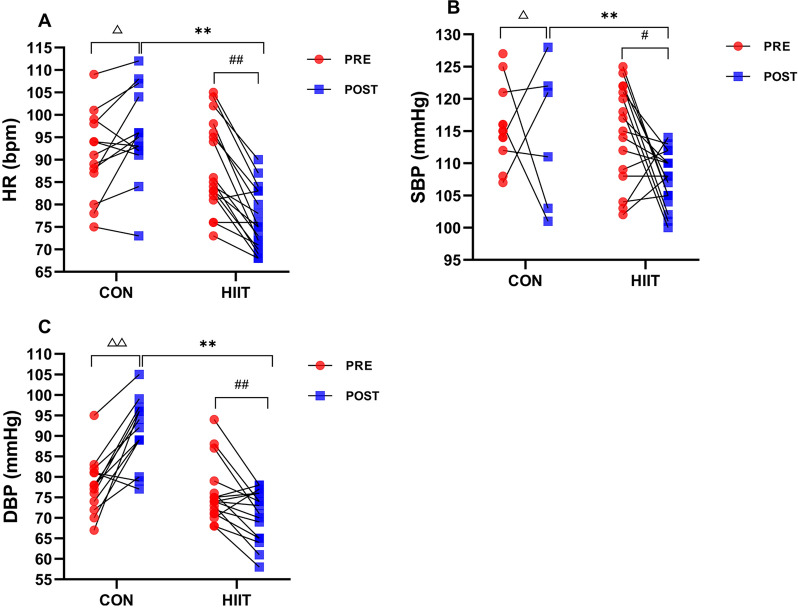
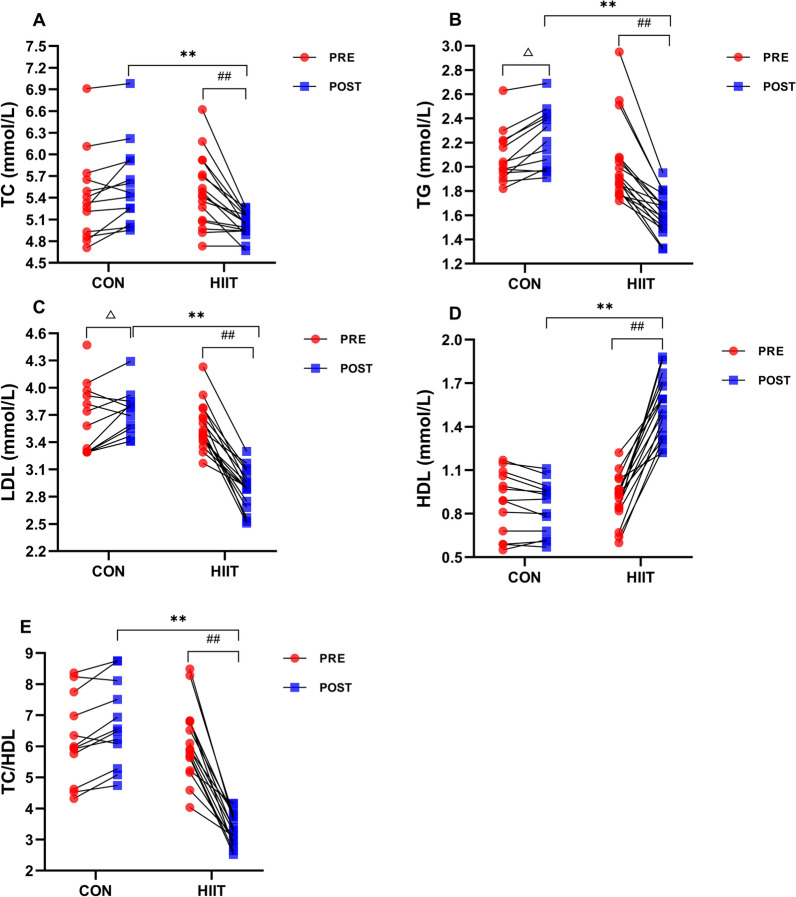
After 4 weeks HIIT statistically significantly improved the body composition by decreasing the body mass index, body fat percent, total body fat mass (BFM), BFM of left arm, measured circumference of left arm, and obesity degree, and increasing the total body skeletal muscle mass, protein content, total body water, fat free mass, body cell mas, and InBody score. HIIT also statistically significantly decreased the HR and BP. As for the lipid profile, HIIT obviously ameliorated the blood lipids metabolism by decreasing the levels of total cholesterol (TC), triglyceride, low-density lipoprotein, and TC/HDL, and increasing the levels of high-density lipoprotein (HDL). In addition, the AVI and API were markedly decreased via HIIT intervention.
HIIT produced significant and meaningful benefits for body composition, HR, BP, and blood lipids metabolism, and could decrease AS in female university students with NWO. This suggests that HIIT may effectively reduce the risk of arteriosclerosis and protect the cardiovascular function for female university students with NWO. Trial registration ChiCTR2100050711. Registered 3 September 2021. Retrospectively registered.
高强度间歇训练(HIIT)已被报道在肥胖症患者的心血管健康方面具有更好的效果,但对于正常体重肥胖(NWO)的女性大学生的动脉僵硬度(AS)知之甚少。因此,本研究旨在探讨 HIIT 对女性 NWO 大学生身体成分、心率(HR)、血压(BP)、血脂代谢以及动脉僵硬度倾向的新参数(动脉速度脉冲指数[AVI]、动脉压力容积指数[API])的影响。
将 40 名 NWO 的女性大学生随机分为对照组(n=20)和 HIIT 组(90%最大心率的 3 个 9 分钟间隔,间隔 1 分钟休息,每周 5 天,n=20)。在训练前和 4 周后进行测试。采用重复测量方差分析和简单效应检验分析处理依赖变量的变化。
4 周 HIIT 训练后,身体成分明显改善,体重指数、体脂百分比、全身脂肪量(BFM)、左臂 BFM、左臂测量周长和肥胖程度降低,全身骨骼肌量、蛋白质含量、总体液量、去脂体重、细胞内液量和 InBody 评分增加。HR 和 BP 也明显降低。血脂代谢方面,HIIT 明显改善了血脂代谢,降低了总胆固醇(TC)、甘油三酯、低密度脂蛋白和 TC/高密度脂蛋白(HDL)的水平,提高了高密度脂蛋白(HDL)的水平。此外,通过 HIIT 干预,AVI 和 API 明显降低。
HIIT 对女性 NWO 大学生的身体成分、HR、BP 和血脂代谢产生了显著而有意义的益处,并可降低 NWO 女性大学生的 AS。这表明 HIIT 可能有效降低动脉硬化风险,保护女性 NWO 大学生的心血管功能。临床试验注册 ChiCTR2100050711。2021 年 9 月 3 日注册。回顾性注册。