Öz Burak, Orhan Cemal, Tuzcu Mehmet, Şahin Nurhan, Özercan İbrahim Hanifi, Demirel Öner Pınar, Koca Süleyman Serdar, Juturu Vijaya, Şahin Kazım
Department of Rheumatology, Fırat University School of Medicine, Elazığ, Turkey.
Department of Animal Nutrition, Fırat University Faculty of Veterinary Science, Elazığ, Turkey.
Eur J Rheumatol. 2021 Oct;8(4):196-201. doi: 10.5152/eujrheum.2020.20192.
Rheumatoid arthritis (RA) is a disabling inflammatory disorder. Ginger is used for food and medicine to treat arthralgia, sprains, and muscle aches. Anti-inflammatory effects of ginger have been observed. The aim of our study was to detect the effects of ginger on experimentally induced inflammatory arthritis.
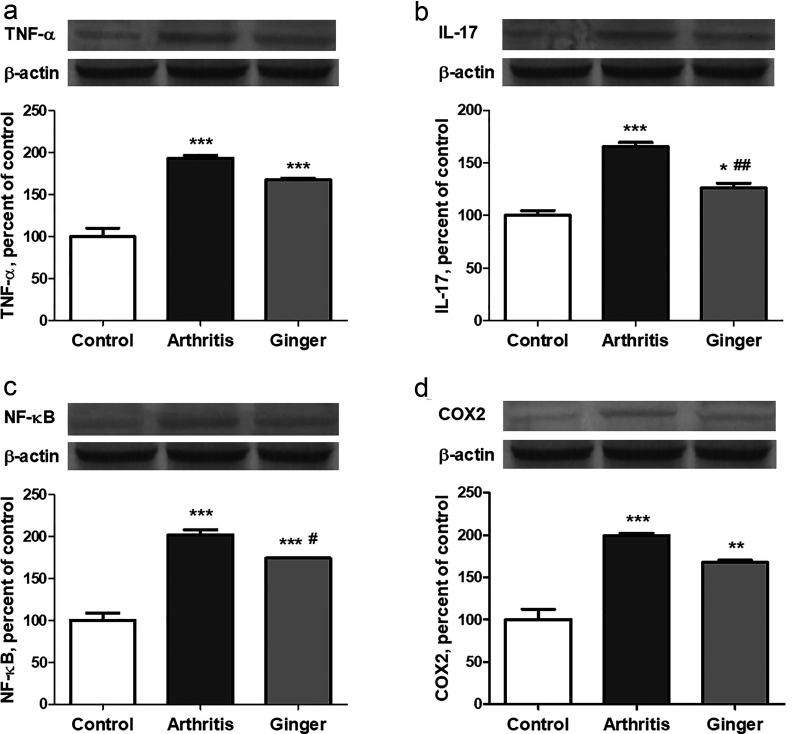
Female Wistar albino rats (n = 21) were randomly separated into three groups (control, arthritis, and arthritis + ginger). Arthritis was generated by an appropriate method using type 2 collagen and Freund's adjuvant (collagen-induced arthritis model). The ginger group was treated starting at the first collagen injection with ginger root extract for 32 days by oral gavage (50 mg/kg/daily). Interleukin (IL)-6, IL-17, tumor necrosis factor-α (TNF-α), sclerostin, dickkopf-related protein-1 (DKK-1), and obestatin serum levels were studied by enzyme-linked immunosorbent assay method. Tissue TNF-α, IL-17, cyclooxygenase-2 (COX-2), and nuclear factor kappa B (NF-κB) levels were detected using the Western blot method.
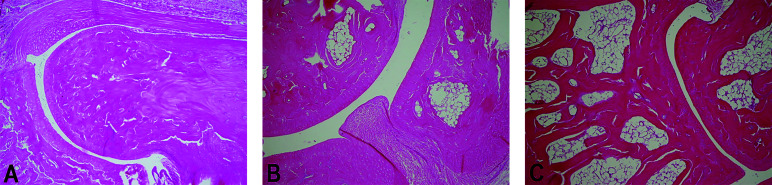
Mean arthritis score and serum levels of TNF-α, IL-6, and IL-17 were significantly decreased in ginger group than in the arthritis group. Increased sclerostin serum level and decreased DKK-1 serum levels were detected in ginger group compared with arthritis group. The decreases of IL-17, TNF-α, COX-2, and NF-κB tissue levels were statistically significant in the ginger group compared with arthritis group. Histopathological evaluation of the ginger group showed a decrease in the inflammation score compared to arthritis group.
It can be concluded that ginger has protective properties in the development of inflammatory arthritis. The antiarthritic acts of ginger are related to NF-κB activity and Wnt pathway. Thus, it may be suggested that ginger is a candidate to research in human RA treatment.
类风湿性关节炎(RA)是一种导致残疾的炎症性疾病。生姜被用于食品和药物中,以治疗关节痛、扭伤和肌肉疼痛。生姜的抗炎作用已被观察到。我们研究的目的是检测生姜对实验性诱导的炎症性关节炎的影响。
将21只雌性Wistar白化大鼠随机分为三组(对照组、关节炎组和关节炎+生姜组)。使用2型胶原蛋白和弗氏佐剂通过适当方法诱导关节炎(胶原诱导的关节炎模型)。生姜组从首次注射胶原蛋白开始,通过口服灌胃给予生姜根提取物32天(50毫克/千克/天)。采用酶联免疫吸附测定法研究白细胞介素(IL)-6、IL-17、肿瘤坏死因子-α(TNF-α)、硬化蛋白、Dickkopf相关蛋白-1(DKK-1)和肥胖抑制素的血清水平。使用蛋白质印迹法检测组织中TNF-α、IL-17、环氧化酶-2(COX-2)和核因子κB(NF-κB)的水平。
生姜组的平均关节炎评分以及TNF-α、IL-6和IL-17的血清水平均显著低于关节炎组。与关节炎组相比,生姜组检测到硬化蛋白血清水平升高,DKK-1血清水平降低。与关节炎组相比,生姜组中IL-17、TNF-α、COX-2和NF-κB的组织水平降低具有统计学意义。生姜组的组织病理学评估显示,与关节炎组相比,炎症评分降低。
可以得出结论,生姜在炎症性关节炎的发展过程中具有保护作用。生姜的抗关节炎作用与NF-κB活性和Wnt信号通路有关。因此,可能提示生姜是人类类风湿性关节炎治疗研究的一个候选对象。