Organic Plant Production and Agroecosystems Research in the Tropics and Subtropics (OPATS), University of Kassel, Steinstr. 19, 37123, Witzenhausen, Germany.
Sci Rep. 2022 Feb 2;12(1):1819. doi: 10.1038/s41598-022-05906-4.
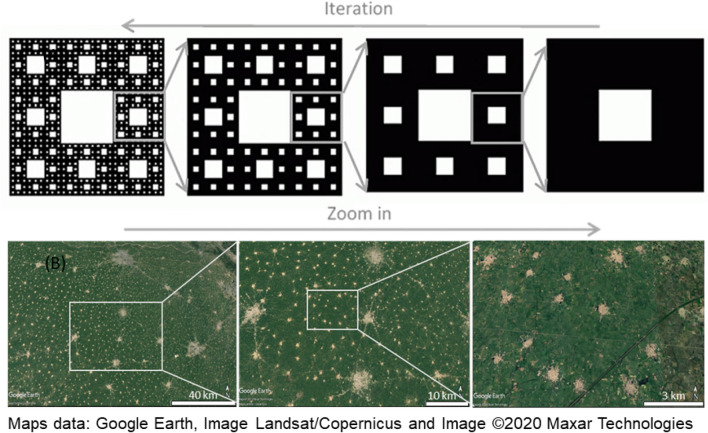
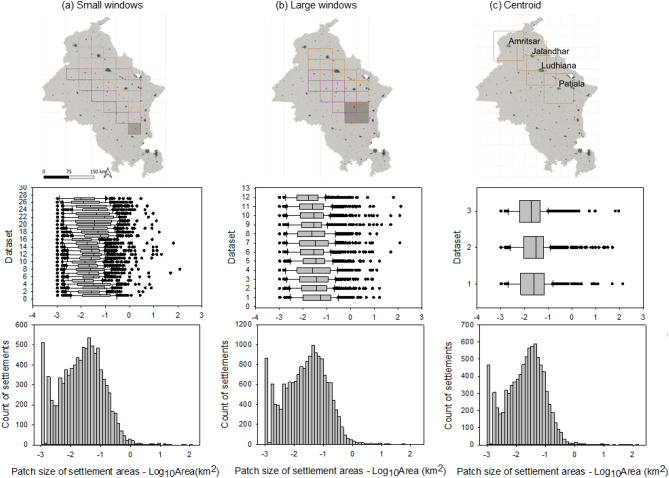
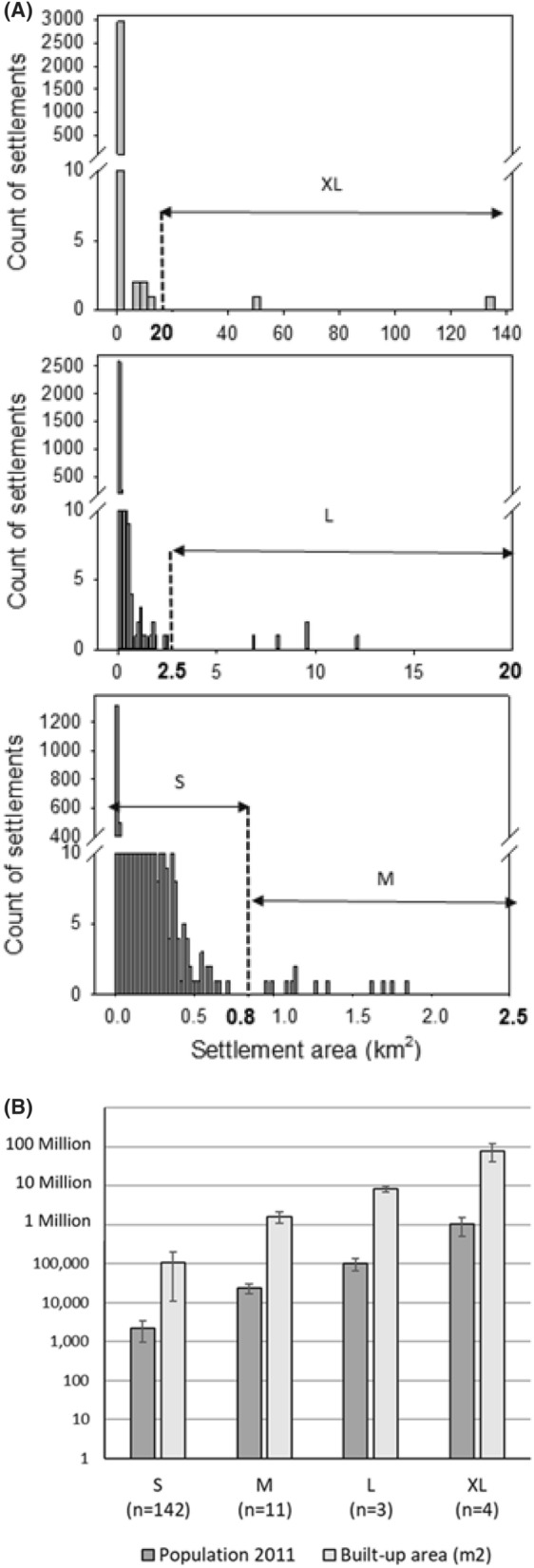
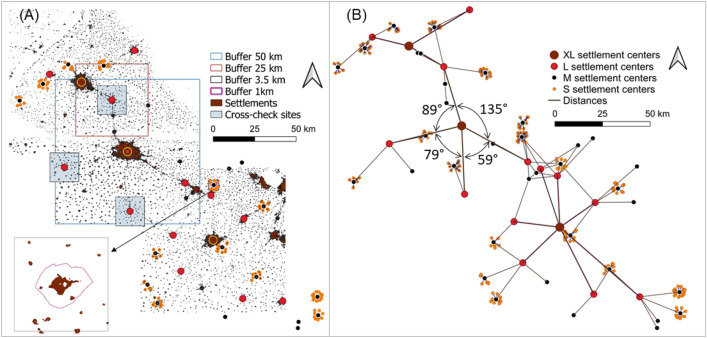
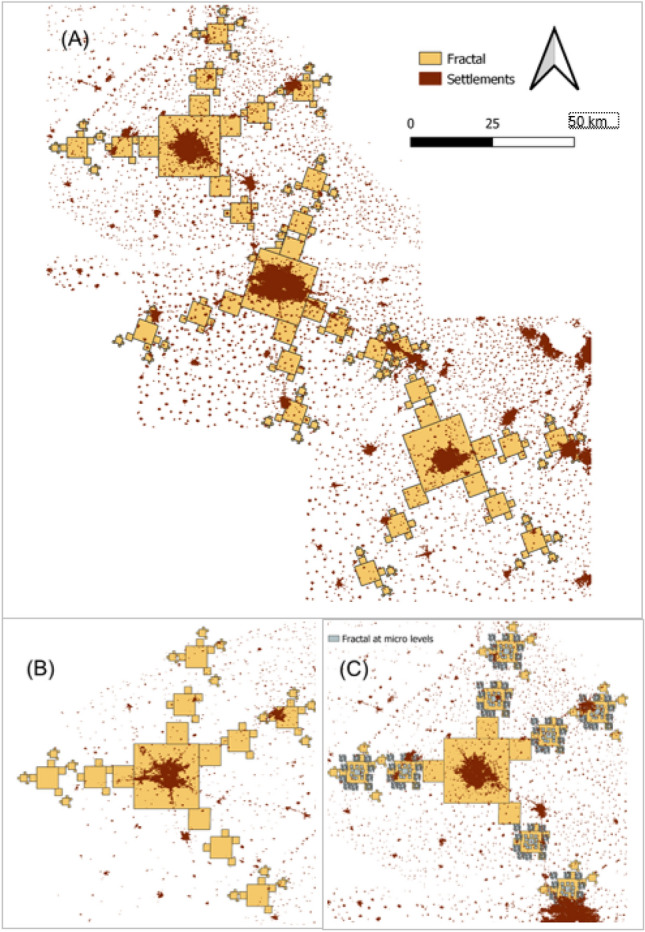
Understanding and governing human settlement patterns is a major challenge of the urban age. While rural settlements emerge as parts of agricultural landscapes, cities typically evolve in economically strategic locations, and over time form hierarchical systems of cities. Purposeful planning and the collective, self-organized behavior of the inhabitants interact in the development of regional settlement patterns. Since self-organizing systems often produce fractal patterns in nature, this study combines approaches of land use science, city ranking, and urban planning under a fractal theory framework, to analyze the settlement system of the Indian Punjab. Scaling levels were defined by discontinuities in the size distribution of built-up areas (Global Urban Footprint), which correlated to population-based classifications (r = 0.9591). Self-similarity across scales was supported by geo-statistical similarity (p < 0.05) of distances and angles between settlements of successive classes, and the overall fractal dimension of D = 1.95. When compared to a modeled Sierpinski Carpet, more than 50% of the settlements met the fractal geometry rules at larger scales. The spatial distribution of small villages, however, deviated, indicating a scale-related shift in organizing principles. Explicitly acknowledging cross-scale relations and self-organisation in regional planning policies may lead to more sustainable settlement structures that are in harmony with natural system properties.
理解和治理人类住区模式是城市时代的主要挑战。虽然农村住区是农业景观的一部分,但城市通常在经济战略位置上发展,并随着时间的推移形成城市的等级制度。有目的的规划和居民的集体自组织行为在区域住区模式的发展中相互作用。由于自组织系统在自然界中经常产生分形模式,因此本研究在分形理论框架下结合土地利用科学、城市排名和城市规划的方法,来分析印度旁遮普邦的住区系统。通过对建成区(全球城市足迹)的大小分布的不连续性来定义尺度等级,这些不连续性与基于人口的分类相关(r=0.9591)。通过对连续级别之间的距离和角度的地统计学相似性(p<0.05)以及整体分形维数 D=1.95,支持了跨尺度的自相似性。与模拟的谢尔宾斯基地毯相比,超过 50%的住区在较大的尺度上符合分形几何规则。然而,小村庄的空间分布却有所偏离,这表明在组织原则上存在与尺度相关的转变。在区域规划政策中明确承认跨尺度关系和自组织,可能会导致更可持续的住区结构,使其与自然系统属性相协调。