Gao Xin, Tham Ivan W K, Yan Jianhua
Shanghai Universal Medical Imaging Diagnostic Center, Shanghai, China.
ASTAR-NUS, Clinical Imaging Research Center, Singapore, Singapore.
Transl Cancer Res. 2020 Aug;9(8):4646-4655. doi: 10.21037/tcr-20-1715.
F-FDG PET based radiomics is promising for precision oncology imaging. This work aims to explore quantitative accuracies of radiomic features (RFs) for low-dose F-FDG PET imaging.
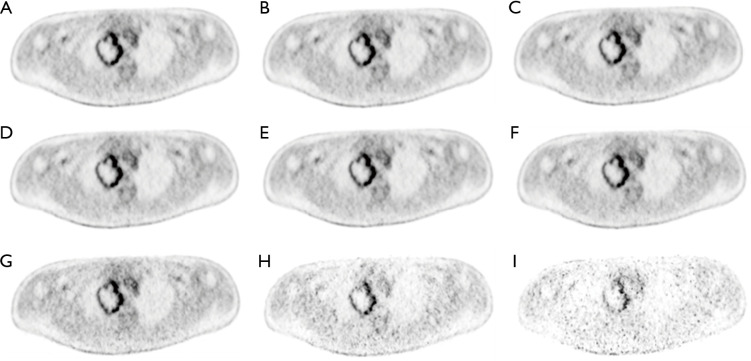
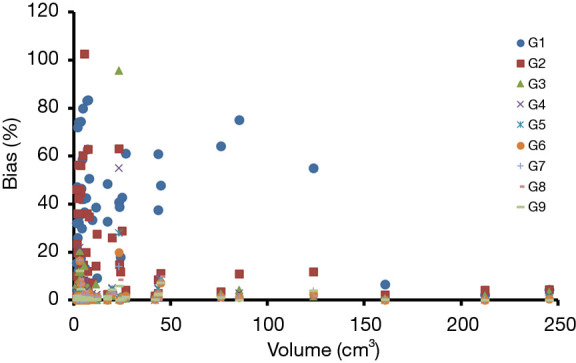
Twenty lung cancer patients were prospectively enrolled and underwent F-FDG PET/CT scans. Low-dose PET situations (true counts: 20×10, 15×10, 10×10, 7.5×10, 5×10, 2×10, 1×10, 0.5×10, 0.25×10) were simulated by randomly discarding counts from the acquired list-mode data. Each PET image was created using the scanner default reconstruction parameters. Each lesion volume of interest (VOI) was obtained via an adaptive contouring method with a threshold of 50% peak standardized uptake value (SUVpeak) in the PET images with full count data and VOIs were copied to the PET images at the reduced count level. Conventional SUV measures, features calculated from first-order statistics (FOS) and texture features (TFs) were calculated. Texture based RF include features calculated from gray-level co-occurrence matrix (GLCM), gray-level run length matrix (GLRLM), gray-level size zone matrix (GLSZM), neighboring gray-level dependence matrix (NGLDM) and neighbor gray-tone difference matrix (NGTDM). Bias percentage (BP) at different count levels for each RF was calculated.
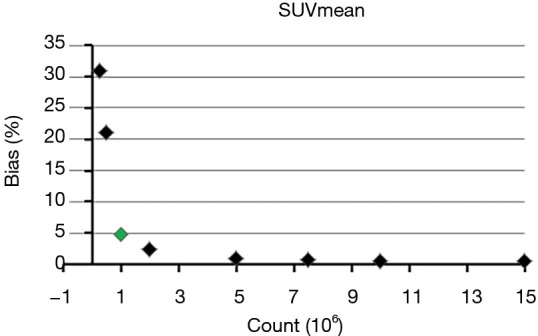
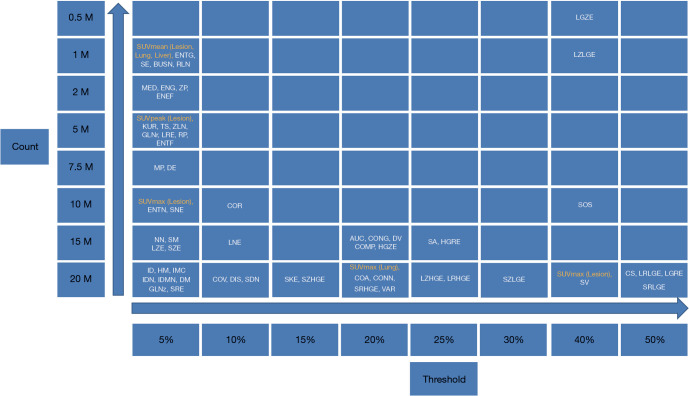
Fifty-seven lesions with a volume greater than 1.5 cm were found (mean volume, 25.7 cm, volume range, 1.5-245.4 cm). In comparison with normal total counts, mean SUV (SUVmean) in the lesions, normal lungs and livers, Entropy and sum entropy from GLCM, busyness from NGTDM and run-length non-uniformity from GLRLM were the most robust features, with a BP of 5% at the count level of 1×10 (equivalent to an effective dose of 0.04 mSv) RF including cluster shade from GLCM, long-run low grey-level emphasis, high grey-level run emphasis and short-run low grey-level emphasis from GLRM exhibited the worst performance with 50% of bias with 20×10 counts (equivalent to an effective dose of 0.8 mSv).
In terms of the lesions included in this study, SUVmean, entropy and sum entropy from GLCM, busyness from NGTDM and run-length non-uniformity from GLRLM were the least sensitive features to lowering count.
基于F-FDG PET的放射组学在精准肿瘤成像方面具有前景。本研究旨在探索低剂量F-FDG PET成像中放射组学特征(RFs)的定量准确性。
前瞻性纳入20例肺癌患者并进行F-FDG PET/CT扫描。通过从采集的列表模式数据中随机丢弃计数来模拟低剂量PET情况(真实计数:20×10、15×10、10×10、7.5×10、5×10、2×10、1×10、0.5×10、0.25×10)。每个PET图像使用扫描仪默认重建参数创建。通过自适应轮廓法在具有全计数数据的PET图像中以50%峰值标准化摄取值(SUVpeak)为阈值获得每个感兴趣病变体积(VOI),并将VOI复制到计数减少水平的PET图像中。计算常规SUV测量值、从一阶统计量(FOS)计算的特征和纹理特征(TFs)。基于纹理的RF包括从灰度共生矩阵(GLCM)、灰度游程长度矩阵(GLRLM)、灰度大小区域矩阵(GLSZM)、相邻灰度依赖性矩阵(NGLDM)和邻域灰度色调差异矩阵(NGTDM)计算的特征。计算每个RF在不同计数水平下的偏差百分比(BP)。
发现57个体积大于1.5 cm的病变(平均体积,25.7 cm,体积范围,1.5 - 245.4 cm)。与正常总计数相比,病变、正常肺和肝脏中的平均SUV(SUVmean)、GLCM的熵和总和熵、NGTDM的繁忙度以及GLRLM的游程长度不均匀性是最稳健的特征,在1×10计数水平(相当于有效剂量0.04 mSv)时BP为5%。包括GLCM的聚类阴影、GLRM的长游程低灰度级强调、高灰度级游程强调和短游程低灰度级强调在内的RF在20×10计数(相当于有效剂量0.8 mSv)时表现最差,偏差为50%。
就本研究中纳入的病变而言,SUVmean以及GLCM的熵和总和熵、NGTDM的繁忙度和GLRLM的游程长度不均匀性对计数降低最不敏感。