Yang Sheng, Yang Xun, Wang Huiwen, Gu Yuelin, Feng Jingjing, Qin Xianfeng, Feng Chaobo, Li Yufeng, Liu Lijun, Fan Guoxin, Liao Xiang, He Shisheng
Department of Orthopedics, Shanghai Tenth People's Hospital, Tongji University School of Medicine, Shanghai, China.
Spinal Pain Research Institute, Tongji University School of Medicine, Shanghai, China.
Front Med (Lausanne). 2022 Jan 18;8:802471. doi: 10.3389/fmed.2021.802471. eCollection 2021.
The study aimed to investigate the prognostic factors of spinal cord astrocytoma (SCA) and establish a nomogram prognostic model for the management of patients with SCA.
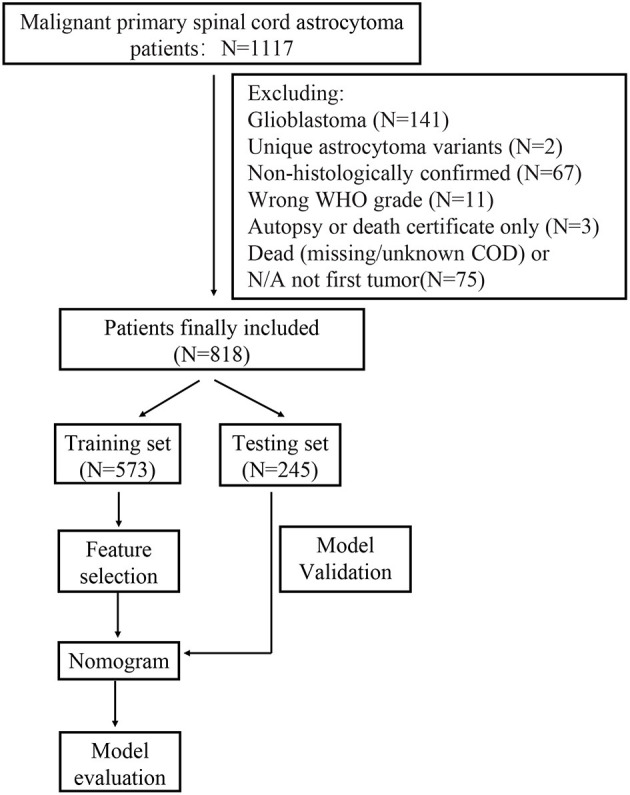
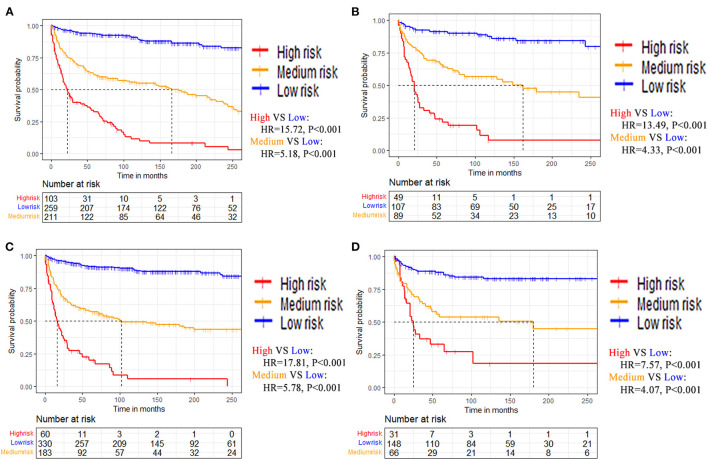
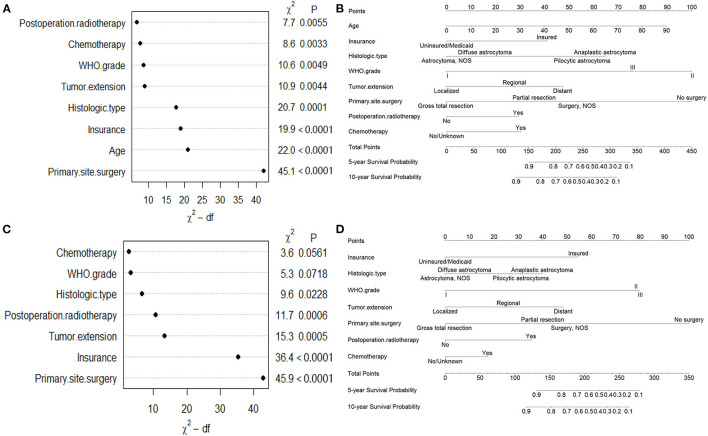
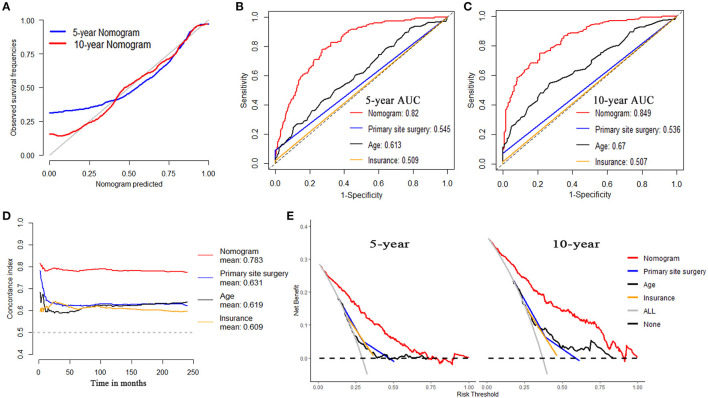
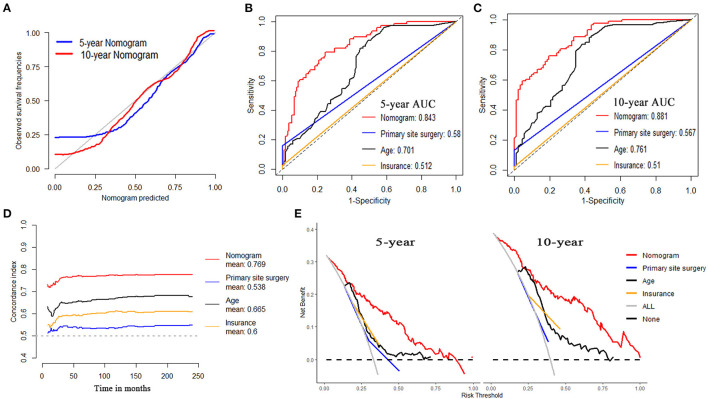
Patients diagnosed with SCA between 1975 and 2016 were extracted from the Surveillance, Epidemiology, and End Results (SEER) database and randomly divided into training and testing datasets (7:3). The primary outcomes of this study were overall survival (OS) and cancer-specific survival (CSS). Cox hazard proportional regression model was used to identify the prognostic factors of patients with SCA in the training dataset and feature importance was obtained. Based on the independent prognostic factors, nomograms were established for prognostic prediction. Calibration curves, concordance index (C-index), and time-dependent receiver operating characteristic (ROC) curves were used to evaluate the calibration and discrimination of the nomogram model, while Kaplan-Meier (KM) survival curves and decision curve analyses (DCA) were used to evaluate the clinical utility. Web-based online calculators were further developed to achieve clinical practicability.
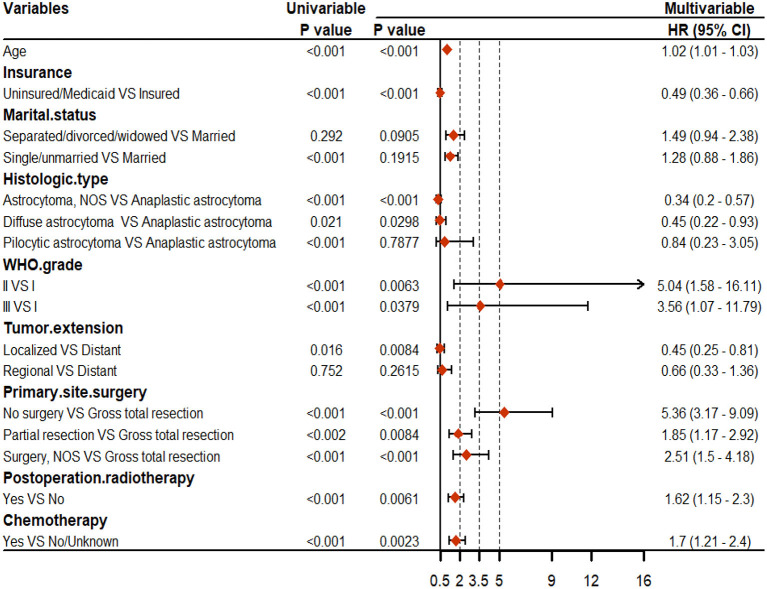
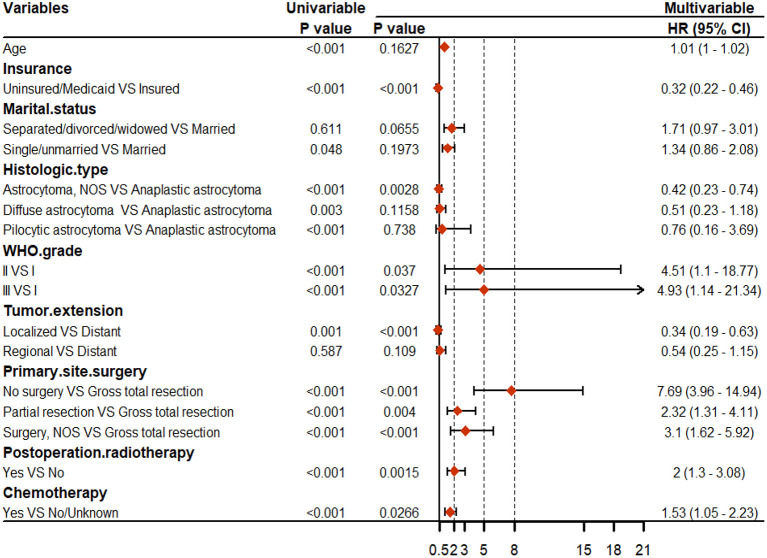
A total of 818 patients with SCA were included in this study, with an average age of 30.84 ± 21.97 years and an average follow-up time of 117.57 ± 113.51 months. Cox regression indicated that primary site surgery, age, insurance, histologic type, tumor extension, WHO grade, chemotherapy, and post-operation radiotherapy (PRT) were independent prognostic factors for OS. While primary site surgery, insurance, tumor extension, PRT, histologic type, WHO grade, and chemotherapy were independent prognostic factors for CSS. For OS prediction, the calibration curves in the training and testing dataset illustrated good calibration, with C-indexes of 0.783 and 0.769. The area under the curves (AUCs) of 5-year survival prediction were 0.82 and 0.843, while 10-year survival predictions were 0.849 and 0.881, for training and testing datasets, respectively. Moreover, the DCA demonstrated good clinical net benefit. The prediction performances of nomograms were verified to be superior to that of single indicators, and the prediction performance of nomograms for CSS is also excellent.
Nomograms for patients with SCA prognosis prediction demonstrated good calibration, discrimination, and clinical utility. This result might benefit clinical decision-making and patient management for SCA. Before further use, more extensive external validation is required for the established web-based online calculators.
本研究旨在探讨脊髓星形细胞瘤(SCA)的预后因素,并建立列线图预后模型以指导SCA患者的治疗。
从监测、流行病学和最终结果(SEER)数据库中提取1975年至2016年间诊断为SCA的患者,并随机分为训练集和测试集(7:3)。本研究的主要结局为总生存期(OS)和癌症特异性生存期(CSS)。采用Cox风险比例回归模型在训练集中识别SCA患者的预后因素并获得特征重要性。基于独立预后因素建立列线图用于预后预测。采用校准曲线、一致性指数(C指数)和时间依赖性受试者工作特征(ROC)曲线评估列线图模型的校准和区分能力,同时采用Kaplan-Meier(KM)生存曲线和决策曲线分析(DCA)评估其临床实用性。进一步开发基于网络的在线计算器以实现临床实用性。
本研究共纳入818例SCA患者,平均年龄30.84±21.97岁,平均随访时间117.57±113.51个月。Cox回归表明,原发部位手术、年龄、保险类型、组织学类型、肿瘤扩展、世界卫生组织(WHO)分级、化疗和术后放疗(PRT)是OS的独立预后因素。而原发部位手术、保险类型、肿瘤扩展、PRT、组织学类型、WHO分级和化疗是CSS的独立预后因素。对于OS预测,训练集和测试集的校准曲线显示校准良好,C指数分别为0.783和0.769。训练集和测试集5年生存预测的曲线下面积(AUC)分别为0.82和0.843,10年生存预测的AUC分别为0.849和0.881。此外,DCA显示出良好的临床净效益。列线图的预测性能经证实优于单一指标,其对CSS的预测性能也很出色。
用于SCA患者预后预测的列线图显示出良好的校准、区分能力和临床实用性。该结果可能有助于SCA的临床决策和患者管理。在进一步使用之前,所建立的基于网络的在线计算器需要更广泛的外部验证。