Faculty of Medical Sciences, Lebanese University, Hadath Campus, Beirut, Lebanon.
Faculty of Pharmacy, Lebanese International University, Beirut, Lebanon.
Ir J Med Sci. 2023 Feb;192(1):291-301. doi: 10.1007/s11845-022-02936-9. Epub 2022 Feb 4.
The COVID-19 pandemic highlighted the need of social media as a medium for gathering health-related information. Simultaneously, a slew of false information, primarily about COVID-19's origin, dissemination, prevention, treatment, and fatality surfaced, making it difficult to distinguish fake from genuine material. However, the possible effects on mental health and the extent to which this influences our decisions, particularly regarding vaccination, are unknown.
The purpose of this questionnaire-based cross-sectional study was to examine Lebanese University students' perceptions of social media influence during the COVID-19 pandemic, as well as to measure the impact of misinformation on respondents' mental health and vaccination decisions.
In total, 440 students took part and were asked to complete an online survey that included questions on social media trust, the "general health questionnaire index" (GHQ-12), and a scale measuring "attitude towards vaccination".
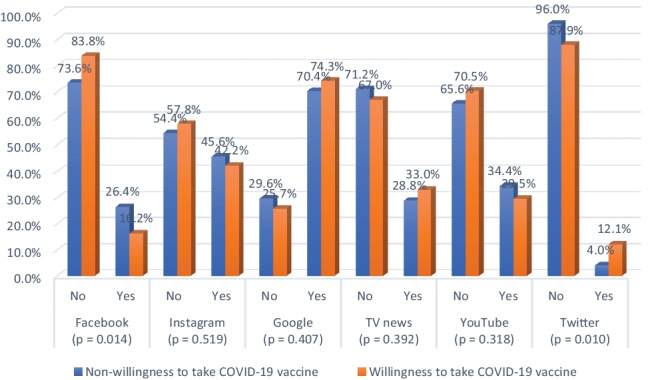
Our data demonstrated a low frequency of mental health disorders among Lebanese University students, which was correlated to frequent social media exposure during the COVID-19 pandemic. These findings suggested that students are more aware of misinformation and had lower rates of despair and anxiety than the general population. Furthermore, Facebook use was associated with worse attitude and behaviour towards vaccination (p = 0.001), but a better mental health. Twitter had the inverse effect (p = 0.002).
It is a necessity to use social media correctly in health-related topics, to push governments and platforms towards making decisions about false and invalidated posts.
新冠疫情凸显了社交媒体作为获取健康相关信息的媒介的重要性。与此同时,大量关于新冠病毒起源、传播、预防、治疗和死亡率的虚假信息大量涌现,使得人们难以辨别真假。然而,这些信息对心理健康可能产生的影响,以及它们在多大程度上影响我们的决策,特别是关于接种疫苗的决策,目前尚不清楚。
本问卷调查性研究旨在探讨黎巴嫩大学生在新冠疫情期间对社交媒体影响力的看法,以及虚假信息对受访者心理健康和接种疫苗决策的影响。
共有 440 名学生参与了这项研究,他们被要求完成一份在线调查,其中包括对社交媒体信任度、“一般健康问卷指数”(GHQ-12)以及衡量“对疫苗接种态度”的量表的问题。
我们的数据显示,黎巴嫩大学生心理健康障碍的发生率较低,这与新冠疫情期间频繁接触社交媒体有关。这些发现表明,学生们对虚假信息的认识更高,绝望和焦虑的发生率低于一般人群。此外,Facebook 的使用与对疫苗接种的态度和行为更差有关(p=0.001),但与更好的心理健康有关。Twitter 的影响则相反(p=0.002)。
有必要在与健康相关的话题中正确使用社交媒体,促使政府和平台对虚假和无效的帖子做出决策。