Max Planck Institute for Chemical Energy Conversion, Stiftstrasse 34-36, 45470 Mülheim an der Ruhr, Germany.
Max-Planck-Institut für Kohlenforschung, Kaiser-Wilhelm-Platz 1, 45470 Mülheim an der Ruhr, Germany.
J Am Chem Soc. 2022 Feb 16;144(6):2637-2656. doi: 10.1021/jacs.1c11083. Epub 2022 Feb 4.
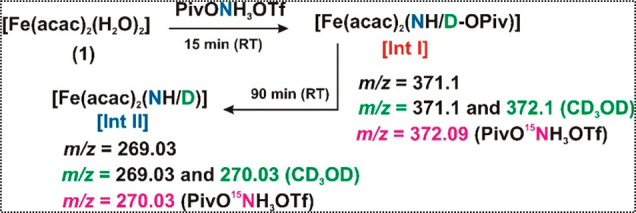
Herein, we study the mechanism of iron-catalyzed direct synthesis of unprotected aminoethers from olefins by a hydroxyl amine derived reagent using a wide range of analytical and spectroscopic techniques (Mössbauer, Electron Paramagnetic Resonance, Ultra-Violet Visible Spectroscopy, X-ray Absorption, Nuclear Resonance Vibrational Spectroscopy, and resonance Raman) along with high-level quantum chemical calculations. The hydroxyl amine derived triflic acid salt acts as the "oxidant" as well as "amino" group donor. It activates the high-spin Fe(II) ( = 2) catalyst [Fe(acac)(HO)] () to generate a high-spin ( = 5/2) intermediate (), which decays to a second intermediate () with = 2. The analysis of spectroscopic and computational data leads to the formulation of as [Fe(III)(acac)--acyloxy] (an alkyl-peroxo-Fe(III) analogue). Furthermore, is formed by N-O bond homolysis. However, it does generate a high-valent Fe(IV)(NH) species (a Fe(IV)(O) analogue), but instead a high-spin Fe(III) center which is strongly antiferromagnetically coupled ( = -524 cm) to an iminyl radical, [Fe(III)(acac)-NH·], giving = 2. Though Fe(NH) complexes as isoelectronic surrogates to Fe(O) functionalities are known, detection of a high-spin Fe(III)--acyloxy intermediate (), which undergoes N-O bond cleavage to generate the active iron-nitrogen intermediate (), is unprecedented. Relative to Fe(IV)(O) centers, features a weak elongated Fe-N bond which, together with the unpaired electron density along the Fe-N bond vector, helps to rationalize its propensity for -transfer reactions onto styrenyl olefins, resulting in the overall formation of aminoethers. This study thus demonstrates the potential of utilizing the iron-coordinated nitrogen-centered radicals as powerful reactive intermediates in catalysis.
在此,我们使用多种分析和光谱技术(穆斯堡尔谱、电子顺磁共振、紫外可见光谱、X 射线吸收、核磁共振振动光谱和共振拉曼)以及高级量子化学计算,研究了铁催化由烯烃直接合成未保护的氨基醚的反应机理,所使用的试剂由羟胺衍生而来。羟胺衍生的三氟甲磺酸盐既是“氧化剂”,也是“氨基”供体。它激活高自旋 Fe(II)( = 2)催化剂[Fe(acac)(HO)](),生成高自旋( = 5/2)中间体(),然后()衰减为第二个中间体(), = 2。光谱和计算数据分析导致了式()为[Fe(III)(acac)--acyloxy](烷基过氧-Fe(III)类似物)的形成。此外,N-O 键均裂导致了()的生成。然而,它没有生成高价态 Fe(IV)(NH)物种(Fe(IV)(O)类似物),而是生成了一个高自旋 Fe(III)中心,其与亚胺基自由基[Fe(III)(acac)-NH·]强烈反铁磁耦合( = -524 cm), = 2。虽然已知 Fe(NH)配合物是 Fe(O)官能团的等电子替代物,但检测到的高自旋 Fe(III)--acyloxy 中间体(),其经历 N-O 键断裂生成活性铁-氮中间物(),这是前所未有的。与 Fe(IV)(O)中心相比,()具有较弱的拉长的 Fe-N 键,以及沿着 Fe-N 键矢量的未配对电子密度,这有助于解释其对苯乙烯基烯烃的 -转移反应倾向,从而导致氨基醚的总体形成。因此,该研究展示了利用铁配位的氮中心自由基作为催化中有力的反应中间体的潜力。