Baker Kelly A, Miller Timothy D, Marino Frank E, Hartmann Tegan E
School of Allied Health, Exercise and Sport Sciences, Charles Sturt University, Bathurst, New South Wales, Australia.
PLoS One. 2022 Feb 4;17(2):e0262534. doi: 10.1371/journal.pone.0262534. eCollection 2022.
This study investigated selected inflammatory responses to acute and chronic exercise in individuals with inflammatory bowel disease (IBD).
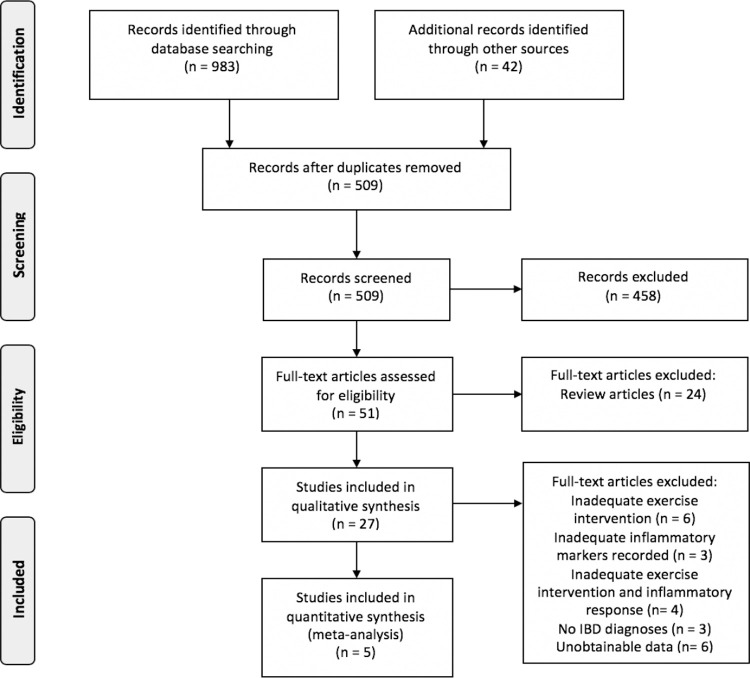
A systematic review and meta-analysis was conducted on all relevant exercise-based intervention publications with IBD participants. The study included articles that utilised a broad range of acute and chronic exercise interventions, with inflammatory biomarkers measured and symptoms documented, both pre- and post-exercise for those with IBD. The search was limited to studies published in English, the use of human participants, and primary studies, with no restrictions on date of publication or participant's age. Articles were retrieved through the electronic databases: PubMed, SPORTDiscus, and Scopus. This study adhered to Preferred Reporting Items for Systematic Reviews and Meta-Analysis (PRISMA) guidelines.
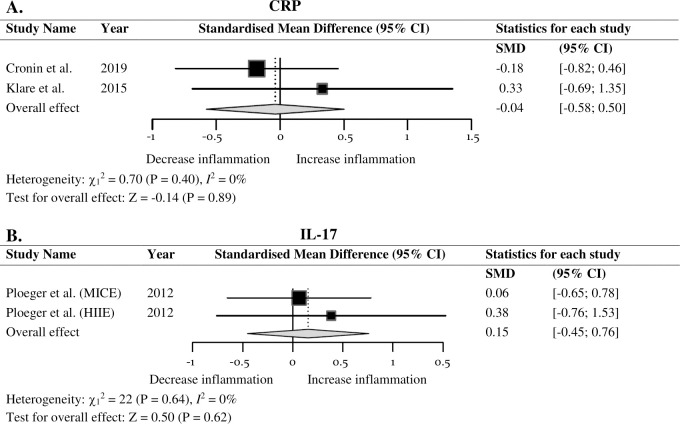
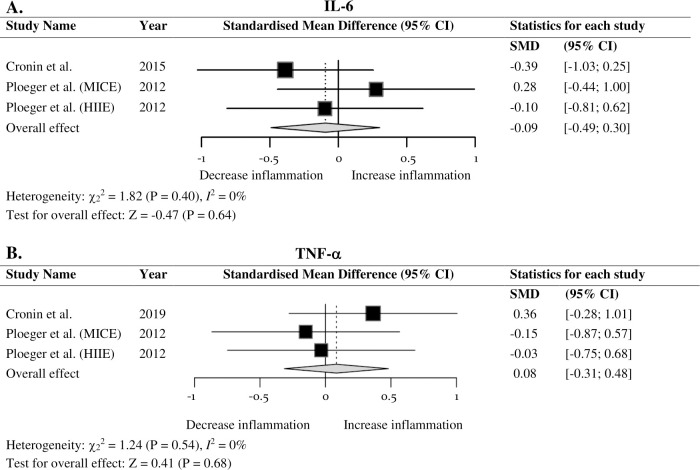
Six inflammatory markers were included in the meta-analysis which consisted of five studies. Exercise interventions resulted in no significant difference in IL-6 (SMD = -0.09; 95% CI = -0.49, 0.30; P = 0.64), TNF-α (SMD = 0.08; 95% CI = -0.31, 0.48; P = 0.68), CRP (SMD = -0.04; 95% CI = -0.58, 0.50; P = 0.89), IL-17 (SMD = 0.15; 95% CI = -0.45, 0.76; P = 0.62), leukocytes (SMD = 0.40; 95% CI = -0.53, 1.33; P = 0.40) or lymphocytes (SMD = 0.32; 95% CI = -0.33, 0.97; P = 0.33), thus, indicating exercise may have no effect on inflammatory markers in IBD. Bowel symptoms improved following regular moderate exercise that incorporated stress management.
Heterogeneity among the identified literature may have led to exercise interventions being ineffective in reducing inflammation. Although the limited number of eligible studies may reduce the reliability of results, it emphasises the need for additional research in this domain. Importantly, no adverse symptomatic responses to exercise indicate that exercise is safe for IBD patients.
本研究调查了炎症性肠病(IBD)患者对急性和慢性运动的特定炎症反应。
对所有涉及IBD参与者的基于运动的干预性出版物进行系统综述和荟萃分析。该研究纳入了采用广泛急性和慢性运动干预措施的文章,对IBD患者在运动前后测量了炎症生物标志物并记录了症状。检索限于以英文发表的研究、使用人类参与者的研究以及原始研究,对发表日期或参与者年龄没有限制。通过电子数据库:PubMed、SPORTDiscus和Scopus检索文章。本研究遵循系统综述和荟萃分析的首选报告项目(PRISMA)指南。
荟萃分析纳入了六项炎症标志物,该分析由五项研究组成。运动干预在白细胞介素-6(标准化均值差[SMD]=-0.09;95%置信区间[CI]=-0.49,0.30;P=0.64)、肿瘤坏死因子-α(SMD=0.08;95%CI=-0.31,0.48;P=0.68)、C反应蛋白(SMD=-0.04;95%CI=-0.58,0.50;P=0.89)、白细胞介素-17(SMD=0.15;95%CI=-0.45,0.76;P=0.62)、白细胞(SMD=0.40;95%CI=-0.53,1.33;P=0.40)或淋巴细胞(SMD=0.32;95%CI=-0.33,0.97;P=0.33)方面未产生显著差异,因此表明运动可能对IBD患者的炎症标志物没有影响。在纳入压力管理的规律适度运动后,肠道症状有所改善。
已识别文献之间的异质性可能导致运动干预在减轻炎症方面无效。尽管符合条件的研究数量有限可能会降低结果的可靠性,但这强调了该领域进一步研究的必要性。重要的是,对运动没有不良症状反应表明运动对IBD患者是安全的。