Department of Electronic Systems Engineering, University of São Paulo, Av. Professor Luciano Gualberto, Travessa 3, São Paulo, 158, Brazil.
Departamento de Moléstias Infecciosas e Parasitarias, Instituto de Medicina Tropical da Faculdade de Medicina da Universidade de São Paulo, Av Dr Eneas de Carvalho 470, 1º andar, São Paulo, 05403-000, Brazil.
BMC Infect Dis. 2022 Feb 5;22(1):127. doi: 10.1186/s12879-022-07094-y.
The city of Manaus, north Brazil, was stricken by a second epidemic wave of SARS-CoV-2 despite high seroprevalence estimates, coinciding with the emergence of the Gamma (P.1) variant. Reinfections were postulated as a partial explanation for the second surge. However, accurate calculation of reinfection rates is difficult when stringent criteria as two time-separated RT-PCR tests and/or genome sequencing are required. To estimate the proportion of reinfections caused by Gamma during the second wave in Manaus and the protection conferred by previous infection, we identified anti-SARS-CoV-2 antibody boosting in repeat blood donors as a mean to infer reinfection.
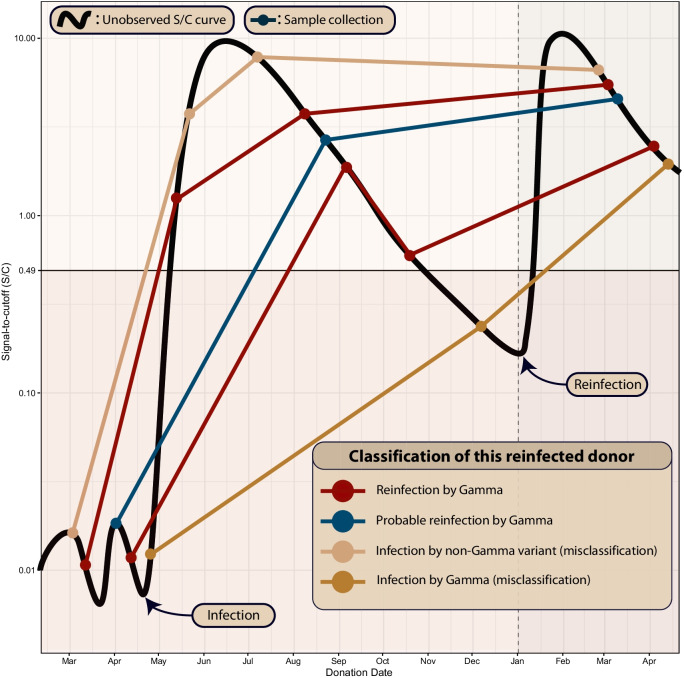
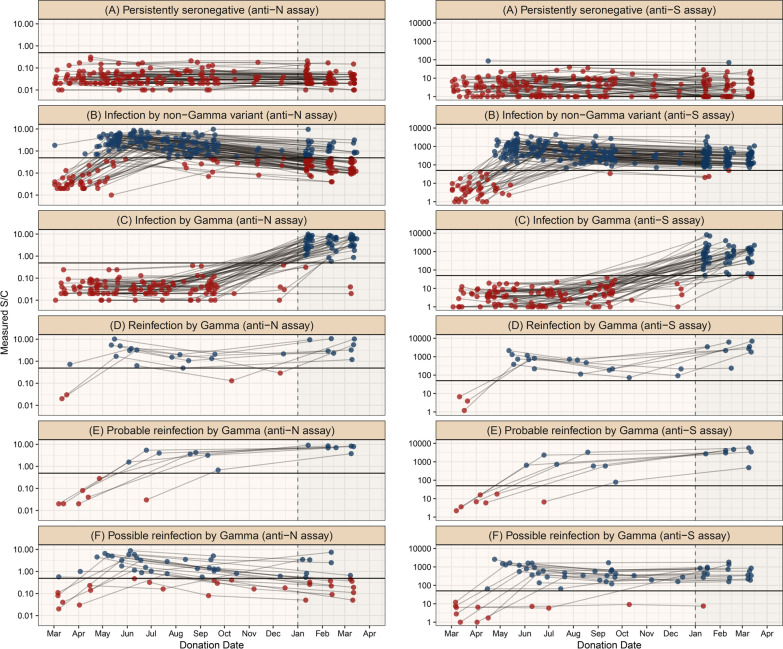
We tested serial blood samples from unvaccinated repeat blood donors in Manaus for the presence of anti-SARS-CoV-2 IgG antibodies using two assays that display waning in early convalescence, enabling the detection of reinfection-induced boosting. Donors were required to have three or more donations, being at least one during each epidemic wave. We propose a strict serological definition of reinfection (reactivity boosting following waning like a V-shaped curve in both assays or three spaced boostings), probable (two separate boosting events) and possible (reinfection detected by only one assay) reinfections. The serial samples were used to divide donors into six groups defined based on the inferred sequence of infection and reinfection with non-Gamma and Gamma variants.
From 3655 repeat blood donors, 238 met all inclusion criteria, and 223 had enough residual sample volume to perform both serological assays. We found 13.6% (95% CI 7.0-24.5%) of all presumed Gamma infections that were observed in 2021 were reinfections. If we also include cases of probable or possible reinfections, these percentages increase respectively to 22.7% (95% CI 14.3-34.2%) and 39.3% (95% CI 29.5-50.0%). Previous infection conferred a protection against reinfection of 85.3% (95% CI 71.3-92.7%), decreasing to respectively 72.5% (95% CI 54.7-83.6%) and 39.5% (95% CI 14.1-57.8%) if probable and possible reinfections are included.
Reinfection by Gamma is common and may play a significant role in epidemics where Gamma is prevalent, highlighting the continued threat variants of concern pose even to settings previously hit by substantial epidemics.
尽管巴西玛瑙斯市的血清阳性率估计很高,与伽马(P.1)变异株的出现相一致,但该市仍遭受了第二波 SARS-CoV-2 疫情的冲击。假设再次感染是第二波疫情的部分原因。然而,当需要两次时间分隔的 RT-PCR 检测和/或基因组测序等严格标准时,准确计算再感染率是困难的。为了估计玛瑙斯第二次疫情中由伽马引起的再感染比例以及先前感染提供的保护,我们将重复献血者的抗 SARS-CoV-2 抗体增强作为推断再感染的一种手段。
我们使用两种检测方法测试了来自玛瑙斯未接种疫苗的重复献血者的连续血液样本,以检测抗 SARS-CoV-2 IgG 抗体的存在,这两种检测方法在早期恢复期显示出衰减,从而能够检测到再感染诱导的增强。要求献血者有三次或更多次献血,并且至少在每次疫情期间都有一次献血。我们提出了一种严格的血清学再感染定义(两种检测方法均表现出衰减后再感染诱导的增强,呈 V 形曲线,或三次间隔增强)、可能(两次单独的增强事件)和可能(仅通过一种检测方法检测到再感染)再感染。将这些连续样本用于根据推断的非伽马和伽马变异感染和再感染的顺序将献血者分为六个组。
从 3655 名重复献血者中,有 238 名符合所有纳入标准,有 223 名有足够的剩余样本量来进行两种血清学检测。我们发现,2021 年观察到的所有假定的伽马感染中,有 13.6%(95%CI 7.0-24.5%)是再感染。如果我们还包括可能或可能的再感染病例,这些百分比分别增加到 22.7%(95%CI 14.3-34.2%)和 39.3%(95%CI 29.5-50.0%)。先前的感染提供了 85.3%(95%CI 71.3-92.7%)的保护,防止再感染,而如果包括可能和可能的再感染,这一比例分别降至 72.5%(95%CI 54.7-83.6%)和 39.5%(95%CI 14.1-57.8%)。
伽马再感染很常见,在伽马流行的情况下可能会在流行中发挥重要作用,这突显了即使在以前遭受过大量疫情的情况下,关注的变异体仍持续构成威胁。