Division of Infectious Diseases and Hospital Epidemiology, Cantonal Hospital St. Gallen, St. Gallen, Switzerland.
Department of Public and Global Health, University of Zurich, Zurich, Switzerland.
Antimicrob Resist Infect Control. 2022 Feb 5;11(1):27. doi: 10.1186/s13756-022-01070-6.
There is insufficient evidence regarding the role of respirators in the prevention of SARS-CoV-2 infection. We analysed the impact of filtering facepiece class 2 (FFP2) versus surgical masks on the risk of SARS-CoV-2 acquisition among Swiss healthcare workers (HCW).
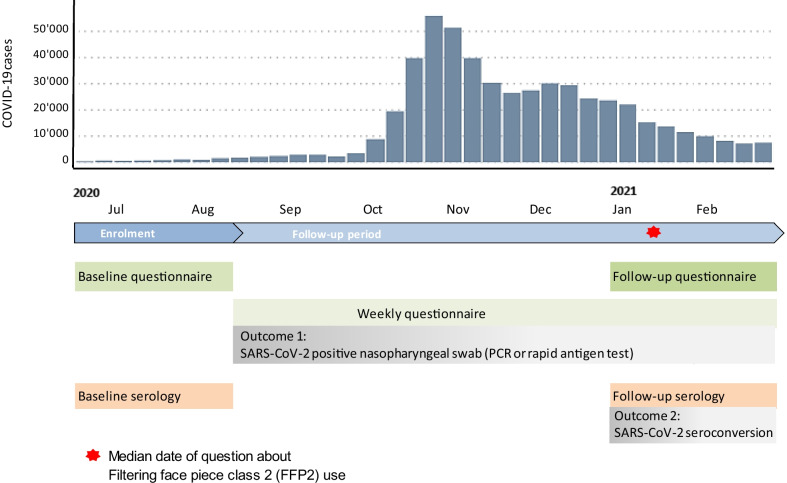
Our prospective multicentre cohort enrolled HCW from June to August 2020. Participants were asked about COVID-19 risk exposures/behaviours, including preferentially worn mask type when caring for COVID-19 patients outside of aerosol-generating procedures. The impact of FFP2 on (1) self-reported SARS-CoV-2-positive nasopharyngeal PCR/rapid antigen tests captured during weekly surveys, and (2) SARS-CoV-2 seroconversion between baseline and January/February 2021 was assessed.
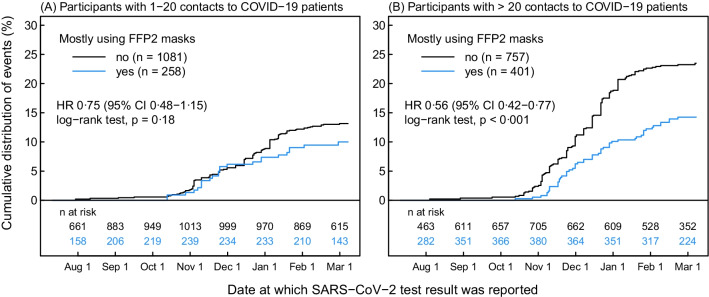
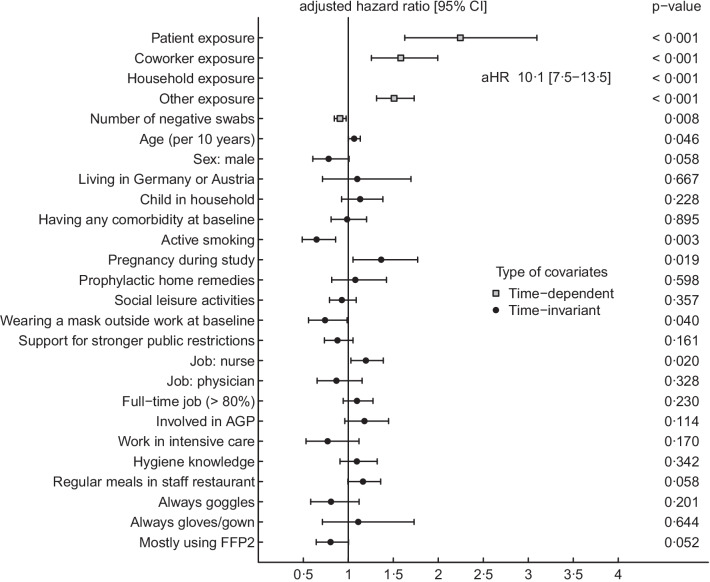
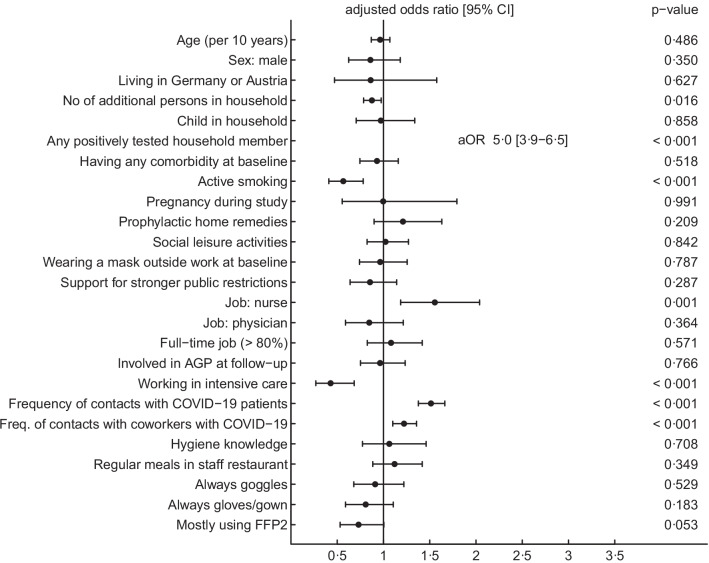
We enrolled 3259 participants from nine healthcare institutions, whereof 716 (22%) preferentially used FFP2. Among these, 81/716 (11%) reported a SARS-CoV-2-positive swab, compared to 352/2543 (14%) surgical mask users; seroconversion was documented in 85/656 (13%) FFP2 and 426/2255 (19%) surgical mask users. Adjusted for baseline characteristics, COVID-19 exposure, and risk behaviour, FFP2 use was non-significantly associated with decreased risk for SARS-CoV-2-positive swab (adjusted hazard ratio [aHR] 0.8, 95% CI 0.6-1.0) and seroconversion (adjusted odds ratio [aOR] 0.7, 95% CI 0.5-1.0); household exposure was the strongest risk factor (aHR 10.1, 95% CI 7.5-13.5; aOR 5.0, 95% CI 3.9-6.5). In subgroup analysis, FFP2 use was clearly protective among those with frequent (> 20 patients) COVID-19 exposure (aHR 0.7 for positive swab, 95% CI 0.5-0.8; aOR 0.6 for seroconversion, 95% CI 0.4-1.0).
Respirators compared to surgical masks may convey additional protection from SARS-CoV-2 for HCW with frequent exposure to COVID-19 patients.
关于呼吸器在预防 SARS-CoV-2 感染中的作用,证据不足。我们分析了过滤式面罩 2 类(FFP2)与外科口罩对瑞士医护人员(HCW)获得 SARS-CoV-2 的风险的影响。
我们的前瞻性多中心队列纳入了 2020 年 6 月至 8 月期间的 HCW。参与者被问及 COVID-19 的风险暴露/行为,包括在进行气溶胶产生程序之外护理 COVID-19 患者时优先佩戴的口罩类型。评估了 FFP2 对(1)每周调查中捕获的自我报告的 SARS-CoV-2 阳性鼻咽 PCR/快速抗原检测,以及(2)基线至 2021 年 1 月/2 月之间的 SARS-CoV-2 血清转化率的影响。
我们从 9 家医疗机构招募了 3259 名参与者,其中 716 名(22%)优先使用 FFP2。在这些人中,81/716 名(11%)报告 SARS-CoV-2 阳性拭子,而 2543 名外科口罩使用者中有 352/2543 名(14%);在 656 名 FFP2 使用者和 2255 名外科口罩使用者中记录到血清转化率分别为 85/656(13%)和 426/2255(19%)。调整基线特征、COVID-19 暴露和风险行为后,FFP2 使用与 SARS-CoV-2 阳性拭子(调整后的危险比[aHR]0.8,95%CI0.6-1.0)和血清转化率(调整后的优势比[aOR]0.7,95%CI0.5-1.0)的风险降低无关;家庭暴露是最强的危险因素(aHR10.1,95%CI7.5-13.5;aOR5.0,95%CI3.9-6.5)。在亚组分析中,FFP2 在频繁(>20 名患者)接触 COVID-19 患者的人群中显然具有保护作用(阳性拭子的 aHR0.7,95%CI0.5-0.8;血清转化率的 aOR0.6,95%CI0.4-1.0)。
与外科口罩相比,呼吸器可为频繁接触 COVID-19 患者的 HCW 提供额外的 SARS-CoV-2 保护。