Cheng Yafang, Ma Nan, Witt Christian, Rapp Steffen, Wild Philipp S, Andreae Meinrat O, Pöschl Ulrich, Su Hang
Max Planck Institute for Chemistry, 55128 Mainz, Germany.
Institute for Environmental and Climate Research, Jinan University, Guangzhou 511443, China.
Science. 2021 May 20;372(6549):1439-43. doi: 10.1126/science.abg6296.
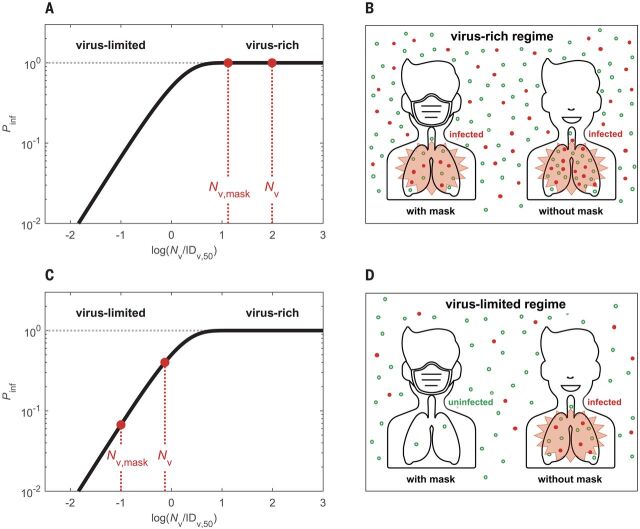
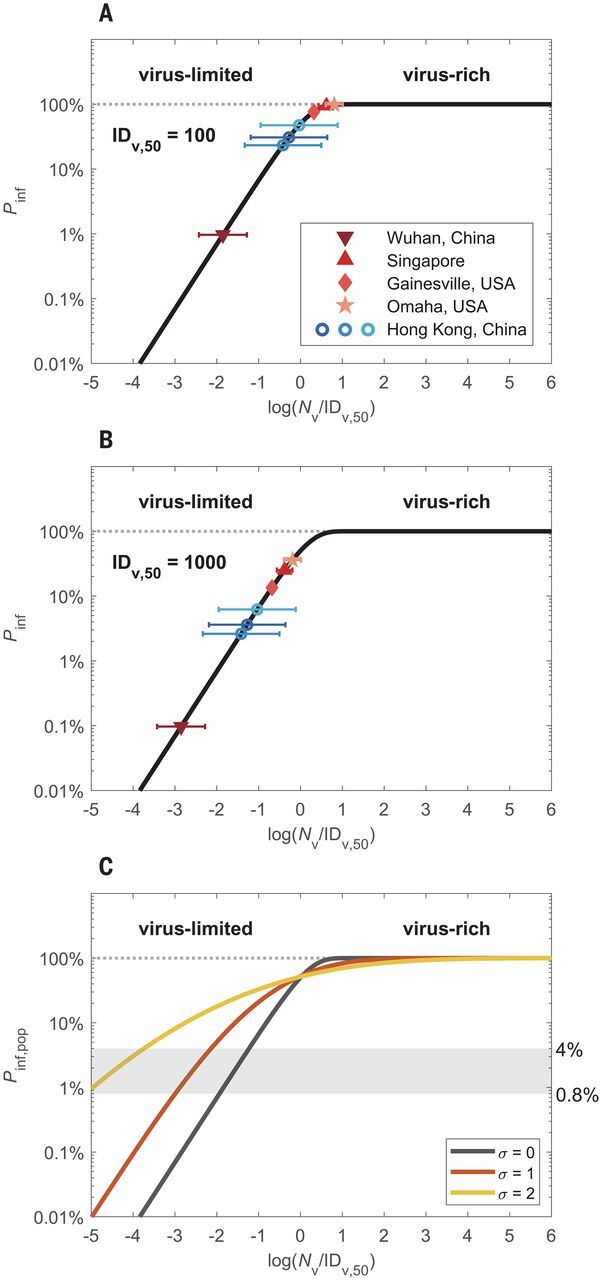
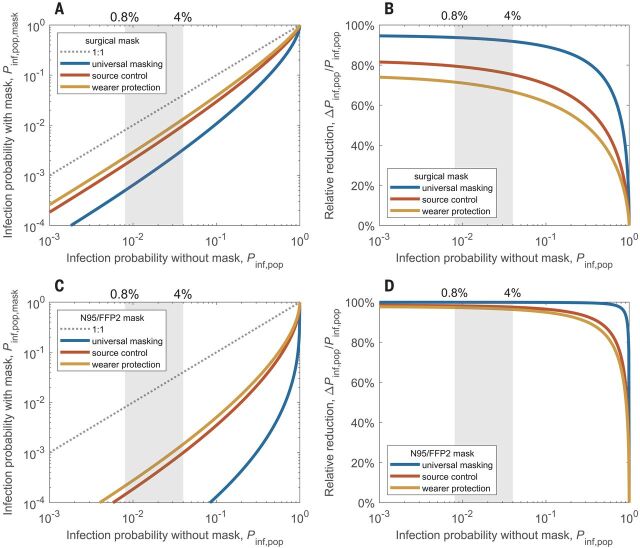
Airborne transmission by droplets and aerosols is important for the spread of viruses. Face masks are a well-established preventive measure, but their effectiveness for mitigating SARS-CoV-2 transmission is still under debate. We show that variations in mask efficacy can be explained by different regimes of virus abundance and related to population-average infection probability and reproduction number. For SARS-CoV-2, the viral load of infectious individuals can vary by orders of magnitude. We find that most environments and contacts are under conditions of low virus abundance (virus-limited) where surgical masks are effective at preventing virus spread. More advanced masks and other protective equipment are required in potentially virus-rich indoor environments including medical centers and hospitals. Masks are particularly effective in combination with other preventive measures like ventilation and distancing.
通过飞沫和气溶胶进行的空气传播对病毒传播很重要。口罩是一种既定的预防措施,但其减轻SARS-CoV-2传播的有效性仍在争论中。我们表明,口罩功效的差异可以由病毒丰度的不同状态来解释,并与人群平均感染概率和繁殖数相关。对于SARS-CoV-2,感染个体的病毒载量可能相差几个数量级。我们发现,大多数环境和接触处于低病毒丰度(病毒受限)条件下,此时外科口罩在预防病毒传播方面有效。在包括医疗中心和医院在内的潜在病毒丰富的室内环境中,需要更先进的口罩和其他防护设备。口罩与通风和保持社交距离等其他预防措施结合使用时特别有效。