Division of Infectious Diseases and Hospital Epidemiology, Cantonal Hospital St Gallen, St. Gallen, Switzerland.
Division of Infectious Diseases and Hospital Epidemiology, Cantonal Hospital Baden, Baden, Switzerland.
Antimicrob Resist Infect Control. 2023 Sep 8;12(1):98. doi: 10.1186/s13756-023-01300-5.
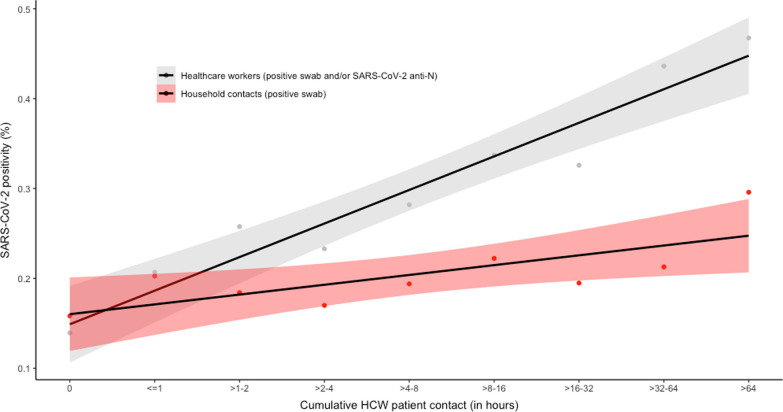
Few studies have assessed whether the increased SARS-CoV-2 risk of healthcare workers (HCW) is carried on to their household contacts. Within a prospective HCW cohort, we assessed the SARS-CoV-2 risk of household contacts of HCW depending on the HCWs cumulative exposure to COVID-19 patients and identified factors influencing this association.
HCW aged ≥ 16 years from nine Swiss healthcare networks participated. HCW without any household contacts were excluded. For HCW, cumulative patient exposure (number of COVID-19 patient contacts times average contact duration during a 12-month follow-up) was calculated. During follow-up, HCW reported SARS-CoV-2 nasopharyngeal swab results and positive swab results of their household contacts. We used multivariable logistic regression to identify variables associated with SARS-CoV-2 household positivity.
Of 2406 HCW, 466 (19%) reported ≥ 1 SARS-CoV-2 positive household. In multivariable analysis, patient exposure of HCW (adjusted OR [aOR] 1.08 per category, 95% CI 1.04-1.12), household size (aOR 1.53 per household member, 95% CI 1.35-1.73) and having children (aOR 0.70, 95% CI 0.53-0.94) remained associated with household positivity. Vaccinated HCW had a lower risk (aOR 0.54, 95% CI 0.38-0.77) of reporting a positive contact, as were those using respirator masks in contact with COVID-19 patients (aOR 0.65, 95% CI 0.49-0.86). Among vaccinated HCW, delayed first vaccination was associated with increased household SARS-CoV-2 positivity (aOR 1.14 per month, 95% CI 1.08-1.21).
SARS-CoV-2 positivity in household contacts of HCW increases with higher cumulative COVID-19 patient exposure of HCWs. Measures reducing the SARS-CoV-2 risk in HCW might indirectly reduce the infection risk of their households.
很少有研究评估医护人员(HCW)感染 SARS-CoV-2 的风险是否会传播给其家庭接触者。在一项前瞻性 HCW 队列研究中,我们评估了 HCW 家庭接触者感染 SARS-CoV-2 的风险,取决于 HCW 接触 COVID-19 患者的累积暴露量,并确定了影响这种关联的因素。
来自瑞士 9 个医疗保健网络的年龄≥16 岁的 HCW 参加了这项研究。不包括任何家庭接触者的 HCW 被排除在外。对于 HCW,计算累积的患者暴露量(COVID-19 患者接触次数乘以 12 个月随访期间的平均接触时间)。在随访期间,HCW 报告了 SARS-CoV-2 鼻咽拭子结果以及其家庭接触者的阳性拭子结果。我们使用多变量逻辑回归来确定与 SARS-CoV-2 家庭阳性相关的变量。
在 2406 名 HCW 中,466 名(19%)报告了≥1 例 SARS-CoV-2 阳性家庭接触者。在多变量分析中,HCW 的患者暴露量(每类别校正优势比[aOR] 1.08,95%CI 1.04-1.12)、家庭规模(每个家庭成员 aOR 1.53,95%CI 1.35-1.73)和有孩子(aOR 0.70,95%CI 0.53-0.94)与家庭阳性仍然相关。接种疫苗的 HCW 报告阳性接触的风险较低(aOR 0.54,95%CI 0.38-0.77),与 COVID-19 患者接触时使用呼吸器口罩的 HCW 也是如此(aOR 0.65,95%CI 0.49-0.86)。在接种疫苗的 HCW 中,首次接种延迟与家庭 SARS-CoV-2 阳性率增加有关(aOR 每月增加 1.14,95%CI 1.08-1.21)。
HCW 家庭接触者的 SARS-CoV-2 阳性率随着 HCW 接触 COVID-19 患者的累积暴露量增加而增加。降低 HCW 感染 SARS-CoV-2 风险的措施可能会间接降低其家庭的感染风险。