Yang Sheng-Yi, Huang Min, Wang Ai-Lian, Ge Ge, Ma Mi, Zhi Hong, Wang Li-Na
Department of Epidemiology and Biostatistics, Southeast University, Nanjing 210009, Jiangsu Province, China.
Yaohua Community Healthcare Center, Nanjing 210046, Jiangsu Province, China.
World J Clin Cases. 2022 Jan 21;10(3):939-953. doi: 10.12998/wjcc.v10.i3.939.
The increased stroke risk associated with atrial fibrillation (AF) burden exceeding 5 min is a matter of debate. In addition, the potential linear or nonlinear relationship between AF burden and stroke risk has been largely unexplored.
To determine the association between AF burden > 5 min and the increased risk of stroke and explore the potential dose-response relationship between these two factors.
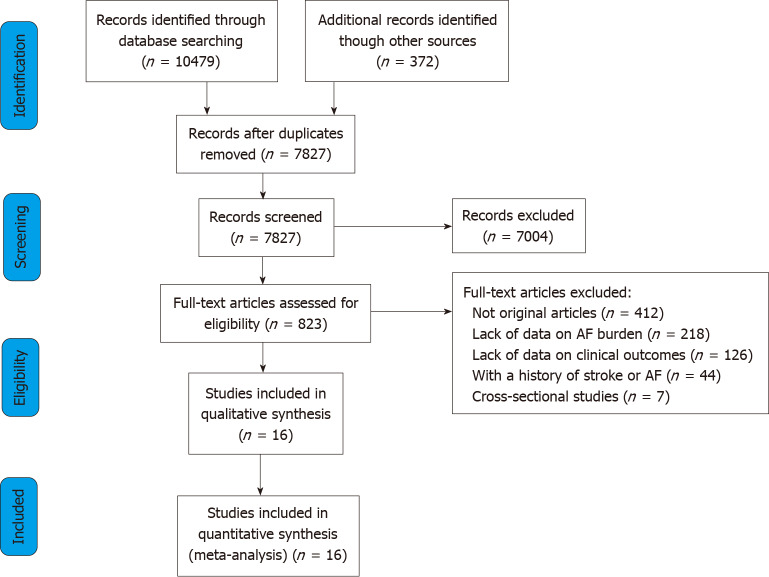
Sixteen studies from six databases with 53141 subjects (mean age 65 years) were included. Fifteen studies were observational studies, and one was a randomized controlled trial study. The potential nonlinear dose-response association was characterized using a restricted cubic splines regression model. AF burden for each 1 h and 2 h was associated with an increased risk of stroke. Trial sequential analysis with a random-effect model was used to evaluate the robustness of the evidence from the included 16 studies.
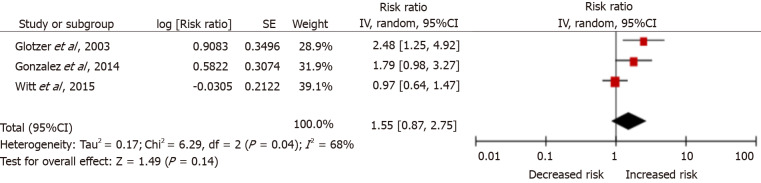
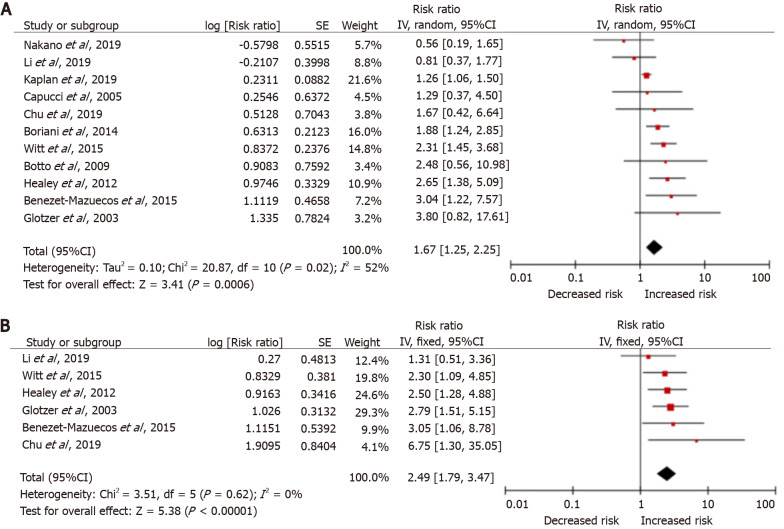
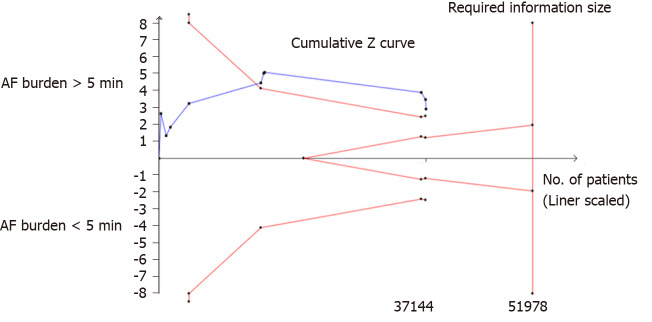
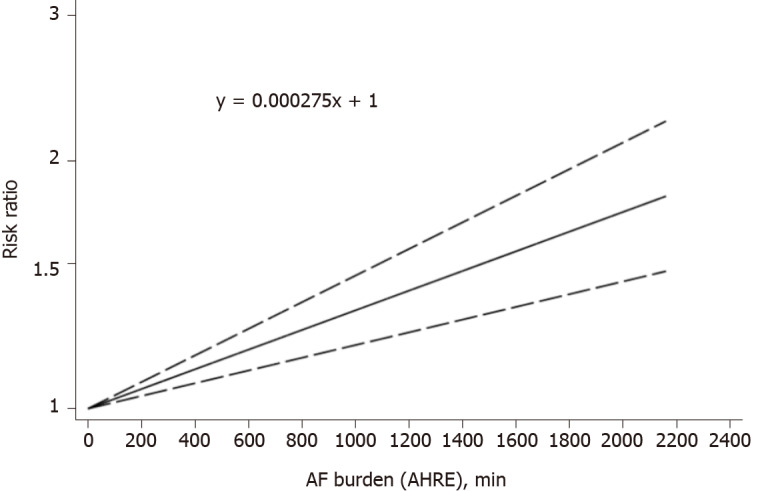
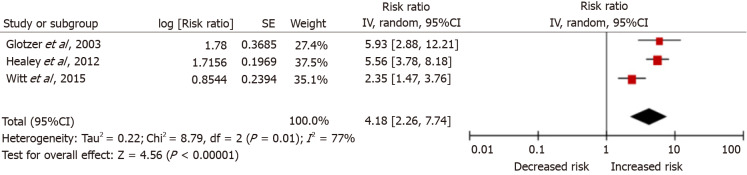
AF burden > 5 min was associated with an increased risk of clinical AF [adjusted risk ratio (RR) = 4.18, 95% confidence interval (CI): 2.26-7.74]. However, no association was found with an increased risk of all-cause mortality (adjusted RR = 1.55, 95%CI: 0.87-2.75). Patients with AF burden > 5 min had an increased risk of stroke (adjusted RR = 2.49, 95%CI: 1.79-3.47). Moreover, a dose-response analysis showed that the increased stroke risk was paralleled by an increase in AF burden at a rate of 2.0% hour ( = 0.656, RR = 1.02, 95%CI: 1.01-1.03). Trial sequential analysis provided robust evidence of the association between AF burden > 5 min and an increased risk of stroke.
AF burden was a significant risk factor for clinical AF and future stroke. A significant linear association was documented between increased AF burden and risk of future stroke.
房颤(AF)负荷超过5分钟与中风风险增加之间的关系存在争议。此外,AF负荷与中风风险之间潜在的线性或非线性关系在很大程度上尚未得到探索。
确定AF负荷>5分钟与中风风险增加之间的关联,并探讨这两个因素之间潜在的剂量反应关系。
纳入了来自六个数据库的16项研究,共53141名受试者(平均年龄65岁)。15项研究为观察性研究,1项为随机对照试验研究。使用受限立方样条回归模型来描述潜在的非线性剂量反应关联。每1小时和2小时的AF负荷与中风风险增加相关。采用随机效应模型的试验序贯分析来评估纳入的16项研究证据的稳健性。
AF负荷>5分钟与临床房颤风险增加相关[调整风险比(RR)=4.18,95%置信区间(CI):2.26-7.74]。然而,未发现与全因死亡率风险增加相关(调整RR=1.55,95%CI:0.87-2.75)。AF负荷>5分钟的患者中风风险增加(调整RR=2.49,95%CI:1.79-3.47)。此外,剂量反应分析表明,中风风险增加与AF负荷以每小时2.0%的速率增加平行( =0.656,RR=1.02,95%CI:1.01-1.03)。试验序贯分析为AF负荷>5分钟与中风风险增加之间的关联提供了有力证据。
AF负荷是临床房颤和未来中风的重要危险因素。记录到AF负荷增加与未来中风风险之间存在显著的线性关联。