Rafiq Rezwana, Ahmed Tanjeeb, Yusuf Sarwar Uddin Md
Institute of Transportation Studies, University of California, Irvine, CA 92697-3600, USA.
Department of Computer Science and Electrical Engineering, University of Missouri-Kansas City, MO 64110, USA.
Transp Res Interdiscip Perspect. 2022 Mar;13:100528. doi: 10.1016/j.trip.2021.100528. Epub 2021 Dec 29.
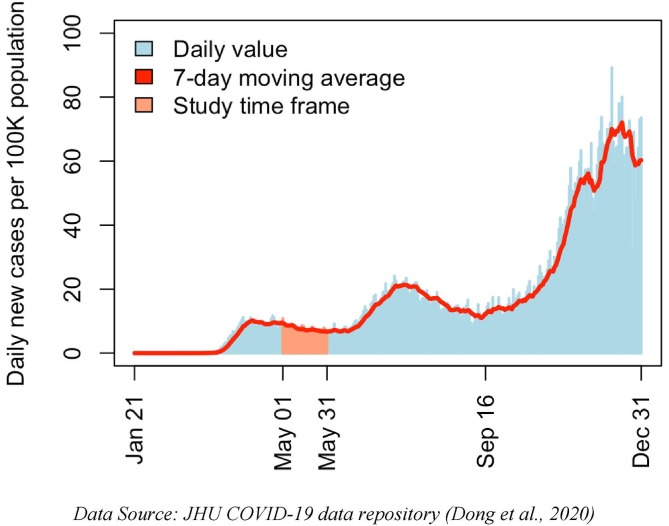
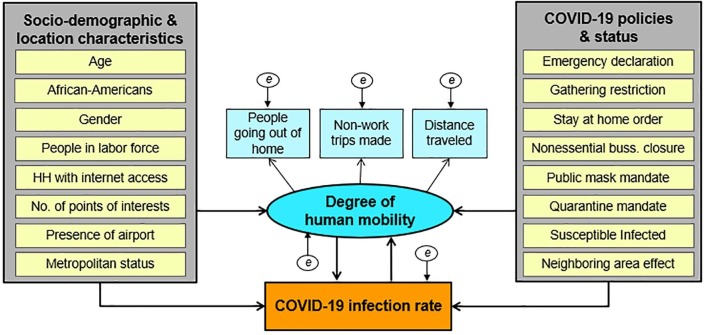
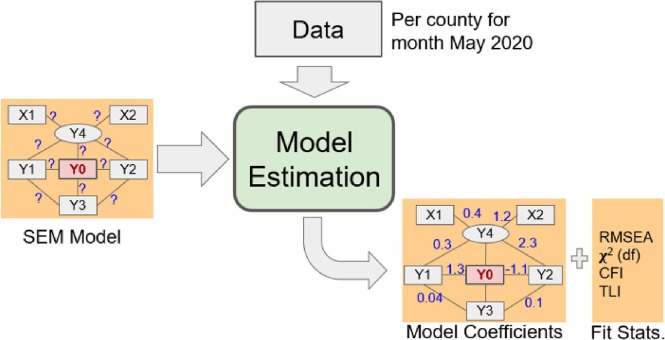
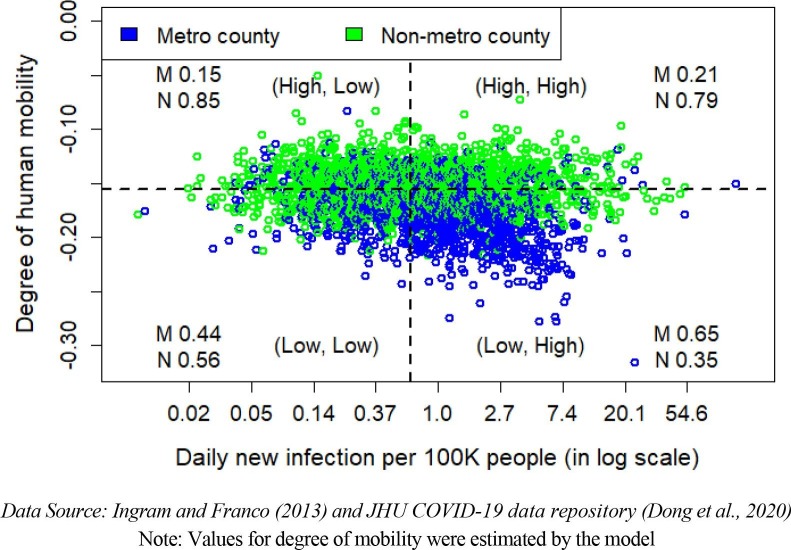
Human mobility is considered as one of the prominent non-pharmaceutical interventions to control the spread of the pandemic (positive effect from mobility to infection). Conversely, the spread of the pandemic triggered massive changes to people's daily schedules by limiting their movement (negative effect from infection to mobility). The purpose of this study is to investigate this bi-directional relationship between human mobility and COVID-19 spread across U.S. counties during the early phase of the pandemic when infection rates were stabilizing and activity-travel behavior reflected a fairly steady return to normal following the drastic changes observed during the pandemic's initial shock. In particular, we applied Structural Regression (SR) model to investigate a bi-directional relationship between COVID-19 infection rate and the degree of human mobility in a county in association with socio-demographic and location characteristics of that county, and state-wide COVID-19 policies. Combining U.S. county-level cross-sectional data from multiple sources, our model results suggested that during the study period, human mobility and infection rate in a county both influenced each other, but in an opposite direction. Metropolitan counties experienced higher infection and lower mobility than non-metropolitan counties in the early stage of the pandemic. Counties with highly infected neighboring counties and more external trips had a higher infection rate. During the study period, community mitigation strategies, such as stay at home order, emergency declaration, and non-essential business closure significantly reduced mobility whereas public mask mandate significantly reduced infection rates. The findings of this study will provide important insights to policy makers in understanding the two-way relationship between human mobility and COVID-19 spread and to derive mobility-driven policy actions accordingly.
人员流动被视为控制疫情传播的主要非药物干预措施之一(从流动到感染的正向影响)。相反,疫情的传播通过限制人们的行动引发了人们日常日程的巨大变化(从感染到流动的负向影响)。本研究的目的是调查在疫情初期感染率趋于稳定且活动出行行为在经历了疫情最初冲击期间的剧烈变化后呈现出相当稳定的恢复正常状态时,美国各县人员流动与新冠病毒传播之间的这种双向关系。具体而言,我们应用结构回归(SR)模型来研究一个县的新冠病毒感染率与人员流动程度之间的双向关系,同时考虑该县的社会人口统计学和地理位置特征以及全州范围的新冠疫情政策。结合来自多个来源的美国县级横断面数据,我们的模型结果表明,在研究期间,一个县的人员流动和感染率相互影响,但方向相反。在疫情初期,大都市县的感染率高于非大都市县,人员流动率则低于非大都市县。相邻县感染率高且外部出行较多的县感染率更高。在研究期间,诸如居家令、紧急声明和非必要商业关闭等社区缓解策略显著降低了人员流动,而公共口罩强制令则显著降低了感染率。本研究的结果将为政策制定者理解人员流动与新冠病毒传播之间的双向关系并据此制定由流动驱动的政策行动提供重要见解。