LPENS, PSL, CNRS, 24 rue Lhomond, 75005, Paris, France.
IBENS, PSL, CNRS, 46 rue d'Ulm, 75005, Paris, France.
Commun Biol. 2022 Feb 7;5(1):113. doi: 10.1038/s42003-022-03053-0.
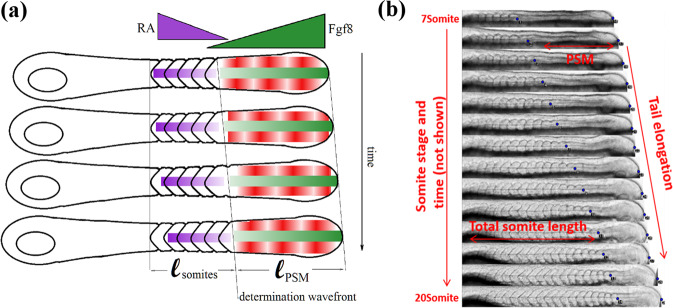
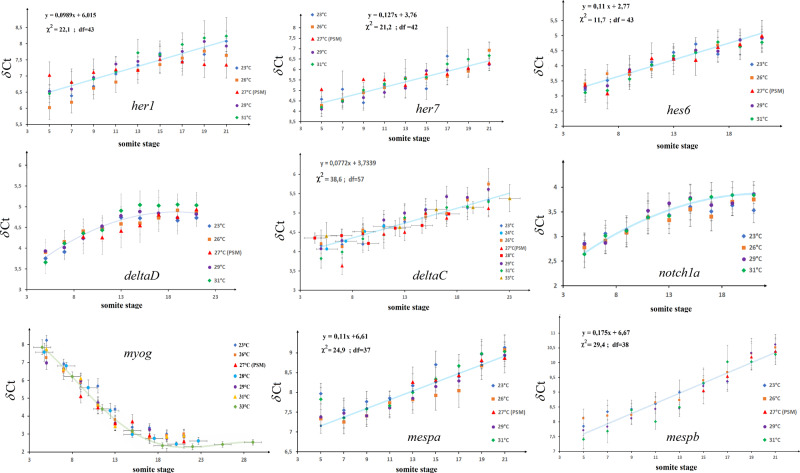
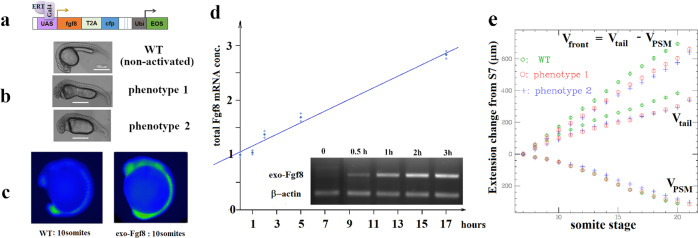
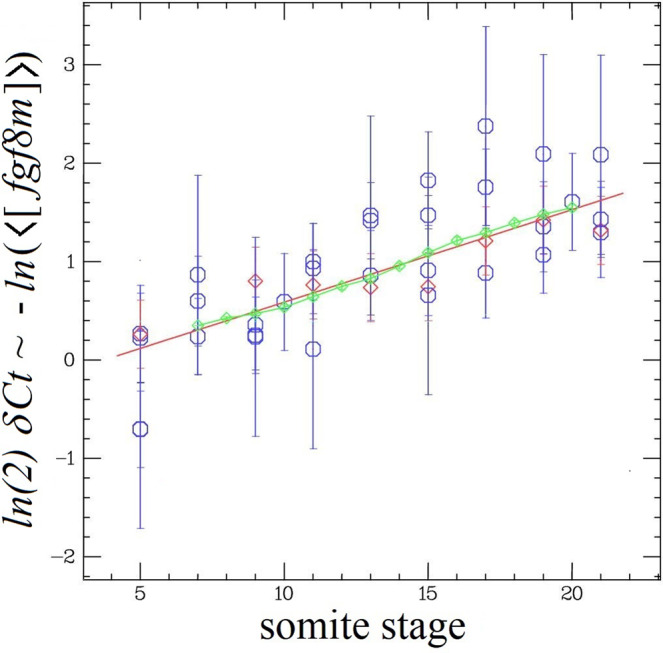
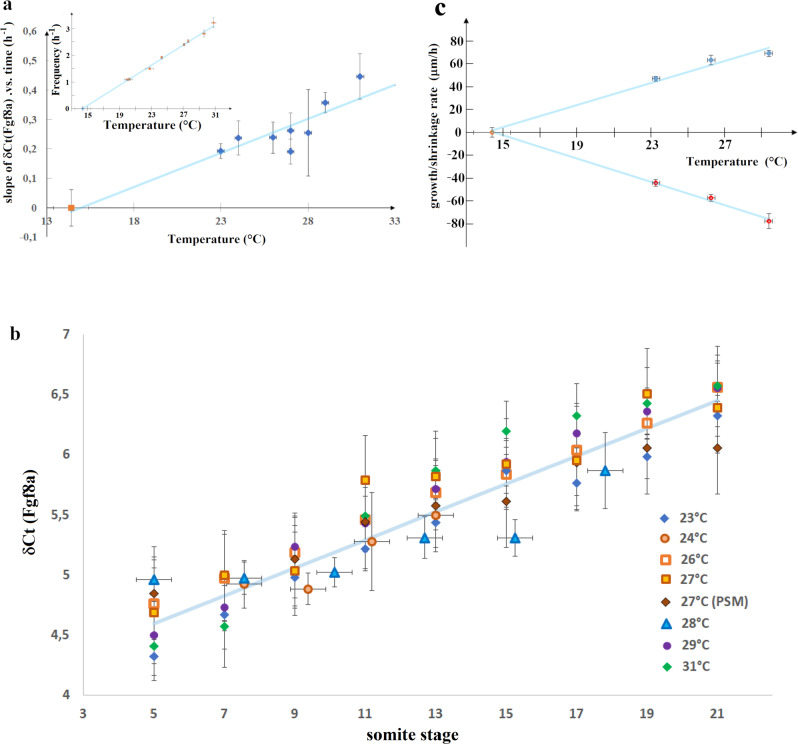
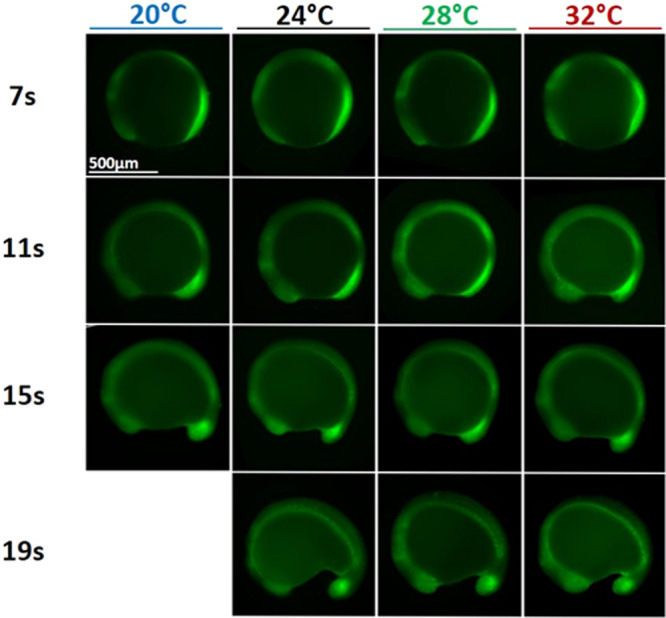
Somitogenesis, the segmentation of the antero-posterior axis in vertebrates, is thought to result from the interactions between a genetic oscillator and a posterior-moving determination wavefront. The segment (somite) size is set by the product of the oscillator period and the velocity of the determination wavefront. Surprisingly, while the segmentation period can vary by a factor three between 20 °C and 32 °C, the somite size is constant. How this temperature independence is achieved is a mystery that we address in this study. Using RT-qPCR we show that the endogenous fgf8 mRNA concentration decreases during somitogenesis and correlates with the exponent of the shrinking pre-somitic mesoderm (PSM) size. As the temperature decreases, the dynamics of fgf8 and many other gene transcripts, as well as the segmentation frequency and the PSM shortening and tail growth rates slows down as T-T (with T = 14.4 °C). This behavior characteristic of a system near a critical point may account for the temperature independence of somitogenesis in zebrafish.
体节发生,即脊椎动物前后轴的分段,被认为是由遗传振荡器和向后移动的决定波前之间的相互作用产生的。节(体节)的大小由振荡器周期和决定波前的速度的乘积决定。令人惊讶的是,虽然在 20°C 和 32°C 之间,分段周期可以变化三倍,但体节大小是恒定的。这种温度独立性是如何实现的是我们在本研究中解决的一个谜。使用 RT-qPCR,我们表明内源性 fgf8 mRNA 浓度在体节发生过程中降低,并与收缩前体节中胚层(PSM)大小的指数相关。随着温度的降低,fgf8 和许多其他基因转录本的动力学,以及分段频率以及 PSM 缩短和尾部生长速率都随着 T-T(T=14.4°C)而减慢。这种接近临界点的系统的行为特征可能解释了斑马鱼体节发生的温度独立性。