School of Psychology, Northwest Normal University, NO. 967 Anning East Road, Lanzhou, China.
Key Laboratory of Behavioral and Mental Health of Gansu, Lanzhou, China.
J Behav Med. 2023 Apr;46(1-2):303-310. doi: 10.1007/s10865-022-00292-8. Epub 2022 Feb 8.
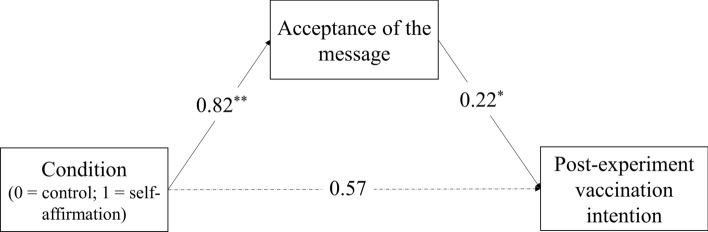
Previous studies have shown that self-affirmation increases acceptance of a message and motivates health behavior change. The present study investigated whether self-affirmation increases the acceptance of persuasive messages on COVID-19 vaccines and promotes vaccination intention. A total of 144 participants were randomly assigned to the self-affirmation (n = 72) or control (n = 72) groups before reading a persuasive message on COVID-19 vaccines. The results revealed that the self-affirmation group showed significantly higher acceptance of persuasive information on COVID-19 vaccines than the control group. Additionally, the self-affirmation group also showed significantly higher post-experiment vaccination intention than the control group. Mediation analysis indicated that increased acceptance of persuasive information significantly mediated the beneficial effects of self-affirmation on post-experiment vaccination intention. The present study demonstrated that self-affirmation could be an effective strategy for increasing the acceptance of persuasive messages on COVID-19 vaccines and promoting vaccination intention.
先前的研究表明,自我肯定可以提高对信息的接受度,并激发健康行为的改变。本研究旨在探讨自我肯定是否会增加对新冠疫苗的说服性信息的接受度,并促进接种意愿。共有 144 名参与者在阅读新冠疫苗的说服性信息之前被随机分配到自我肯定组(n=72)或对照组(n=72)。结果显示,自我肯定组对新冠疫苗的说服性信息的接受度明显高于对照组。此外,自我肯定组在实验后的接种意愿也明显高于对照组。中介分析表明,对说服性信息的接受度增加显著中介了自我肯定对实验后接种意愿的有益影响。本研究表明,自我肯定可以作为一种有效策略,提高对新冠疫苗的说服性信息的接受度,并促进接种意愿。