Department of Research and Development, Netherlands Comprehensive Cancer Organization (IKNL), Utrecht, The Netherlands.
Department of Medical Oncology, Northwest Clinics, Wilhelminalaan 12, Alkmaar 1815JD, The Netherlands.
Int J Qual Health Care. 2022 Mar 19;34(1). doi: 10.1093/intqhc/mzac007.
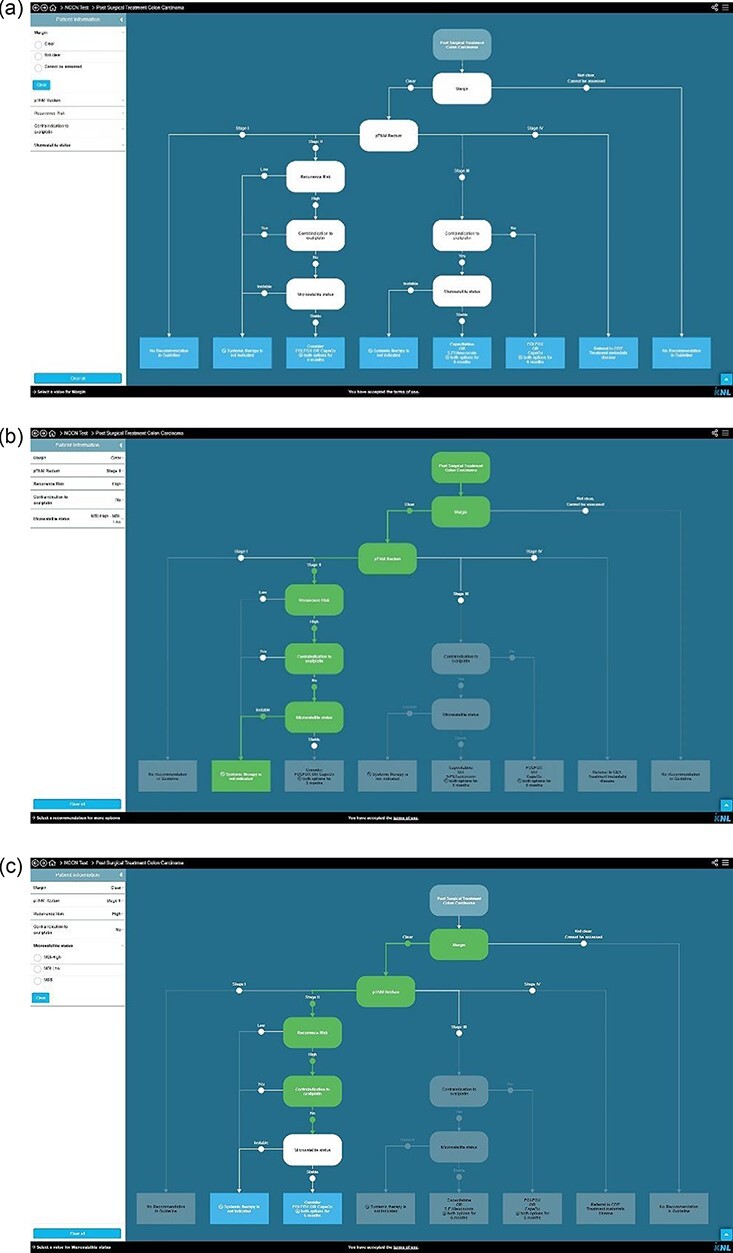
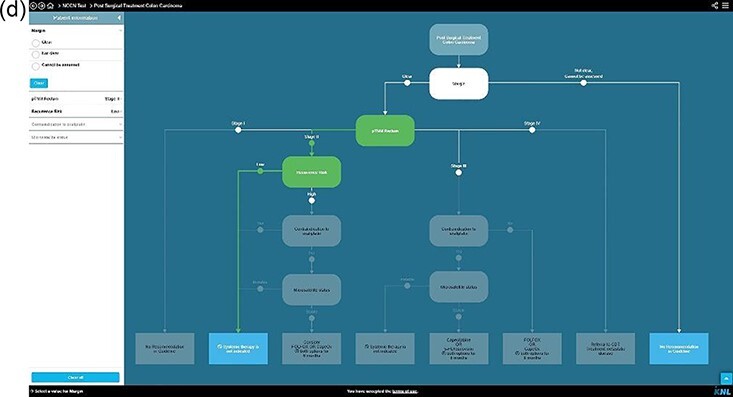
Multidisciplinary team meetings formulate guideline-based individual treatment plans based on patient and disease characteristics and motivate reasons for deviation. Clinical decision trees could support multidisciplinary teams to adhere more accurately to guidelines. Every clinical decision tree is tailored to a specific decision moment in a care pathway and is composed of patient and disease characteristics leading to a guideline recommendation.
This study investigated (1) the concordance between multidisciplinary team and clinical decision tree recommendations and (2) the completeness of patient and disease characteristics available during multidisciplinary team meetings to apply clinical decision trees such that it results in a guideline recommendation.
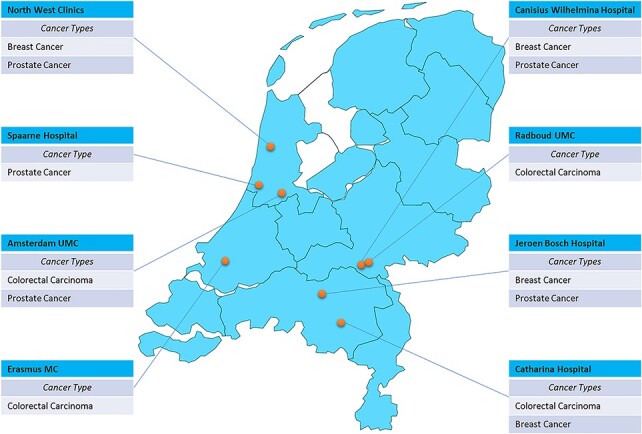
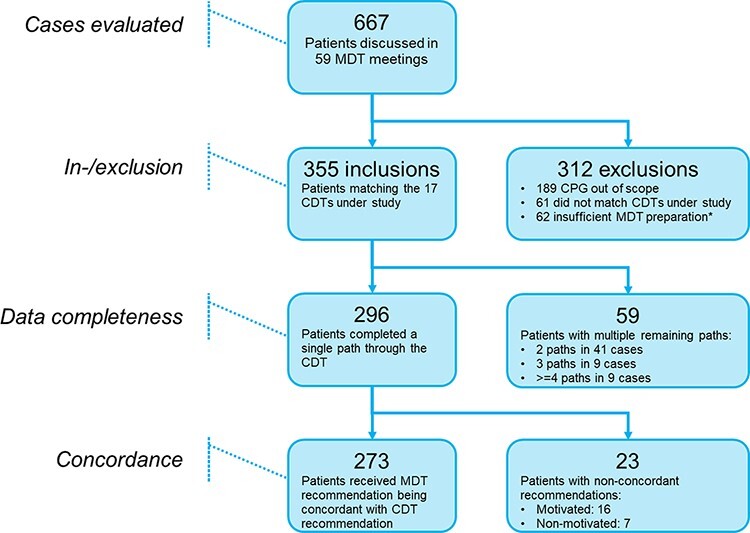
This prospective, multicenter, observational concordance study evaluated 17 selected clinical decision trees, based on the prevailing Dutch guidelines for breast, colorectal and prostate cancers. In cases with sufficient data, concordance between multidisciplinary team and clinical decision tree recommendations was classified as concordant, conditional concordant (multidisciplinary team specified a prerequisite for the recommendation) and non-concordant.
Fifty-nine multidisciplinary team meetings were attended in 8 different hospitals, and 355 cases were included. For 296 cases (83.4%), all patient data were available for providing an unconditional clinical decision tree recommendation. In 59 cases (16.6%), insufficient data were available resulting in provisional clinical decision tree recommendations. From the 296 successfully generated clinical decision tree recommendations, the multidisciplinary team recommendations were concordant in 249 (84.1%) cases, conditional concordant in 24 (8.1%) cases and non-concordant in 23 (7.8%) cases of which in 7 (2.4%) cases the reason for deviation from the clinical decision tree generated guideline recommendation was not motivated.
The observed concordance of recommendations between multidisciplinary teams and clinical decision trees and data completeness during multidisciplinary team meetings in this study indicate a potential role for implementation of clinical decision trees to support multidisciplinary team decision-making.
多学科团队会议根据患者和疾病特点制定基于指南的个体化治疗计划,并激发偏离指南的原因。临床决策树可以帮助多学科团队更准确地遵循指南。每一个临床决策树都是针对特定的治疗路径中的决策时刻定制的,由导致指南推荐的患者和疾病特征组成。
本研究旨在调查(1)多学科团队和临床决策树推荐的一致性,以及(2)多学科团队会议期间可用于应用临床决策树的患者和疾病特征的完整性,以便产生指南推荐。
这项前瞻性、多中心、观察性一致性研究评估了基于现行荷兰乳腺癌、结直肠癌和前列腺癌指南的 17 种临床决策树。在数据充足的情况下,多学科团队和临床决策树推荐的一致性分为一致、有条件一致(多学科团队指定了推荐的前提条件)和不一致。
在 8 家不同的医院参加了 59 次多学科团队会议,共纳入了 355 例患者。对于 296 例(83.4%)患者,所有患者数据都可用于提供无条件的临床决策树推荐。在 59 例(16.6%)患者中,数据不足导致了临时的临床决策树推荐。从 296 例成功生成的临床决策树推荐中,多学科团队的推荐在 249 例(84.1%)患者中是一致的,在 24 例(8.1%)患者中是有条件一致的,在 23 例(7.8%)患者中是不一致的,其中 7 例(2.4%)患者偏离了临床决策树生成的指南推荐的原因未被激发。
本研究中观察到的多学科团队和临床决策树推荐的一致性以及多学科团队会议期间患者数据的完整性表明,临床决策树的实施有可能支持多学科团队的决策。