• 文献检索
  • 文档翻译
  • 深度研究
  • 学术资讯
  • Suppr Zotero 插件Zotero 插件
  • 邀请有礼
  • 套餐&价格
  • 历史记录
应用&插件
Suppr Zotero 插件Zotero 插件浏览器插件Mac 客户端Windows 客户端微信小程序
定价
高级版会员购买积分包购买API积分包
服务
文献检索文档翻译深度研究API 文档MCP 服务
关于我们
关于 Suppr公司介绍联系我们用户协议隐私条款
关注我们

Suppr 超能文献

核心技术专利:CN118964589B侵权必究
粤ICP备2023148730 号-1Suppr @ 2026

文献检索

告别复杂PubMed语法,用中文像聊天一样搜索,搜遍4000万医学文献。AI智能推荐,让科研检索更轻松。

立即免费搜索

文件翻译

保留排版,准确专业,支持PDF/Word/PPT等文件格式,支持 12+语言互译。

免费翻译文档

深度研究

AI帮你快速写综述,25分钟生成高质量综述,智能提取关键信息,辅助科研写作。

立即免费体验

如何应对医保支付系统中持续的高/低费用支出者?

How to deal with persistently low/high spenders in health plan payment systems?

机构信息

Erasmus School of Health Policy & Management, Erasmus University Rotterdam, Rotterdam, The Netherlands.

出版信息

Health Econ. 2022 May;31(5):784-805. doi: 10.1002/hec.4477. Epub 2022 Feb 8.

DOI:10.1002/hec.4477
PMID:35137476
原文链接:https://pmc.ncbi.nlm.nih.gov/articles/PMC9305280/
Abstract

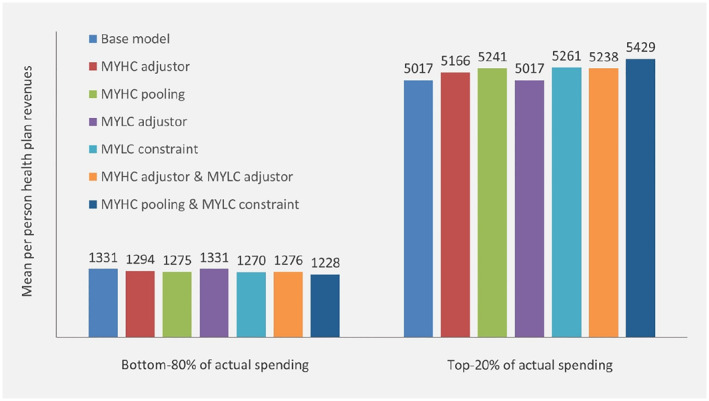
Health insurance markets with community-rated premiums typically include risk adjustment (RA) to mitigate selection problems. Over the past decades, RA systems have evolved from simple demographic models to sophisticated morbidity-based models. Even the most sophisticated models, however, tend to overcompensate people with persistently low spending and undercompensate those with persistently high spending. This paper compares three methods that exploit spending-level persistence for improving health plan payment systems: (1) implementation of spending-based risk adjustors, (2) implementation of high-risk pooling for people with multiple-year high spending, and (3) indirect use of spending persistence via constrained regression. Based on incentive measures for risk selection and cost control, we conclude that a combination of the last two options can substantially outperform the first, which is currently used in the health plan payment system in the Netherlands.

摘要

医疗保险市场通常采用按人头计费的保费,以减轻选择问题。在过去的几十年中,风险调整(RA)系统已经从简单的人口统计学模型发展到复杂的基于发病率的模型。然而,即使是最复杂的模型也往往会过度补偿持续低支出的人群,而对持续高支出的人群补偿不足。本文比较了三种利用支出水平持续性来改善医疗保险支付系统的方法:(1)实施基于支出的风险调整器,(2)对多年高支出人群实施高风险池,(3)通过约束回归间接利用支出持续性。基于风险选择和成本控制的激励措施,我们得出结论,最后两种选择的结合可以大大优于目前在荷兰医疗保险支付系统中使用的第一种选择。
https://cdn.ncbi.nlm.nih.gov/pmc/blobs/279c/9305280/f4fbdfc6e94b/HEC-31-784-g001.jpg
https://cdn.ncbi.nlm.nih.gov/pmc/blobs/279c/9305280/babae6220e41/HEC-31-784-g003.jpg
https://cdn.ncbi.nlm.nih.gov/pmc/blobs/279c/9305280/5f6ea6afb80b/HEC-31-784-g002.jpg
https://cdn.ncbi.nlm.nih.gov/pmc/blobs/279c/9305280/f4fbdfc6e94b/HEC-31-784-g001.jpg
https://cdn.ncbi.nlm.nih.gov/pmc/blobs/279c/9305280/babae6220e41/HEC-31-784-g003.jpg
https://cdn.ncbi.nlm.nih.gov/pmc/blobs/279c/9305280/5f6ea6afb80b/HEC-31-784-g002.jpg
https://cdn.ncbi.nlm.nih.gov/pmc/blobs/279c/9305280/f4fbdfc6e94b/HEC-31-784-g001.jpg

相似文献

1
How to deal with persistently low/high spenders in health plan payment systems?如何应对医保支付系统中持续的高/低费用支出者?
Health Econ. 2022 May;31(5):784-805. doi: 10.1002/hec.4477. Epub 2022 Feb 8.
2
Very high and low residual spenders in private health insurance markets: Germany, The Netherlands and the U.S. Marketplaces.私人医疗保险市场中高和低剩余支出者:德国、荷兰和美国市场。
Eur J Health Econ. 2021 Feb;22(1):35-50. doi: 10.1007/s10198-020-01227-3. Epub 2020 Aug 29.
3
Extreme under and overcompensation in morbidity-based health plan payments: The case of Switzerland.基于发病率的医疗保险支付中的过度补偿和不足补偿:瑞士的案例。
Health Policy. 2020 Jan;124(1):61-68. doi: 10.1016/j.healthpol.2019.11.008. Epub 2019 Nov 23.
4
Examining unpriced risk heterogeneity in the Dutch health insurance market.考察荷兰健康保险市场中未定价风险的异质性。
Eur J Health Econ. 2018 Dec;19(9):1351-1363. doi: 10.1007/s10198-018-0979-x. Epub 2018 Apr 18.
5
Risk equalization in competitive health insurance markets: Identifying healthy individuals on the basis of multiple-year low spending.竞争性健康保险市场中的风险均衡:基于多年低支出识别健康个体。
Health Serv Res. 2019 Apr;54(2):455-465. doi: 10.1111/1475-6773.13065. Epub 2018 Oct 16.
6
Incorporating self-reported health measures in risk equalization through constrained regression.通过约束回归将自我报告的健康措施纳入风险均等化。
Eur J Health Econ. 2020 Jun;21(4):513-528. doi: 10.1007/s10198-019-01146-y. Epub 2020 Jan 8.
7
Persistence in health expenditures in the short run: prevalence and consequences.短期内医疗支出的持续性:患病率及后果
Med Care. 2003 Jul;41(7 Suppl):III53-III64. doi: 10.1097/01.MLR.0000076046.46152.EF.
8
Improving diagnosis-based cost groups in the Dutch risk equalization model: the effects of a new clustering method and allowing for multimorbidity.改进荷兰风险均等化模型中的基于诊断的费用分组:一种新聚类方法和允许多病共存的影响。
Int J Health Econ Manag. 2023 Jun;23(2):303-324. doi: 10.1007/s10754-023-09345-0. Epub 2023 Mar 2.
9
How the COVID-19 pandemic can distort risk adjustment of health plan payment.新冠疫情如何扭曲医保计划支付的风险调整
Eur J Health Econ. 2021 Sep;22(7):1005-1016. doi: 10.1007/s10198-021-01346-5. Epub 2021 Jul 15.
10
Integrating risk adjustment and enrollee premiums in health plan payment.在健康计划支付中整合风险调整与参保人保费。
J Health Econ. 2013 Dec;32(6):1263-77. doi: 10.1016/j.jhealeco.2013.05.002.

引用本文的文献

1
A critical review of the use of R in risk equalization research.对R在风险均等化研究中的应用的批判性综述。
Eur J Health Econ. 2025 Apr;26(3):363-375. doi: 10.1007/s10198-024-01709-8. Epub 2024 Aug 9.
2
A framework for ex-ante evaluation of the potential effects of risk equalization and risk sharing in health insurance markets with regulated competition.一个用于对具有监管竞争的健康保险市场中风险均等化和风险分担的潜在影响进行事前评估的框架。
Health Econ Rev. 2024 Jul 24;14(1):57. doi: 10.1186/s13561-024-00540-4.
3
High-risk pooling for mitigating risk selection incentives in health insurance markets with sophisticated risk equalization: an application based on health survey information.

本文引用的文献

1
Improving the Performance of Risk Adjustment Systems: Constrained Regressions, Reinsurance, and Variable Selection.提升风险调整系统的性能:约束回归、再保险与变量选择
Am J Health Econ. 2021 Fall;7(4):497-521. doi: 10.1086/716199. Epub 2021 Oct 4.
2
Screening in Contract Design: Evidence from the ACA Health Insurance Exchanges.合同设计中的筛选:来自《平价医疗法案》医疗保险交易所的证据。
Am Econ J Econ Policy. 2019 May;11(2):64-107. doi: 10.1257/pol.20170014.
3
Upcoding: Evidence from Medicare on Squishy Risk Adjustment.高编计费:来自医疗保险关于模糊风险调整的证据。
高风险池在医疗保险市场中缓解复杂风险均衡的风险选择激励:基于健康调查信息的应用。
BMC Health Serv Res. 2024 Mar 4;24(1):273. doi: 10.1186/s12913-024-10774-x.
4
Risk adjustment for regional healthcare funding allocations with ensemble methods: an empirical study and interpretation.基于集成方法的区域医疗保健资金分配风险调整:实证研究与解释。
Eur J Health Econ. 2024 Sep;25(7):1117-1131. doi: 10.1007/s10198-023-01656-w. Epub 2024 Jan 3.
5
Heteroscedasticity of residual spending after risk equalization: a potential source of selection incentives in health insurance markets with premium regulation.风险均衡后剩余支出的异方差性:保费监管下医疗保险市场中选择激励的潜在来源。
Eur J Health Econ. 2024 Apr;25(3):379-396. doi: 10.1007/s10198-023-01592-9. Epub 2023 May 10.
J Polit Econ. 2020 Mar;12(3):984-1026. doi: 10.1086/704756. Epub 2020 Jan 29.
4
Incorporating self-reported health measures in risk equalization through constrained regression.通过约束回归将自我报告的健康措施纳入风险均等化。
Eur J Health Econ. 2020 Jun;21(4):513-528. doi: 10.1007/s10198-019-01146-y. Epub 2020 Jan 8.
5
Estimating Morbidity Rates Based on Routine Electronic Health Records in Primary Care: Observational Study.基于基层医疗中常规电子健康记录估算发病率:观察性研究。
JMIR Med Inform. 2019 Jul 26;7(3):e11929. doi: 10.2196/11929.
6
Selection Incentives for Health Insurers in the Presence of Sophisticated Risk Adjustment.存在复杂风险调整时,对健康保险公司的选择激励。
Med Care Res Rev. 2020 Dec;77(6):584-595. doi: 10.1177/1077558719825982. Epub 2019 Feb 1.
7
Strategic Formulary Design in Medicare Part D Plans.医疗保险D部分计划中的战略处方集设计。
Am Econ J Econ Policy. 2018 Aug;10(3):154-192. doi: 10.1257/pol.20160248.
8
Risk equalization in competitive health insurance markets: Identifying healthy individuals on the basis of multiple-year low spending.竞争性健康保险市场中的风险均衡:基于多年低支出识别健康个体。
Health Serv Res. 2019 Apr;54(2):455-465. doi: 10.1111/1475-6773.13065. Epub 2018 Oct 16.
9
Deriving risk adjustment payment weights to maximize efficiency of health insurance markets.推导出风险调整支付权重以最大化医疗保险市场效率。
J Health Econ. 2018 Sep;61:93-110. doi: 10.1016/j.jhealeco.2018.07.001. Epub 2018 Jul 23.
10
Plan responses to diagnosis-based payment: Evidence from Germany's morbidity-based risk adjustment.基于诊断的支付方案应对策略:来自德国基于发病率风险调整的证据。
J Health Econ. 2017 Dec;56:397-413. doi: 10.1016/j.jhealeco.2017.03.001.