Corica Bernadette, Bonini Niccolò, Imberti Jacopo Francesco, Romiti Giulio Francesco, Vitolo Marco, Attanasio Lisa, Basili Stefania, Freedman Ben, Potpara Tatjana S, Boriani Giuseppe, Lip Gregory Y H, Proietti Marco
Liverpool Centre for Cardiovascular Science at University of Liverpool, Liverpool John Moores University and Liverpool Heart and Chest Hospital, 6 West Derby Street, Liverpool L7 8TX, UK.
Department of Translational and Precision Medicine, Sapienza University of Rome, Viale del Policlinico 155, Rome 00161, Italy.
Eur Heart J Open. 2023 Mar 22;3(2):oead031. doi: 10.1093/ehjopen/oead031. eCollection 2023 Mar.
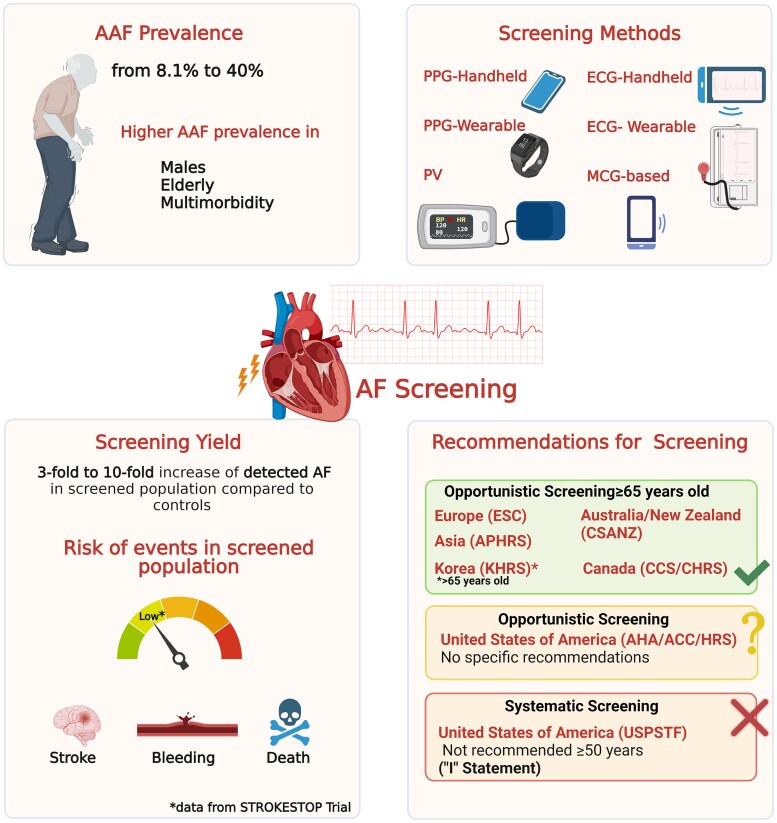
Atrial fibrillation (AF) is the most prevalent arrhythmia worldwide. The presence of AF is associated with increased risk of systemic thromboembolism, but with the uptake of oral anticoagulant (OAC) and implementation of a holistic and integrated care management, this risk is substantially reduced. The diagnosis of AF requires a 30-s-long electrocardiographic (ECG) trace, irrespective of the presence of symptoms, which may represent the main indication for an ECG tracing. However, almost half patients are asymptomatic at the time of incidental AF diagnosis, with similar risk of stroke of those with clinical AF. This has led to a crucial role of screening for AF, to increase the diagnosis of population at risk of clinical events. The aim of this review is to give a comprehensive overview about the epidemiology of asymptomatic AF, the different screening technologies, the yield of diagnosis in asymptomatic population, and the benefit derived from screening in terms of reduction of clinical adverse events, such as stroke, cardiovascular, and all-cause death. We aim to underline the importance of implementing AF screening programmes and reporting about the debate between scientific societies' clinical guidelines recommendations and the concerns expressed by the regulatory authorities, which still do not recommend population-wide screening. This review summarizes data on the ongoing trials specifically designed to investigate the benefit of screening in terms of risk of adverse events which will further elucidate the importance of screening in reducing risk of outcomes and influence and inform clinical practice in the next future.
心房颤动(AF)是全球最常见的心律失常。AF的存在与全身血栓栓塞风险增加相关,但随着口服抗凝剂(OAC)的应用以及全面综合护理管理的实施,这种风险大幅降低。AF的诊断需要30秒时长的心电图(ECG)记录,无论有无症状,而症状可能是进行ECG记录的主要指征。然而,几乎一半的患者在偶然诊断出AF时无症状,其卒中风险与临床AF患者相似。这使得AF筛查发挥关键作用,以增加对有临床事件风险人群的诊断。本综述的目的是全面概述无症状AF的流行病学、不同的筛查技术、无症状人群的诊断率,以及筛查在降低临床不良事件(如卒中、心血管疾病和全因死亡)方面的益处。我们旨在强调实施AF筛查计划的重要性,并报告科学协会临床指南建议与监管机构所表达的担忧之间的争论,监管机构目前仍不建议进行全人群筛查。本综述总结了正在进行的试验数据,这些试验专门设计用于研究筛查在不良事件风险方面的益处,这将进一步阐明筛查在降低结局风险方面的重要性,并在未来影响和指导临床实践。