Chair of Cardiology, Department of Translational Medical Sciences, University of Campania "Luigi Vanvitelli", Monaldi Hospital, P.Zzale Ettore Ruggeri, 80131, Naples, Italy.
Department of Political Sciences, University of Naples Federico II, Naples, Italy.
Eur J Clin Pharmacol. 2022 May;78(5):879-886. doi: 10.1007/s00228-022-03286-2. Epub 2022 Feb 9.
Older age is associated with inappropriate dose prescription of direct oral anticoagulants. The aim of our study was to describe the prevalence and the clinical predictors of inappropriate DOACs dosage among octogenarians in real-world setting.
Data for this study were sourced from the multicenter prospectively maintained Atrial Fibrillation (AF) Research Database (NCT03760874). Of the AF patients aged ≥ 80 who received DOACs treatment, 253 patients were selected. Participants were categorized as appropriate dosage, overdosage, or underdosage. Underdosage and overdosage were, respectively, defined as administration of a lower or higher DOAC dose than recommended in the EHRA consensus.
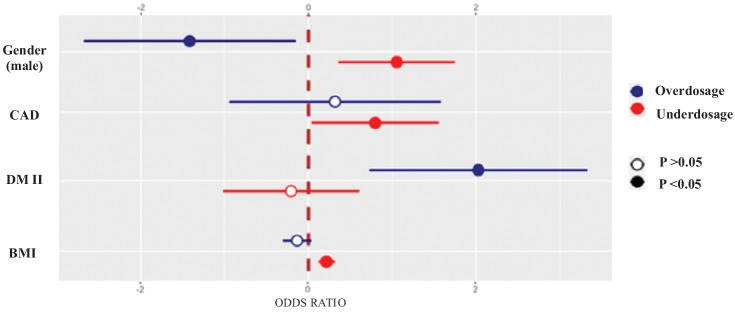
A total of 178 patients (71%) received appropriate DOACs dose and 75 patients (29%) inappropriate DOACs dose; among them, 19 patients (25.6%) were overdosed and 56 (74.4%) were underdosed. Subgroup analysis demonstrated that underdosage was independently associated with male gender [OR = 3.15 (95% IC; 1.45-6.83); p < 0.001], coronary artery disease [OR = 3.60 (95% IC 1.45-9.10); p < 0.001] and body mass index [OR = 1.27 (1.14-1.41); p < 0.001]. Overdosage was independently associated with diabetes mellitus [OR = 18 (3.36-96); p < 0.001], with age [OR = 0.76 (95% IC; 0.61-0.96; p = 0.045], BMI [OR = 0.77 (95% IC; 0.62-0.97; p = 0.043] and with previous bleedings [OR = 6.40 (0.7; 1.43-28); p = 0.039]. There wasn't significant difference in thromboembolic, major bleeding events and mortality among different subgroups. Underdosage group showed a significatively lower survival compared with appropriate dose group (p < 0.001).
In our analysis, nearly one-third of octogenarians with AF received an inappropriate dose of DOAC. Several clinical factors were associated with DOACs' overdosage (diabetes mellitus type II, previous bleeding) or underdosage (male gender, coronary artery disease, and higher body mass index). Octogenarians with inappropriate DOACs underdosage showed less survival.
年龄较大与直接口服抗凝剂的不适当剂量处方有关。本研究的目的是描述真实世界中 80 岁以上人群中 DOAC 剂量不适当的发生率和临床预测因素。
本研究的数据来自多中心前瞻性维持的心房颤动(AF)研究数据库(NCT03760874)。在接受 DOAC 治疗的年龄≥80 岁的 AF 患者中,选择了 253 名患者。将参与者分为适当剂量组、超剂量组和低剂量组。低剂量和高剂量分别定义为低于 EHRA 共识推荐的 DOAC 剂量和高于推荐剂量。
共有 178 名患者(71%)接受了适当的 DOAC 剂量,75 名患者(29%)接受了不适当的 DOAC 剂量;其中 19 名患者(25.6%)剂量过高,56 名患者(74.4%)剂量过低。亚组分析表明,男性[比值比(OR)=3.15(95%置信区间;1.45-6.83);p<0.001]、冠状动脉疾病[OR=3.60(95%置信区间 1.45-9.10);p<0.001]和体重指数[OR=1.27(1.14-1.41);p<0.001]与剂量过低独立相关。剂量过高与糖尿病[OR=18(3.36-96);p<0.001]、年龄[OR=0.76(95%置信区间;0.61-0.96;p=0.045]、体重指数[OR=0.77(95%置信区间;0.62-0.97;p=0.043]和既往出血[OR=6.40(0.7;1.43-28);p=0.039]独立相关。不同亚组之间在血栓栓塞、大出血事件和死亡率方面无显著差异。与适当剂量组相比,剂量过低组的生存率显著降低(p<0.001)。
在我们的分析中,近三分之一的 80 岁以上 AF 患者接受了不适当的 DOAC 剂量。一些临床因素与 DOAC 剂量过高(2 型糖尿病、既往出血)或过低(男性、冠状动脉疾病和较高的体重指数)有关。接受 DOAC 剂量过低的 80 岁以上患者生存率较低。