Faculty of Science and Engineering, School of Mathematical Sciences, University of Nottingham Malaysia, Jalan Broga, Semenyih, Selangor, Malaysia.
Department of Public Health and Primary Care, Centre for Cancer Genetic Epidemiology, University of Cambridge, Cambridge, United Kingdom.
J Clin Oncol. 2022 May 10;40(14):1542-1551. doi: 10.1200/JCO.21.01647. Epub 2022 Feb 10.
With the development of poly (ADP-ribose) polymerase inhibitors for treatment of patients with cancer with an altered or gene, there is an urgent need to ensure that there are appropriate strategies for identifying mutation carriers while balancing the increased demand for and cost of cancer genetics services. To date, the majority of mutation prediction tools have been developed in women of European descent where the age and cancer-subtype distributions are different from that in Asian women.
In this study, we built a new model (Asian Risk Calculator) for estimating the likelihood of carrying a pathogenic variant in or gene, using germline genetic testing results in a cross-sectional population-based study of 8,162 Asian patients with breast cancer. We compared the model performance to existing mutation prediction models. The models were evaluated for discrimination and calibration.
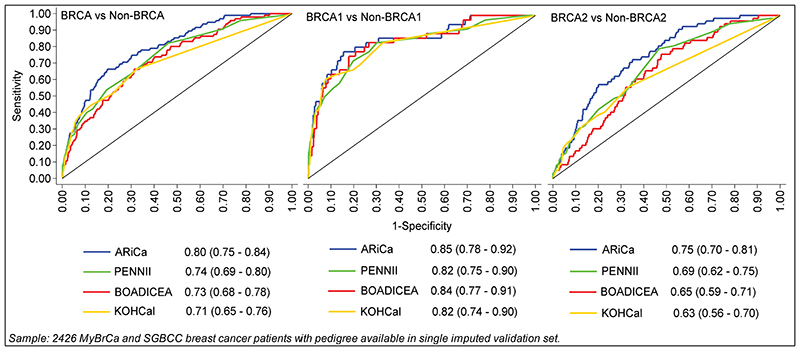
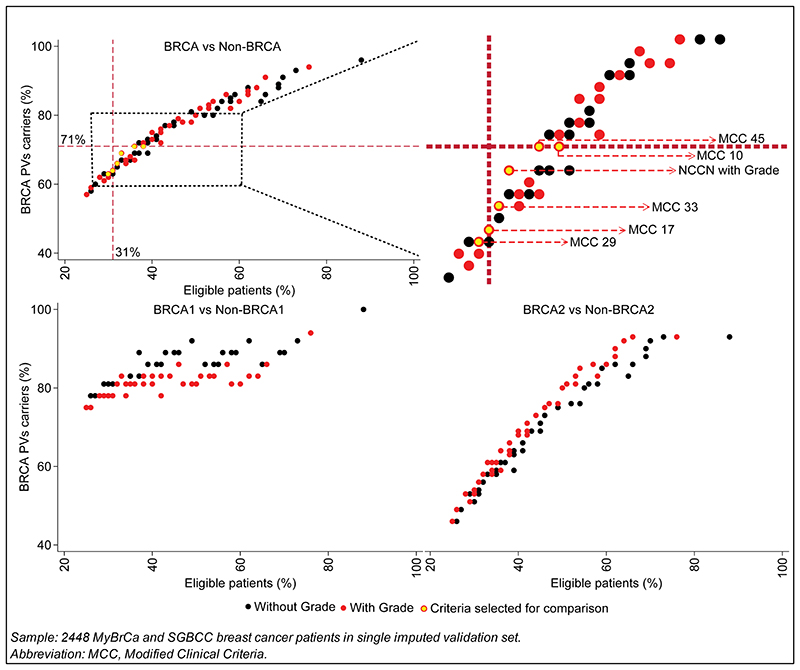
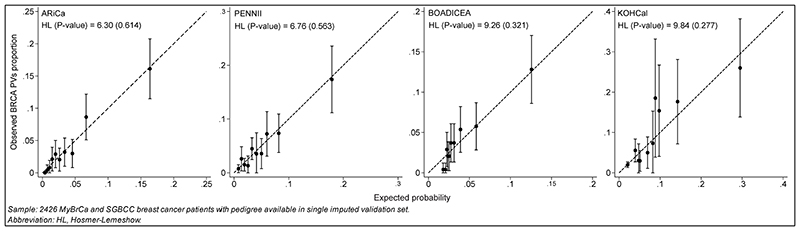
Asian Risk Calculator included age of diagnosis, ethnicity, bilateral breast cancer, tumor biomarkers, and family history of breast cancer or ovarian cancer as predictors. The inclusion of tumor grade improved significantly the model performance. The full model was calibrated (Hosmer-Lemeshow value = .614) and discriminated well between and non- pathogenic variant carriers (area under receiver operating curve, 0.80; 95% CI, 0.75 to 0.84). Addition of grade to the existing clinical genetic testing criteria targeting patients with breast cancer age younger than 45 years reduced the proportion of patients referred for genetic counseling and testing from 37% to 33% ( value = .003), thereby improving the overall efficacy.
Population-specific customization of mutation prediction models and clinical genetic testing criteria improved the accuracy of BRCA mutation prediction in Asian patients.
随着聚(ADP-核糖)聚合酶抑制剂在治疗携带 或 基因突变的癌症患者中的发展,迫切需要确保有适当的策略来识别突变携带者,同时平衡癌症遗传学服务的需求增加和成本。迄今为止,大多数突变预测工具都是在欧洲血统的女性中开发的,其年龄和癌症亚型分布与亚洲女性不同。
在这项研究中,我们使用基于横断面的 8162 例亚洲乳腺癌患者的种系基因检测结果,构建了一个新的模型(亚洲风险计算器),用于估计携带 或 基因致病性变异的可能性。我们比较了该模型与现有突变预测模型的性能。评估了模型的区分度和校准度。
亚洲风险计算器包括诊断年龄、种族、双侧乳腺癌、肿瘤生物标志物以及乳腺癌或卵巢癌家族史作为预测因素。肿瘤分级的纳入显著提高了模型性能。全模型校准良好(Hosmer-Lemeshow 值=0.614),并能很好地区分 和非致病性变异携带者(接收者操作特征曲线下面积,0.80;95%置信区间,0.75 至 0.84)。将肿瘤分级添加到针对 45 岁以下乳腺癌患者的现有临床遗传检测标准中,将需要进行遗传咨询和检测的患者比例从 37%降低到 33%( 值=0.003),从而提高了整体疗效。
对突变预测模型和临床遗传检测标准进行人群特异性定制,提高了亚洲患者 BRCA 突变预测的准确性。