Hu Huiling, Wang Chongkun, Lan Yue, Wu Xue
School of Nursing, Peking University, Beijing, 100191, P.R. China.
BMC Nurs. 2022 Feb 10;21(1):43. doi: 10.1186/s12912-022-00821-5.
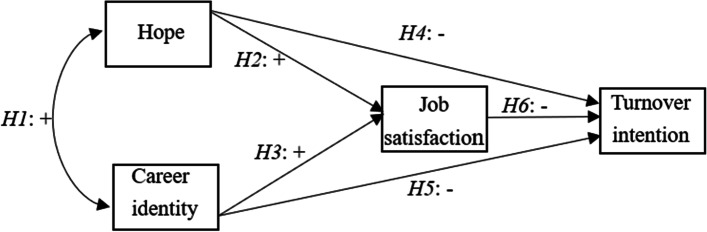
A high turnover rate has become a critical issue in the field of nursing and how to tackle the problem of nursing turnover has received increased attention worldwide. Hope, career identity, job satisfaction may be useful for reducing turnover. The aim of this study is to explore the relationships among career identity, hope, job satisfaction, and the turnover intention of nurses, and to test the mediating role of job satisfaction on the associations of hope and career identity with turnover intention.
A descriptive cross-sectional design was used. A total of 500 nurses were recruited from five comprehensive tertiary hospitals using convenience sampling. The questionnaire included items about sociodemographic information as well as the Adult Dispositional Hope Scale, Nursing Career Identity Scale, Job Satisfaction Index Scale, and Nurse Turnover Intention Scale. Pearson's correlation, multiple linear regression, and structural equation modeling were used to analyze the data. We describe the study in accordance with the STROBE statement.
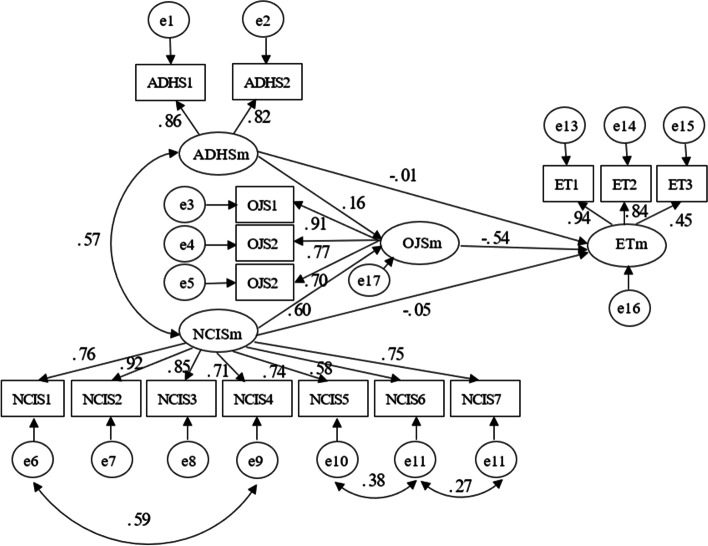
Hope (r = - 0.227, p < 0.001) and career identity (r = - 0.342, p < 0.001) were negatively correlated with turnover intention. Job satisfaction played a completely mediating role on the associations of hope and career identity with turnover intention (β = - 0.09, β = - 0.33).
Job satisfaction mediated the associations of career identity and hope with turnover intention. Thus, effective measures can be taken to enhance nurses' hope and career identity in order to improve their job satisfaction and thereby reduce their turnover intention. Providing nurses with more support, helping them find a spiritual foundation, and holding mindful activities that stimulate positive emotions are helpful. In addition, colleges should pay more attention to instilling nursing students with career identity and nursing values.
高离职率已成为护理领域的一个关键问题,如何解决护理人员离职问题在全球范围内受到了越来越多的关注。希望、职业认同、工作满意度可能有助于减少离职。本研究旨在探讨职业认同、希望、工作满意度与护士离职意愿之间的关系,并检验工作满意度在希望和职业认同与离职意愿关联中的中介作用。
采用描述性横断面设计。通过便利抽样从五家综合性三级医院招募了共500名护士。问卷包括社会人口学信息项目以及成人特质希望量表、护理职业认同量表、工作满意度指数量表和护士离职意愿量表。采用Pearson相关性分析、多元线性回归分析和结构方程模型分析数据。我们按照STROBE声明对本研究进行描述。
希望(r = -0.227,p < 0.001)和职业认同(r = -0.342,p < 0.001)与离职意愿呈负相关。工作满意度在希望和职业认同与离职意愿的关联中起完全中介作用(β = -0.09,β = -0.33)。
工作满意度介导了职业认同和希望与离职意愿的关联。因此,可以采取有效措施增强护士的希望和职业认同,以提高他们的工作满意度,从而降低他们的离职意愿。为护士提供更多支持,帮助他们找到精神寄托,开展激发积极情绪的正念活动会有所帮助。此外,院校应更加注重向护理专业学生灌输职业认同和护理价值观。