Ren Yaoxiang, Lu Chaoyi, Yang Han, Ma Qianyue, Barnhart Wesley R, Zhou Jianjun, He Jinbo
School of Humanities and Social Science, The Chinese University of Hong Kong, Shenzhen, 518172, Guangdong, China.
School of Data Science, The Chinese University of Hong Kong, Shenzhen, Guangdong, China.
J Eat Disord. 2022 Feb 10;10(1):19. doi: 10.1186/s40337-022-00545-6.
Many previous studies have investigated the risk factors associated with eating disorders (EDs) from the perspective of emotion regulation (ER). However, limited research has investigated interactions between co-existing risk factors for EDs, especially in China where research in EDs is underrepresented.
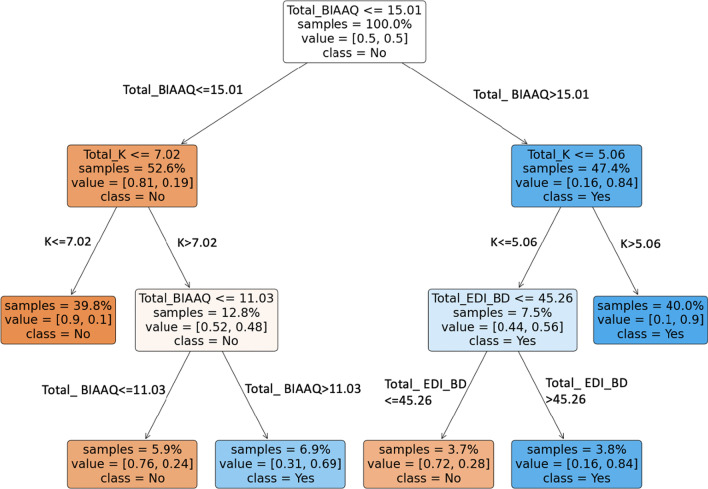
This study examined core risk factors related to maladaptive eating behaviors and ER, and how their interactions affect the detection of EDs. Using machine learning, a decision tree model was constructed on a data set of 830 non-clinical Chinese young women with an average age of 18.91 years (SD = 0.95). The total data set was split into training and testing data sets with a ratio of 70 to 30%.
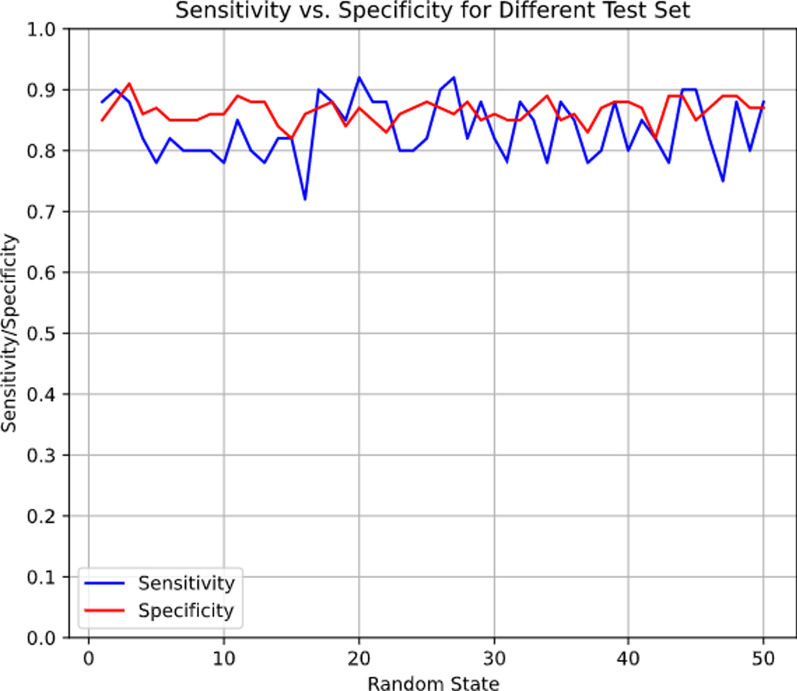
Body image inflexibility was identified as the major classifier for women at high risk of EDs. Furthermore, interactions between body image inflexibility, psychological distress, and body dissatisfaction were important in detecting women at high risk of EDs. Overall, the model classifying women at high-risk for EDs had a sensitivity of 0.88 and a specificity of 0.85 when applied to the testing data set.
Body image inflexibility, psychological distress, and body dissatisfaction were identified as the major classifiers for young women in China at high risk of EDs. Researchers and practitioners may consider these findings in the screening, prevention, and treatment of EDs among young women in China.
此前许多研究已从情绪调节(ER)的角度调查了与饮食失调(EDs)相关的风险因素。然而,针对饮食失调共存风险因素之间相互作用的研究有限,尤其是在中国,饮食失调方面的研究较少。
本研究考察了与适应不良饮食行为和情绪调节相关的核心风险因素,以及它们的相互作用如何影响饮食失调的检测。使用机器学习方法,在830名平均年龄为18.91岁(标准差=0.95)的非临床中国年轻女性的数据集中构建了决策树模型。总数据集按70比30的比例分为训练数据集和测试数据集。
身体意象僵化被确定为饮食失调高风险女性的主要分类指标。此外,身体意象僵化、心理困扰和身体不满之间的相互作用在检测饮食失调高风险女性方面很重要。总体而言,该饮食失调高风险女性分类模型应用于测试数据集时,灵敏度为0.88,特异度为0.85。
身体意象僵化、心理困扰和身体不满被确定为中国年轻女性饮食失调高风险的主要分类指标。研究人员和从业者在中国年轻女性饮食失调的筛查、预防和治疗中可考虑这些发现。