Hapke Ulfert, Cohrdes Caroline, Nübel Julia
Robert Koch Institute, Berlin Department of Epidemiology and Health Monitoring.
J Health Monit. 2019 Dec 11;4(4):57-65. doi: 10.25646/6227. eCollection 2019 Dec.
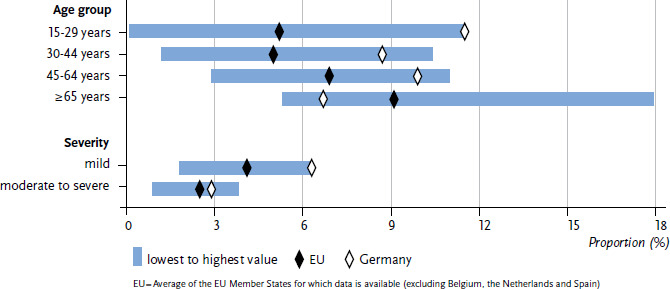
Depression is associated with a significant individual and social burden of disease. The European Health Interview Survey (EHIS) provides data that can be used to compare the situation in Germany to that of other European countries. Data was evaluated from 254,510 interviewees from Germany and 24 additional Member States of the European Union (EU). Depressive symptoms as defined by the Patient Health Questionnaire (PHQ-8) were used as an indicator of depression. The prevalence in Germany (9.2%) is higher than the European average (6.6%). However, when the severity of depression is taken into account, only the prevalence of mild depressive symptoms is higher (6.3% versus 4.1%). In Germany, young people display depressive symptoms more frequently (11.5% versus 5.2%) than older people (6.7% versus 9.1%). These results should be discussed against the backdrop of differences in age and social structure and point toward a need for prevention and provision of care targeting younger people in Germany, in particular.
抑郁症与重大的个人和社会疾病负担相关。欧洲健康访谈调查(EHIS)提供的数据可用于比较德国与其他欧洲国家的情况。对来自德国的254,510名受访者以及欧盟另外24个成员国的数据进行了评估。采用患者健康问卷(PHQ - 8)定义的抑郁症状作为抑郁症的指标。德国的患病率(9.2%)高于欧洲平均水平(6.6%)。然而,考虑到抑郁症的严重程度,只有轻度抑郁症状的患病率较高(6.3%对4.1%)。在德国,年轻人比老年人更频繁地表现出抑郁症状(11.5%对5.2%,而老年人为6.7%对9.1%)。这些结果应结合年龄和社会结构差异的背景进行讨论,尤其表明德国需要针对年轻人进行预防和提供护理。