Bretschneider Julia, Kuhnert Ronny, Hapke Ulfert
Robert Koch Institute, Department of Epidemiology and Health Monitoring, Berlin.
J Health Monit. 2017 Oct 9;2(3):77-83. doi: 10.17886/RKI-GBE-2017-070. eCollection 2017 Oct.
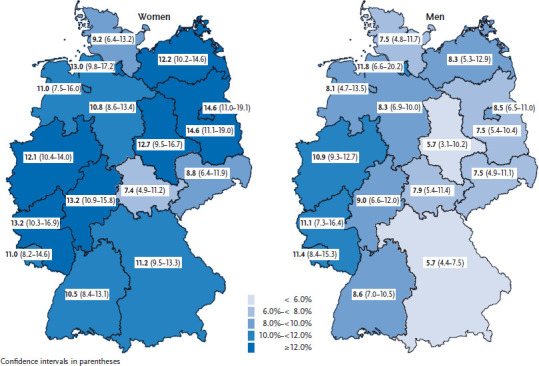
Depressive symptoms imply a loss of quality of life, leading to increased morbidity and mortality as well as increased costs to the healthcare system. Information on the prevalence and distribution of depressive symptoms in the population is essential in light of planning prevention and care. GEDA 2014/2015-EHIS surveyed current depressive symptoms among adults in Germany through the Patient Health Questionnaire (PHQ-8). The surveyed prevalence of 10.1% indicates the widespread occurrence of depressive symptoms, regardless of an actual clinical diagnosis of depression. Prevalence for women (11.6%) is higher than for men (8.6%). Further differences exist concerning age and education as well as regional differences. The results are discussed in the light of the data available so far.
抑郁症状意味着生活质量下降,会导致发病率和死亡率上升,同时也会增加医疗保健系统的成本。鉴于预防和护理规划的需要,了解人群中抑郁症状的患病率和分布情况至关重要。2014/2015年德国健康访谈与检查调查(GEDA 2014/2015 - EHIS)通过患者健康问卷(PHQ - 8)对德国成年人当前的抑郁症状进行了调查。所调查的10.1%的患病率表明抑郁症状广泛存在,无论是否实际诊断为抑郁症。女性的患病率(11.6%)高于男性(8.6%)。在年龄、教育程度以及地区方面还存在进一步的差异。将根据目前可得的数据对结果进行讨论。