Chen Xiao-Jun, Zhang Hong, Yang Fei, Liu Yu, Chen Guochun
Department of Nephrology, The Second Xiangya Hospital, Central South University, Changsha, China.
Hunan Key Laboratory of Kidney Disease and Blood Purification, Changsha, China.
Front Physiol. 2021 Mar 2;12:637480. doi: 10.3389/fphys.2021.637480. eCollection 2021.
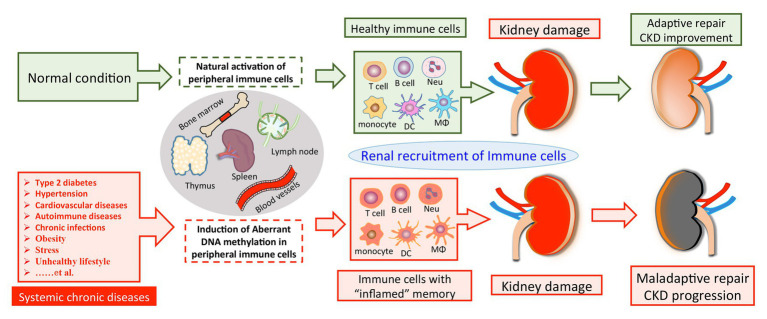
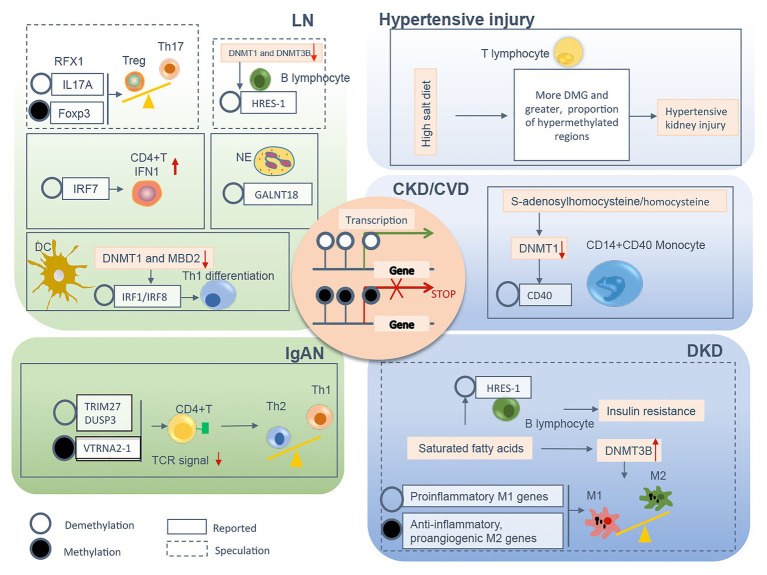
The incidence of chronic kidney disease (CKD) has rapidly increased in the past decades. A progressive loss of kidney function characterizes a part of CKD even with intensive supportive treatment. Irrespective of its etiology, CKD progression is generally accompanied with the development of chronic kidney inflammation that is pathologically featured by the low-grade but chronic activation of recruited immune cells. Cumulative evidence support that aberrant DNA methylation pattern of diverse peripheral immune cells, including T cells and monocytes, is closely associated with CKD development in many chronic disease settings. The change of DNA methylation profile can sustain for a long time and affect the future genes expression in the circulating immune cells even after they migrate from the circulation into the involved kidney. It is of clinical interest to reveal the underlying mechanism of how altered DNA methylation regulates the intensity and the time length of the inflammatory response in the recruited effector cells. We and others recently demonstrated that altered DNA methylation occurs in peripheral immune cells and profoundly contributes to CKD development in systemic chronic diseases, such as diabetes and hypertension. This review will summarize the current findings about the influence of aberrant DNA methylation on circulating immune cells and how it potentially determines the outcome of CKD.
在过去几十年中,慢性肾脏病(CKD)的发病率迅速上升。即使进行强化支持治疗,部分CKD仍以肾功能进行性丧失为特征。无论其病因如何,CKD的进展通常伴随着慢性肾脏炎症的发展,其病理特征是募集的免疫细胞低度但持续激活。越来越多的证据表明,包括T细胞和单核细胞在内的多种外周免疫细胞的异常DNA甲基化模式在许多慢性疾病背景下与CKD的发生密切相关。DNA甲基化谱的变化可以长期持续,甚至在循环免疫细胞从循环中迁移到受累肾脏后,仍会影响其未来的基因表达。揭示DNA甲基化改变如何调节募集的效应细胞中炎症反应的强度和持续时间的潜在机制具有临床意义。我们和其他人最近证明,外周免疫细胞中发生的DNA甲基化改变在系统性慢性疾病(如糖尿病和高血压)中对CKD的发展有深远影响。本综述将总结关于异常DNA甲基化对循环免疫细胞的影响及其如何潜在地决定CKD结局的当前研究结果。