Koganti Deepak V, Lamghare Purnachandra, Parripati Vinay Kumar, Khandelwal Rachit, Reddy Ayapaneni Dileep
Radiology, Dr. D.Y. Patil Medical College, Hospital and Research Centre, Pune, IND.
Cureus. 2022 Jan 8;14(1):e21025. doi: 10.7759/cureus.21025. eCollection 2022 Jan.
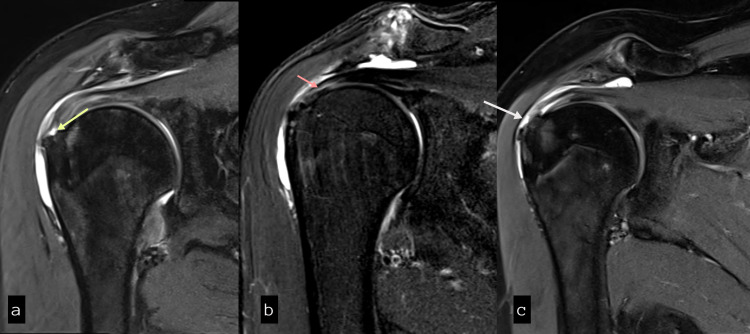
Background Magnetic resonance imaging (MRI), with the advent of surface coils, is becoming the modality of choice for imaging soft tissues around the shoulder joint. Good knowledge regarding the MR characteristics of rotator cuff tendons, acromion, and the abnormalities in these tendons is necessary for appropriate diagnosis. Methods This was a hospital-based descriptive, analytical and prospective study conducted at our tertiary care hospital. The study was performed on 50 patients with rotator cuff lesions detected on MRI of the shoulder joint. Results The age distribution found in the study is between 19 and 66 years with mean being 43 ± 14.8 years. The peak incidence was found in the fifth and sixth decades of life. Gender-wise distribution of rotator cuff pathologies has shown no significant gender variation. The pain was the most common presenting complaint. An abnormal supraspinatus tendon was seen in 82% of the 50 study patients, making it the most commonly affected tendons, followed by subscapularis and infraspinatus tendons. No apparent teres minor pathology was identified in the study patients. The most common pathology affecting the supraspinatus tendon was tendinosis (38%) closely followed by a partial tear (36%). Among the partial tears, the articular surface type of tear was the most common. About 52% patients had type II (curved) acromion; making it the most common type of acromion followed by type III (hook), supraspinatus tendinopathy was more common in type II acromion. A reduction in the acromiohumeral distance can cause supraspinatus tendinosis and also makes it more susceptible to tear. About 45.5% showed supraspinatus tendon tears when the acromiohumeral distance was less than 8mm as compared to 13.6% when more than 10mm. Only 4.2% had normal supraspinatus tendon in patients with this distance less than 7mm. Conclusion MRI provides valuable information to the orthopaedic surgeon regarding the status of tendons, bones, and joints. In order to choose the appropriate course of action, it is crucial first to identify the issue and report relevant data from rotator cuff imaging. A full grasp of the rotator cuff's architecture and function, as well as the repercussions of rotator cuff diseases, is required.
背景 随着表面线圈的出现,磁共振成像(MRI)正成为肩关节周围软组织成像的首选方式。了解肩袖肌腱、肩峰的磁共振特征以及这些肌腱的异常情况对于准确诊断至关重要。方法 这是一项在我们的三级护理医院进行的基于医院的描述性、分析性和前瞻性研究。该研究对50例肩关节MRI检查发现肩袖损伤的患者进行。结果 研究发现年龄分布在19至66岁之间,平均年龄为43±14.8岁。发病高峰出现在50至60岁。肩袖病变的性别分布未显示出明显的性别差异。疼痛是最常见的主诉。在50例研究患者中,82%可见冈上肌腱异常,使其成为最常受累的肌腱,其次是肩胛下肌腱和冈下肌腱。研究患者中未发现明显的小圆肌病变。影响冈上肌腱最常见的病变是肌腱病(38%),其次是部分撕裂(36%)。在部分撕裂中,关节面型撕裂最为常见。约52%的患者为II型(弧形)肩峰,使其成为最常见的肩峰类型,其次是III型(钩形),II型肩峰中冈上肌腱病更为常见。肩峰下间隙减小可导致冈上肌腱病,也使其更容易撕裂。当肩峰下间隙小于8mm时,约45.5%的患者出现冈上肌腱撕裂,而间隙大于10mm时为13.6%。当该间隙小于7mm时,只有4.2%的患者冈上肌腱正常。结论 MRI为骨科医生提供了有关肌腱、骨骼和关节状况的有价值信息。为了选择合适的治疗方案,首先确定问题并报告肩袖成像的相关数据至关重要。需要全面掌握肩袖的结构和功能,以及肩袖疾病的影响。