Nickoloff Jac A, Sharma Neelam, Taylor Lynn, Allen Sage J, Lee Suk-Hee, Hromas Robert
Department of Environmental and Radiological Health Sciences, Colorado State University, Fort Collins, CO, United States.
Department of Biochemistry & Molecular Biology, Indiana University School of Medicine, Indianapolis, IN, United States.
Front Oncol. 2022 Jan 28;12:808757. doi: 10.3389/fonc.2022.808757. eCollection 2022.
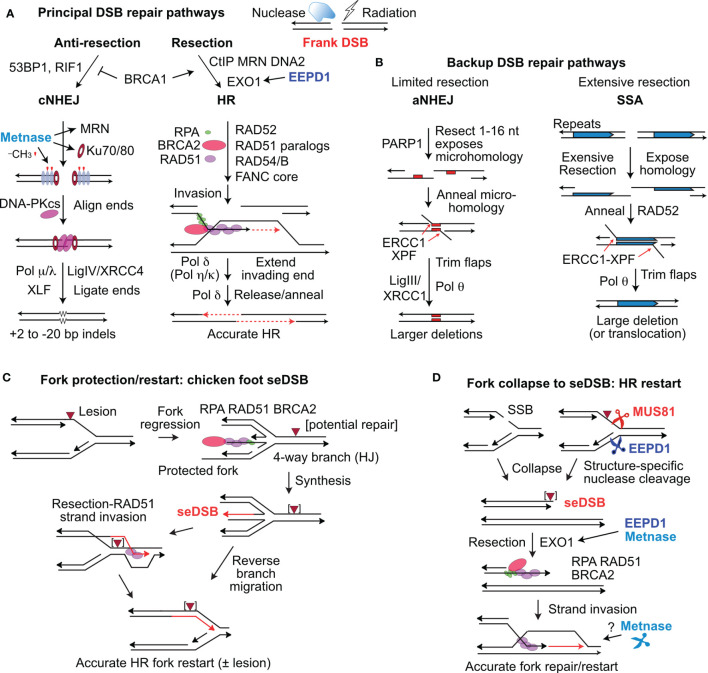
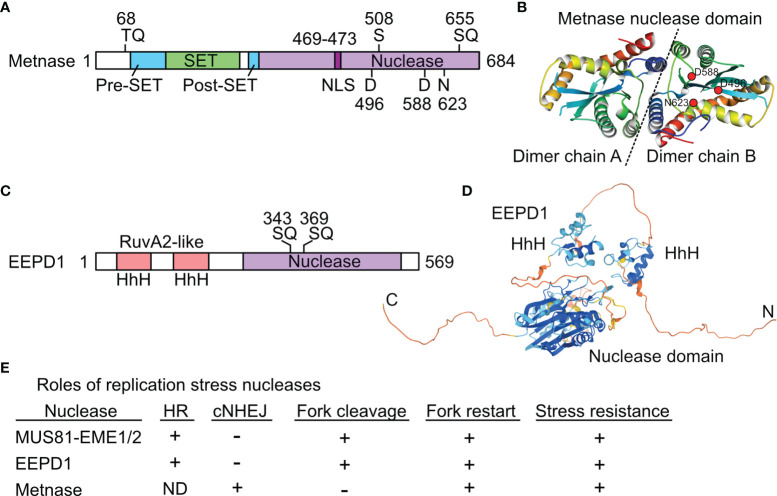
Cells respond to DNA damage by activating signaling and DNA repair systems, described as the DNA damage response (DDR). Clarifying DDR pathways and their dysregulation in cancer are important for understanding cancer etiology, how cancer cells exploit the DDR to survive endogenous and treatment-related stress, and to identify DDR targets as therapeutic targets. Cancer is often treated with genotoxic chemicals and/or ionizing radiation. These agents are cytotoxic because they induce DNA double-strand breaks (DSBs) directly, or indirectly by inducing replication stress which causes replication fork collapse to DSBs. EEPD1 and Metnase are structure-specific nucleases, and Metnase is also a protein methyl transferase that methylates histone H3 and itself. EEPD1 and Metnase promote repair of frank, two-ended DSBs, and both promote the timely and accurate restart of replication forks that have collapsed to single-ended DSBs. In addition to its roles in HR, Metnase also promotes DSB repair by classical non-homologous recombination, and chromosome decatenation mediated by TopoIIα. Although mutations in Metnase and EEPD1 are not common in cancer, both proteins are frequently overexpressed, which may help tumor cells manage oncogenic stress or confer resistance to therapeutics. Here we focus on Metnase and EEPD1 DNA repair pathways, and discuss opportunities for targeting these pathways to enhance cancer therapy.
细胞通过激活信号传导和DNA修复系统对DNA损伤作出反应,这一过程被称为DNA损伤反应(DDR)。阐明DDR通路及其在癌症中的失调对于理解癌症病因、癌细胞如何利用DDR在内源性和治疗相关应激中存活,以及将DDR靶点鉴定为治疗靶点至关重要。癌症通常采用基因毒性化学物质和/或电离辐射进行治疗。这些药物具有细胞毒性,因为它们直接诱导DNA双链断裂(DSB),或通过诱导复制应激间接导致复制叉坍塌为DSB。EEPD1和Metnase是结构特异性核酸酶,Metnase还是一种蛋白质甲基转移酶,可使组蛋白H3和其自身甲基化。EEPD1和Metnase促进完全的、两端均为DSB的修复,并且两者都促进坍塌为单端DSB的复制叉及时、准确地重新启动。除了在同源重组(HR)中的作用外,Metnase还通过经典的非同源重组促进DSB修复,以及由拓扑异构酶IIα介导的染色体解连环。尽管Metnase和EEPD1的突变在癌症中并不常见,但这两种蛋白质经常过度表达,这可能有助于肿瘤细胞应对致癌应激或赋予对治疗的抗性。在这里,我们重点关注Metnase和EEPD1的DNA修复通路,并讨论靶向这些通路以增强癌症治疗效果的机会。