Guest Emma E, Stamps Brittany F, Durish Nevin D, Hale Amanda M, Hein Cris D, Morton Brogan P, Weaver Sara P, Fritts Sarah R
Department of Biology, Texas State University, 601 University Drive, San Marcos, TX 78666, USA.
ESE Partners, LLC, 5910 Courtyard Drive Suite 170, Austin, TX 78731, USA.
Animals (Basel). 2022 Jan 31;12(3):343. doi: 10.3390/ani12030343.
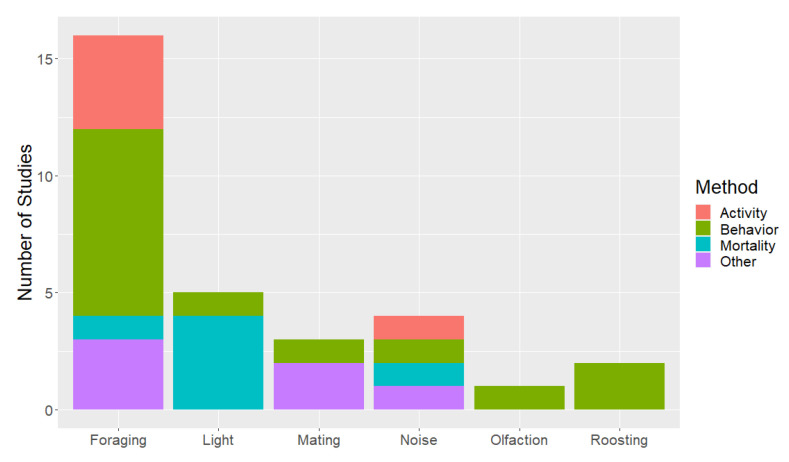
Patterns of bat activity and mortalities at wind energy facilities suggest that bats are attracted to wind turbines based on bat behavioral responses to wind turbines. For example, current monitoring efforts suggest that bat activity increases post-wind turbine construction, with bats making multiple passes near wind turbines. We separated the attraction hypothesis into five previously proposed explanations of bat interactions at or near wind turbines, including attraction based on noise, roost sites, foraging and water, mating behavior, and lights, and one new hypothesis regarding olfaction, and provide a state of the knowledge in 2022. Our review indicates that future research should prioritize attraction based on social behaviors, such as mating and scent-marking, as this aspect of the attraction hypothesis has many postulates and remains the most unclear. Relatively more data regarding attraction to wind turbines based on lighting and noise emission exist, and these data indicate that these are unlikely attractants. Analyzing attraction at the species-level should be prioritized because of differences in foraging, flight, and social behavior among bat species. Lastly, research assessing bat attraction at various scales, such as the turbine or facility scale, is lacking, which could provide important insights for both wind turbine siting decisions and bat mortality minimization strategies. Identifying the causes of bat interactions with wind turbines is critical for developing effective impact minimization strategies.
风能设施处蝙蝠的活动模式和死亡情况表明,蝙蝠是基于对风力涡轮机的行为反应而被吸引到风力涡轮机附近的。例如,目前的监测工作表明,风力涡轮机建成后蝙蝠活动增加,蝙蝠会在风力涡轮机附近多次飞过。我们将吸引假说分为之前提出的关于蝙蝠在风力涡轮机处或附近相互作用的五种解释,包括基于噪音、栖息地、觅食和水源、交配行为以及灯光的吸引,还有一个关于嗅觉的新假说,并介绍了2022年的知识现状。我们的综述表明,未来的研究应优先关注基于社交行为的吸引,如交配和气味标记,因为吸引假说的这一方面有许多假设且仍最不清楚。关于基于灯光和噪音排放对风力涡轮机的吸引,已有相对较多的数据,这些数据表明它们不太可能是吸引因素。由于蝙蝠物种在觅食、飞行和社交行为方面存在差异,应优先在物种层面分析吸引情况。最后,缺乏在各种尺度上评估蝙蝠吸引力的研究,如涡轮机或设施尺度,这可能为风力涡轮机选址决策和将蝙蝠死亡率降至最低的策略提供重要见解。确定蝙蝠与风力涡轮机相互作用的原因对于制定有效的影响最小化策略至关重要。